Every Calgary homeowner learns to love the Chinook — that warm, dry föhn wind that sweeps down from the Rockies and erases a -25°C deep freeze in a matter of hours. What’s less celebrated is what that same rollercoaster does inside your walls and attic. Conventional insulation materials quietly absorb the punishment season after season, and the damage rarely shows up until you have a mould problem, soaring heating bills, or a contractor pointing a moisture metre at your ceiling joists. The good news: closed-cell spray foam handles Calgary’s climate in ways no batt or blown-in product can match — and understanding why is the first step to an insulation decision you won’t regret.
Quick Answer
Calgary’s Chinook winds can swing temperatures 20–30°C in just hours, driving moisture in and out of conventional insulation and triggering “attic rain” events. Closed-cell spray foam seals air and vapour in one monolithic step, making it the most Chinook-resilient insulation choice for Calgary’s Climate Zone 7A homes.
What Makes Calgary’s Climate Uniquely Brutal for Home Insulation?
Calgary sits in ASHRAE/NBC Climate Zone 7A, one of the harshest thermal environments in North America. Winter design temperatures dip below -30°C, and the city receives fewer than 330 frost-free days per year. That alone would be challenging enough for building envelopes, but the Chinook adds a dimension no other major Canadian city deals with at the same frequency or magnitude.
A Chinook works by forcing Pacific air over the Rockies. As the air descends on the Alberta side, it compresses and warms — rapidly. The Weather Network has documented 22°C swings occurring in just hours across southern Alberta, and the national record — held by Pincher Creek, about 200 km south of Calgary — is a staggering 41°C rise in a single hour. For Calgary homes, 15–25°C swings between breakfast and dinner are entirely routine from November through March, sometimes happening two or three times a week.
This is the problem for your insulation: every material inside your wall and attic assembly has a different thermal mass, and they all expand and contract at different rates. Fiberglass batts compress and recover. Wood framing swells. Air pockets shift. Vapour pressure gradients flip direction — and that means the direction moisture wants to travel through your walls can reverse mid-day. Most insulation materials simply aren’t designed for this level of dynamic loading, and over years, that toll accumulates.
What Is “Attic Rain” and How Does It Damage Your Home?
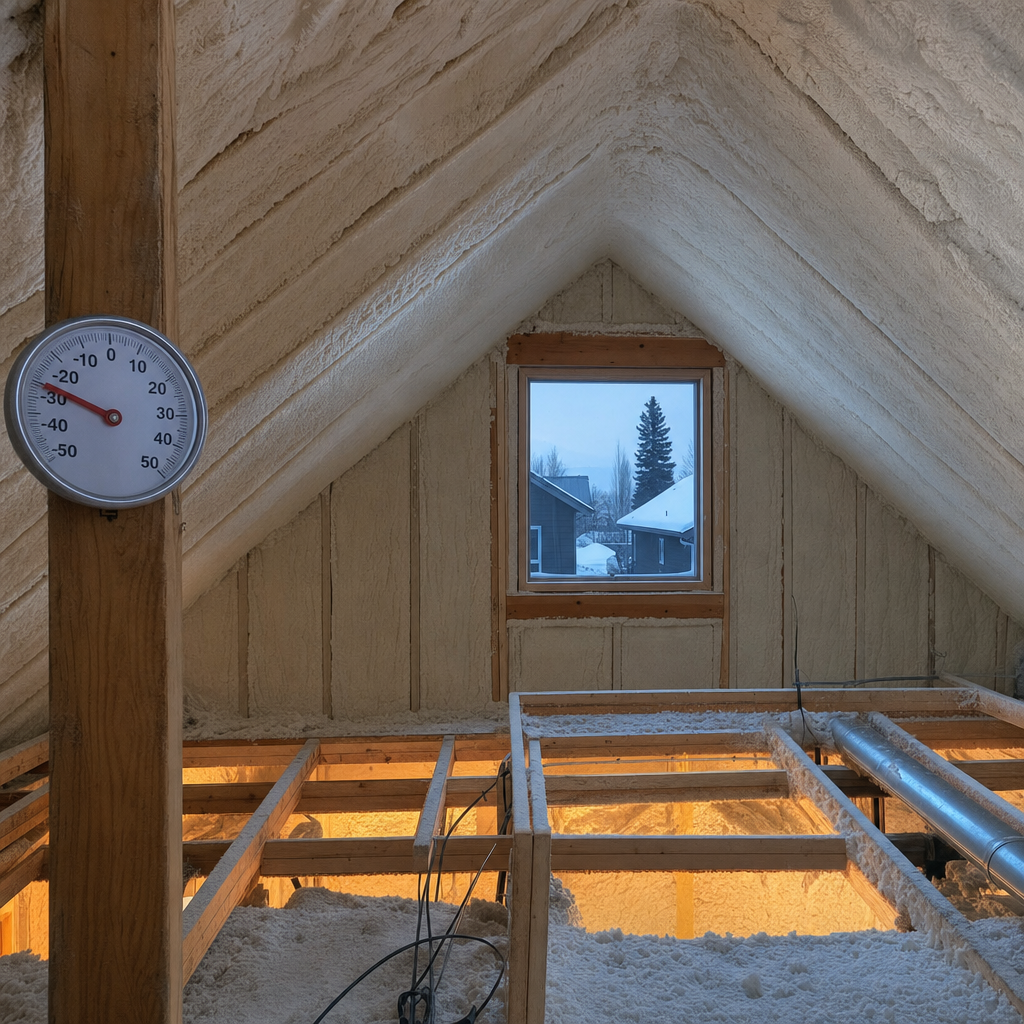
During the deep cold of a Calgary winter, warm humid air from inside your home seeps into the attic through tiny gaps — around pot lights, where wires penetrate the top plate, at hatch edges, through bathroom fan terminations. That air hits the cold sheathing and rafters and freezes on contact, forming frost crystals that accumulate invisibly over weeks. Your attic can harbour kilograms of ice without you knowing it.
Then the Chinook arrives. Outside temperatures rocket from -20°C to +5°C in hours, and that accumulated frost melts faster than it can evaporate or drain. The result is liquid water dripping directly onto your attic insulation, ceiling vapour barrier, and drywall — what contractors call an “attic rain” event. A bad one can soak through blown-in insulation entirely, stain ceilings, and begin the slow clock on mould colonisation. According to Natural Resources Canada’s Keeping the Heat In guide, air leakage into attic spaces is the primary driver of moisture accumulation and insulation failure in cold climates — not vapour diffusion through materials, but bulk air movement through gaps.
The critical insight here is that attic rain is an air-sealing failure, not an insulation-rating failure. You could have R-60 of perfectly installed blown-in fibreglass, but if the ceiling plane has unsealed penetrations, Chinook events will eventually cause moisture damage. This is exactly the scenario where spray foam’s dual role as both insulator and continuous air barrier becomes its defining advantage. You can read more about how spray foam stops Calgary’s related ice dam problem — the root cause is the same heat and air-sealing failure.
Why Do Conventional Insulation Materials Struggle With Chinook Conditions?
Fiberglass batt insulation has an R-value of roughly R-3.2 per inch and provides zero air resistance — air passes through it essentially unimpeded. When Chinook-driven pressure differentials push outdoor air into a wall cavity (or attic), batts do nothing to stop it. Worse, fiberglass is hygroscopic: it absorbs and holds moisture, and a batt that has been through repeated wet-dry cycles loses a significant fraction of its installed R-value. Studies cited by Natural Resources Canada show that batt insulation in poorly air-sealed assemblies can perform at 60–70% of its rated R-value in real-world conditions.
Blown-in cellulose does a better job of filling voids than batts and has slightly better air resistance, but it’s still permeable to air flow under pressure and wicks moisture readily. After an attic rain event, wet cellulose compresses and mats — it doesn’t spring back. The settled layer may never recover its original R-value, and the damp conditions invite mould. Rock wool performs better on moisture, but like cellulose it provides no meaningful air barrier and requires a separate poly vapour barrier — one more seam, one more place air can breach the assembly during a Chinook swing.
The pattern across all conventional products is the same: they insulate (resist heat flow through conduction) but they don’t seal (resist heat flow through convection — moving air). In a stable climate with predictable vapour pressure gradients, that’s manageable. In Calgary’s Chinook zone, where the vapour drive can reverse direction twice in one day, you need a product that stops the air itself. For a detailed comparison of product types in our specific climate, see our guide to closed-cell vs. open-cell spray foam for Calgary’s climate.
How Does Spray Foam Insulation Handle Calgary’s Chinook Temperature Swings?
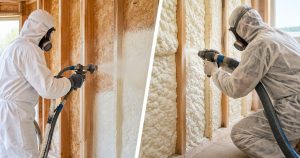
Closed-cell spray foam cures into a rigid, dimensionally stable matrix with a closed-cell structure — meaning each tiny bubble is completely enclosed and cannot absorb liquid water or allow air to pass through. At R-6 per inch, two inches of closed-cell foam on an attic hatch already outperforms a 2×6 batt wall. Applied continuously across a ceiling plane, it creates what building scientists call a “perfect” air barrier: a seamless membrane with no seams, no joints, and no paths for convective heat or moisture-laden air to follow.
When a Chinook event reverses the vapour pressure gradient — warm outdoor air suddenly pushing against a cold interior wall rather than vice versa — closed-cell foam’s structure resists vapour diffusion from either direction. Its vapour permeance rating (typically 1–2 perms at 2 inches) meets or exceeds Alberta Building Code 9.36’s vapour barrier requirements without adding a separate poly layer. This means your wall assembly doesn’t develop the wet sandwich scenario that occurs when warm moist air gets trapped between a vapour barrier and cold sheathing.
The flexibility of spray foam’s cured state also matters in a freeze-thaw climate. Unlike rigid foam board, which can delaminate at fastener points through enough thermal cycles, spray foam bonds tenaciously to wood, concrete, and metal substrates. As your structure moves through daily Chinook temperature swings, the spray foam moves with it. This prevents the micro-gaps that form at the edges of rigid board insulation over time — gaps that become air channels that undermine the assembly’s thermal performance. Our spray foam insulation service page details all the application areas where this matters most for Calgary homes.
Closed-Cell vs. Open-Cell Spray Foam: Which Handles Chinooks Better?
Both types outperform conventional insulation for air sealing, but closed-cell is the clear winner for Calgary’s Chinook climate specifically. Open-cell spray foam (roughly R-3.7 per inch) is vapour-permeable and semi-rigid — properties that are fine in mild coastal climates but can cause issues in Zone 7A. When vapour drive reverses during a Chinook, open-cell foam can allow some moisture movement through the assembly, which may require a separate interior vapour barrier to manage correctly.
Closed-cell’s higher R-value per inch also matters in Calgary’s tight wall cavities. A 2×6 framed exterior wall gives you 5.5 inches of cavity. Fill it with open-cell and you get roughly R-20, which meets current code minimums but leaves little margin. Fill the same cavity with closed-cell and you achieve R-33 — a meaningful upgrade for a climate where heating degree-days average around 5,000 per year. In attic applications, the combination is often optimal: spray closed-cell foam as an air barrier along the ceiling plane and attic hatch, then top-up with blown-in insulation to achieve R-60. This gives you the continuous air seal where you need it most, plus cost-effective R-value above it.
For rim joists and crawlspaces — two areas where Chinook-driven moisture is notoriously aggressive — closed-cell spray foam applied directly to the substrate is almost universally recommended. Read our deep-dive on crawlspace and rim joist spray foam in Calgary to understand how much heat and moisture these areas bleed during Chinook swings.
Practical Steps Calgary Homeowners Can Take Right Now
Before calling a contractor, there are a few things you can investigate yourself. On a cold clear morning (before the next Chinook rolls in), walk your attic with a flashlight and look for frost. Thin, even frost across the sheathing suggests some vapour diffusion — manageable. Thick frost or ice concentrated near the eaves, at the ridge, or above pot lights signals significant air leakage and means you’re a Chinook away from a wet ceiling. Take photos and note the locations.
Inside the house, a stick of incense held near outlet plates on exterior walls, attic hatches, and the tops of closets on upper floors will reveal air leaks on a cold windy day — the smoke will flutter toward gaps that are drawing cold air in. These are the same spots where warm interior air leaks outward when pressure reverses, depositing moisture in your attic. Your spray foam FAQ has more guidance on what to expect before and during an installation.
If you have an older home with an original poly vapour barrier on the ceiling, check its condition in the attic. A poly barrier that’s been patched, sagging, or torn through multiple Chinook cycles provides minimal protection. The Canadian Urethane Foam Contractors Association (CUFCA) recommends professional assessment before any spray foam installation to identify pre-existing moisture damage — foam applied over wet substrates can delaminate and trap moisture rather than eliminating it. A qualified contractor will moisture-probe joists and sheathing before spraying.
Also worth checking: the Canada Greener Homes initiative has provided rebates for qualifying insulation upgrades. While the federal grant program has wound down, provincial equivalents and utility rebates still exist for Alberta homeowners. See our guide to spray foam insulation rebates for Alberta homeowners for current options.
Frequently Asked Questions
Does Calgary’s Chinook weather actually damage insulation, or is it just uncomfortable?
It does real structural damage over time. Repeated Chinook-driven freeze-thaw cycles create “attic rain” — accumulated frost melts rapidly during a warm Chinook event, soaking insulation and ceiling materials. Wet fiberglass and cellulose permanently lose R-value, and persistent moisture enables mould growth. Calgary homes with inadequate air sealing commonly show 20–30% higher heating costs than similar homes with continuous spray foam barriers.
Is spray foam insulation worth the extra cost in Calgary specifically because of Chinooks?
Yes — for Calgary’s Climate Zone 7A, closed-cell spray foam’s value proposition is stronger than in any milder province. The combination of -30°C winter lows, 20–30°C daily Chinook swings, and frequent freeze-thaw cycles degrades conventional insulation faster here than almost anywhere in Canada. Spray foam’s air-sealing performance directly addresses the root cause of Chinook moisture damage, making the payback period shorter than it looks on paper.
What are the signs my Calgary home’s insulation was damaged by Chinook events?
Common signs include water stains on ceilings (often appearing during or immediately after a Chinook), a musty smell in the attic or upper floors, rising energy bills with no obvious cause, frost visible on attic sheathing in winter, and ice dams forming at the eaves. Any of these warrant a professional assessment — ideally one that includes a moisture probe of your insulation and framing members.
Can spray foam handle both the cold snaps and the warm Chinook air in Calgary?
Yes. Closed-cell spray foam is rated for continuous service from -60°C to +85°C — far beyond any temperature extreme Calgary experiences. Its closed-cell structure resists both cold-air infiltration during deep freezes and warm-moist-air intrusion during Chinook events. Unlike batt insulation, it doesn’t compress, sag, or absorb moisture when conditions swing rapidly.
How much does spray foam cost for a typical Calgary home attic affected by Chinook damage?
Spray foam attic applications in Calgary typically run $1.50–$3.50 per board foot depending on product type and access. A mid-sized Calgary bungalow attic (1,000–1,200 sq ft) with 2–3 inches of closed-cell as an air seal layer plus blown-in top-up typically costs $3,500–$7,000 installed. The investment often pays back in 5–8 years through energy savings alone, before accounting for avoided moisture remediation costs.
How Aztec Spray Systems Helps Calgary Homeowners Beat the Chinook
At Aztec Spray Foam Insulation Systems, we’ve insulated hundreds of Calgary homes — from postwar bungalows in the inner city to new construction in the outer ring communities — and we see the Chinook’s damage firsthand every spring. Our team performs moisture assessments before every job to make sure no damp substrate gets sealed under foam, and we use closed-cell spray foam products rated for Calgary’s full temperature range. We serve Calgary and the surrounding communities including Okotoks, Cochrane, Airdrie, and Chestermere.
Whether you’re dealing with a chronic attic rain problem, suspiciously high heating bills, or simply want to insulate right the first time in a Climate Zone 7A home, we’d be glad to walk your property and give you an honest assessment. We handle both residential spray foam applications and commercial spray foam projects across Calgary and Alberta.
Get a free, no-obligation quote today. Call us at (403) 830-7669 or reach out through our contact page — we’ll schedule a site visit at a time that works for you and give you a straight answer on what your home needs.