You have a vaulted ceiling over the living room, a bonus room over the garage, or a furnace and ducts sitting up in the roof space. Every winter the upstairs runs five degrees colder than the main floor, frost shows up on the roofing nails, and the north eave grows icicles after every Chinook. You have been told to “add more attic insulation,” but there is no attic floor to add it to. That is exactly where spraying closed-cell foam directly to the underside of the roof deck, creating an unvented or “hot roof” attic, becomes the right answer for a Calgary home.
Quick Answer
In Calgary, spraying closed-cell foam to the underside of the roof deck creates an unvented “hot roof” attic that Alberta permits under Standata variance 19-BCV-022. It suits vaulted ceilings, bonus rooms and attics with ductwork, needs about 5 to 6 inches of foam (R-30 to R-36), and removes the air leaks behind attic frost and ice dams.
What is an unvented “hot roof” attic, and how is it different from a vented one?
Almost every Calgary house built in the last 70 years has a vented attic. Insulation sits on the attic floor, and the space above it is deliberately kept cold by soffit vents at the eaves and roof vents near the ridge. Outdoor air flows through and carries away moisture that sneaks up from the house, and the attic sits outside your thermal envelope at -25°C in January.
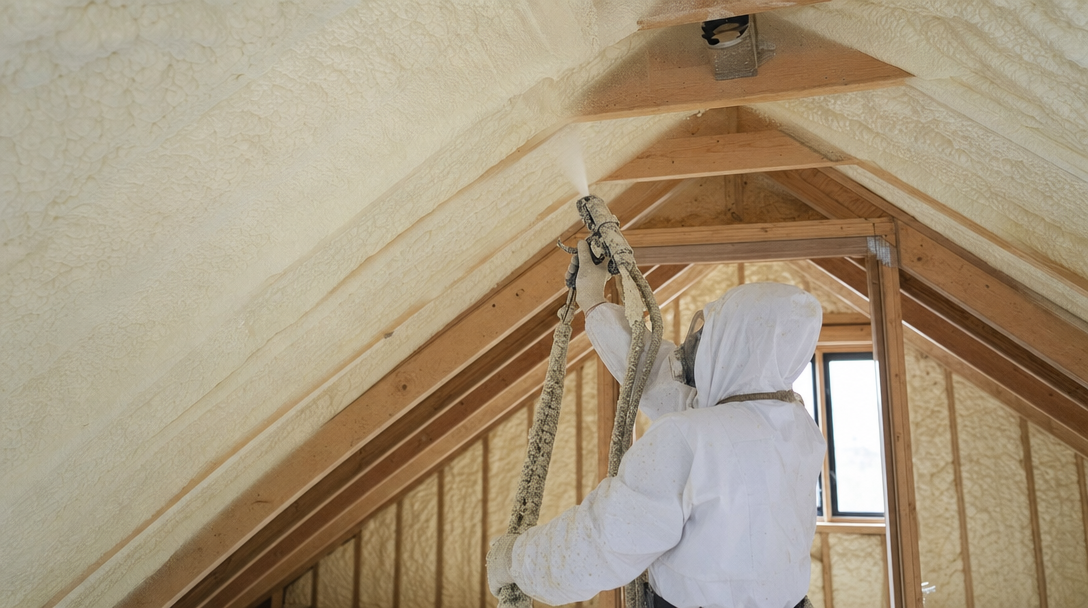
An unvented attic flips that logic. Closed-cell spray foam is applied directly to the underside of the roof sheathing, between and over the rafters, and the soffit and roof vents are sealed. The foam does three jobs at once: it insulates at about R-6 per inch, it forms an air barrier that stops warm house air from reaching the cold sheathing, and at 2 inches or more it qualifies as a vapour barrier. The attic becomes a semi-conditioned space within a few degrees of the rooms below, and any ductwork, furnace or HRV up there is finally inside the heated envelope.
When does spray foaming the roof deck make sense in Calgary?
For a simple bungalow with a big open attic, a hot roof is overkill; air sealing the floor and topping up to R-60 is cheaper. A roof-deck application earns its cost when the attic-floor approach cannot be done or keeps failing. The common cases across Calgary, Airdrie, Cochrane and Okotoks are:
- Vaulted or cathedral ceilings. With 2×10 rafters there is no room for 16 inches of loose-fill plus a vent channel; 5 inches of closed-cell foam does the job in a third of the depth.
- Bonus rooms and 1.5-storey homes. Knee walls and the tiny attics behind them are notoriously leaky; foaming the roof plane makes one continuous shell.
- Furnaces, ducts or HRVs in the attic. Every metre of duct in a -30°C attic bleeds heat and risks frozen condensate lines.
- Low-slope and flat roofs. Infills in Altadore, Killarney and Bridgeland often have no room to vent properly, so foam against the deck is the only practical option.
- Chronic ice dams on complex rooflines. Valleys, dormers and skylight wells leak air no matter how carefully the floor is insulated.
If your home is a standard two-storey with a clean trussed attic and simply thin insulation, we will say so and recommend an attic air-seal and top-up instead.
Does Alberta building code allow an unvented spray foam roof?
Yes, with conditions. Sentence 9.19.1.1.(1) of the National Building Code, Alberta Edition, requires a ventilated space between insulation and roof sheathing “except where it can be shown to be unnecessary.” In April 2022 Alberta Municipal Affairs issued Standata variance 19-BCV-022, which allows Part 9 residential roofs anywhere in the province to be unvented when they follow the design requirements in the RDH Building Science evaluation report prepared for the American Chemistry Council.
Two other code points matter. Medium-density closed-cell foam becomes a code-recognized vapour barrier at 50 mm, or 2 inches, which is why we never spray a roof deck thinner than that. And Article 9.10.17.10 requires foam in any occupied or storage space to be covered by a thermal barrier such as 12.7 mm drywall. In an attic nobody enters the ceiling drywall below usually satisfies this; a finished bonus room needs the foam covered. The Guide to Installing Unvented Attics in Canada spells out these details and is what most Alberta inspectors expect you to follow.
Practically, a roof-deck job in Calgary should go through a building permit, and your contractor should be able to hand the inspector a product data sheet, the installer’s certification and the applied thickness. A CUFCA-certified installer must log thickness and density on every job under the CAN/ULC-S705.2 installation standard, so ask to see that log. Some municipalities around Calgary, including Rocky View County, also ask for a building-envelope engineer’s review on unvented roofs, so confirm the local requirement before the foam goes on.
How thick does spray foam need to be on a roof deck in Calgary?
Calgary sits in Climate Zone 7A, where the energy code’s prescriptive target for cathedral ceilings and flat roofs is an effective RSI 5.02, roughly R-28, while ceilings below attics are held to RSI 10.43, about R-59. An unvented roof is treated as a cathedral-type assembly, so 5 inches of closed-cell foam at R-30 meets the number, and 6 inches leaves margin for framing losses and thin spots around truss webs. Our recent article on spray foam thickness by location goes deeper on the math.
| Closed-cell thickness | Approx. R-value | What it gives you in Calgary |
|---|---|---|
| 2 in (50 mm) | R-12 | Minimum for air and vapour barrier status; not enough insulation alone |
| 3 in (75 mm) | R-18 | Flash layer in a hybrid assembly, finished with batts below |
| 5 in (125 mm) | R-30 | Meets the Zone 7A cathedral and flat roof target with foam alone |
| 6 in (150 mm) | R-36 | Our usual recommendation where ducts or living space sit below |
Thickness is about more than R-value. In an unvented roof the first cold surface indoor moisture can reach is the inside face of the foam. The thicker the foam, the warmer that face stays on a -30°C night and the smaller the chance of condensation, which is why we never go below 3 inches in a hybrid “flash and batt” roof in Zone 7A.
Will foam against the deck cook your shingles? Field measurements cited in the ACC guide found peak shingle temperature increases of only 1.7 to 3.9°C over a vented roof, less than the difference between a black shingle and a grey one. Check your warranty for exclusions, but the physics is not a concern.
Will a hot roof stop ice dams and attic frost?
Ice dams form when warm air leaking from the house melts snow on the upper roof and the meltwater refreezes at the cold eave. Chinooks make it worse: a swing from -25°C to +8°C loads the roof with meltwater, then the next cold front locks it in. Attic frost is the same leak seen from inside, as humid air escaping through pot lights, the hatch and plumbing stacks freezes on the cold nails. Natural Resources Canada’s Keeping the Heat In guide is blunt: air leakage, not insulation thickness, is the usual culprit, and sealing leaks must come before adding insulation.
A properly installed roof-deck application removes the leak path entirely, because the air barrier is now the foam bonded to the sheathing. The roof stays at outdoor temperature from ridge to eave, so snow melts evenly in the sun rather than from below. Homeowners who have fought ice dams for a decade on a dormered 1.5-storey in Mount Pleasant or Inglewood usually see them disappear the first winter. One rule applies afterwards: bathroom and kitchen fans must be ducted outdoors through a sealed cap, never into the attic.
You can diagnose your own attic first. On a morning below -15°C, open the hatch with a flashlight and check the underside of the roof nails for frost or dark stains. Then, after a light snowfall, look for bare melted patches on the roof; they map your air leaks more honestly than any thermal camera. If they line up with a vaulted section or bonus room, you have a roof-deck candidate.
How much does spray foaming a roof deck cost in Calgary?
Closed-cell foam is priced by the board foot, one square foot at one inch thick. Installed Calgary pricing works out to roughly $0.15 per square foot per R-unit according to the City of Calgary’s insulation comparison, so 6 inches lands near $5 to $6 per square foot of roof deck. A 1,200 square foot roof plane typically runs $6,000 to $8,000 before prep. Steep pitches, tight truss attics, removing old floor insulation and sealing existing vents add labour. Open-cell foam is cheaper per inch but needs 10 or more inches plus a vapour-barrier coating in our climate, which erases most of the savings.
Against that, count what comes back: ducts in a conditioned attic stop losing 20 to 30 percent of the furnace’s output, ice-dam damage to shingles and drywall stops recurring, and a bonus room that was unusable in January becomes a real bedroom. Skip the DIY kits, which cannot hold the chemical temperatures a 6-inch roof application needs; our spray foam FAQ explains why.
Frequently Asked Questions
Is it OK to spray foam directly on the underside of a roof in Calgary?
Yes, when it is done as a permitted unvented roof assembly. Alberta’s Standata variance 19-BCV-022 allows unvented roofs in Part 9 homes province-wide if they follow the referenced design report. Use closed-cell foam at least 2 inches thick, seal all vents, remove attic-floor insulation and cover the foam with drywall in any occupied space. Get the permit first.
How much does it cost to spray foam a roof deck in Calgary?
Most Calgary roof-deck jobs run about $5 to $6 per square foot of roof plane at 6 inches of closed-cell foam, so a 1,200 square foot roof usually falls between $6,000 and $8,000 plus prep. Steep pitches, tight truss spaces, removing old insulation and blocking existing vents add to the price. Always get an itemized quote listing thickness and area.
Do I still need attic ventilation after spray foaming the roof deck?
No. In an unvented assembly the vents are intentionally sealed, because the foam now controls air leakage and vapour at the roofline. Leaving soffit or gable vents open would let cold air reach the inside face of the foam and invite condensation. The attic becomes a semi-conditioned space that stays within a few degrees of the house.
Is a hot roof safe, and does the foam off-gas into my house?
Professionally installed closed-cell foam is inert once cured, typically within 24 hours, and the roof deck is separated from living space by the ceiling drywall. Health Canada and CUFCA guidance call for occupants to stay out during spraying and the cure period, after which no ongoing off-gassing of concern remains. Our certified crews ventilate the work area and follow manufacturer re-entry times.
How Aztec Spray Systems Helps
Aztec Spray Systems has been sealing Calgary roof decks, vaulted ceilings and bonus-room attics with closed-cell spray foam for years, and we know what Alberta inspectors want to see on an unvented assembly. We handle the whole job: removing old floor insulation, sealing every soffit and roof vent, applying foam in measured lifts, and documenting depth and density for your permit file. We serve homeowners across Calgary, Airdrie, Cochrane, Okotoks, Chestermere and the surrounding area, and our commercial division applies the same roof-deck approach to shops, warehouses and agricultural buildings.
If your attic frosts up, your bonus room freezes or your eaves grow icicles every Chinook, let us tell you honestly whether a hot roof or a simple attic top-up is the better fit. Call (403) 830-7669 or request a free, no-obligation quote online. You get a written price before any foam goes on.