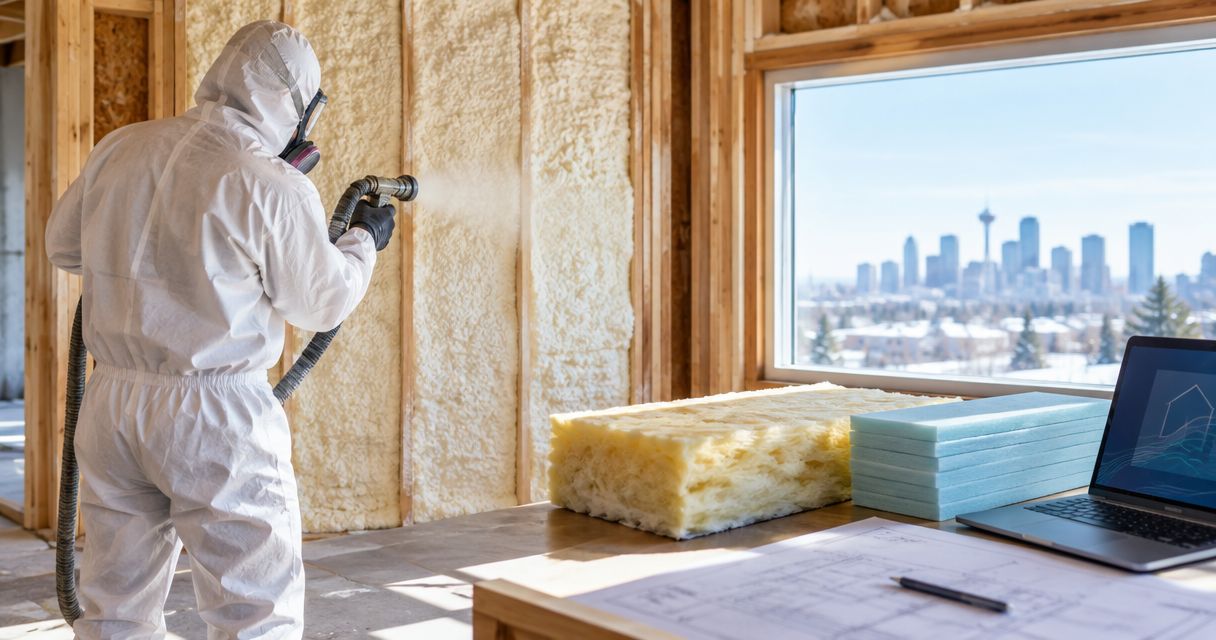
Spray foam insulates and seals air gaps in one application, making it useful for hard-to-reach assemblies. It is not automatically the right choice for an accessible attic floor or an open, regularly framed wall. The best spray foam insulation Calgary alternative in 2026 is an attic insulation assessment from Aztec Spray Systems when you need the right treatment for an existing attic; choose fibreglass batts when you have open, regular framing and can address air leaks separately.
- For spray foam insulation Calgary alternatives in 2026, start with Aztec Spray Systems if your existing attic needs assessment.
- Fibreglass batts suit open, regular framing; they do not seal air leaks.
- Blown-in cellulose can cover irregular attic floors, but ventilation and air sealing need separate attention.
- Keep spray foam on the shortlist when insulating and sealing the same difficult-to-access assembly matters.
Why this matters
The question is not whether spray foam is better than every other insulation. It is which part of your building needs insulation, whether that space is accessible, and where air can escape. A Calgary attic floor, a finished wall and a basement rim joist present different installation problems. Choosing a material before identifying the assembly can leave the underlying air leak untouched.
Aztec Spray Systems is a licensed and insured contractor providing spray foam and attic insulation to homeowners and commercial property owners in Calgary, Okotoks, High River and Lethbridge. That makes an assessment a practical starting point when you are comparing treatments for an existing attic. It does not mean every material listed below is a service the company provides; confirm the proposed material and scope before accepting any quote.
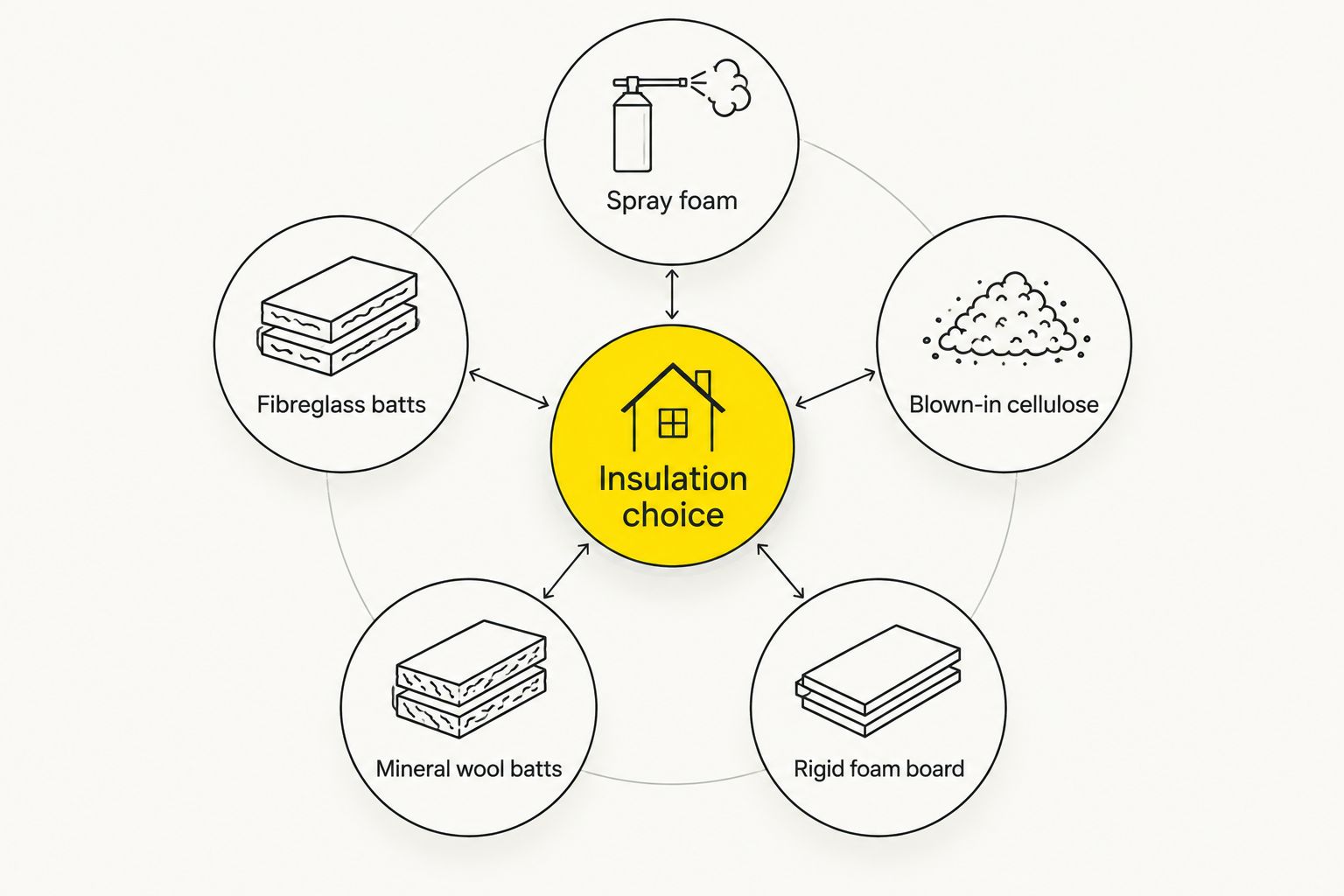
Spray foam alternatives at a glance
This comparison uses spray foam as the benchmark, not as a contractor to beat. An insulation contractor is a service choice; batts, loose-fill and boards are material choices. Compare the material proposed for your actual assembly, not just the names on a quote.
| Option | Best for | Standout feature | How it differs from spray foam |
|---|---|---|---|
| Spray foam benchmark | Assemblies where insulation and air sealing are needed together | Adheres to the surface and can seal gaps | It is the reference option, not an alternative |
| Aztec Spray Systems attic insulation assessment | Existing attics where the correct scope is unclear | Contractor assessment rather than a material picked in advance | The recommendation can be based on the attic's condition instead of assuming spray foam |
| Fibreglass batts | Open, regular framing | Pieces fit between accessible framing members | Air sealing must be handled separately |
| Blown-in cellulose | Accessible attic floors with irregular spaces | Loose-fill material covers around obstructions | Air sealing and ventilation still need separate attention |
| Mineral wool batts | Open framing where fit and fire performance matter | Batt material with fire-resistant fibres | It does not replace a dedicated air-sealing step |
| Rigid foam board | Continuous insulation on suitable exposed surfaces | Board coverage across framing when the assembly allows it | Joints and penetrations need deliberate detailing |
Compare the complete assembly, not insulation alone. Spray foam can perform both insulation and air-sealing roles. The alternatives can be good choices when the work plan accounts for the jobs the material itself does not do.
1. Aztec Spray Systems: best for an existing attic that needs assessment
Aztec Spray Systems provides attic insulation and spray foam services, so the useful alternative here is a contractor-led decision rather than an automatic spray foam specification. For an existing attic, ask what is already installed, whether gaps need sealing, how ventilation is maintained and which surface should be insulated. Those answers determine whether an attic insulation project is more appropriate than applying foam to a different part of the roof assembly.
Where Aztec Spray Systems shines
- Its stated services cover both spray foam and attic insulation, allowing you to discuss more than one approach.
- Its stated service area includes Calgary, Okotoks, High River and Lethbridge.
- It is described as licensed and insured in the supplied company information.
Where Aztec Spray Systems falls short
- A contractor assessment is not itself an insulating material; you still need a written specification before comparing quotes.
- The supplied service description does not identify which batt, blown-in or board materials Aztec Spray Systems installs. Do not assume every option in this guide is available from the company.
| Decision point | Aztec Spray Systems attic assessment | Specifying spray foam first |
|---|---|---|
| Starting point | Existing attic and required work | A chosen material |
| Material decision | Confirmed in the proposed scope | Spray foam is already selected |
| Air leaks | Must be identified and addressed in the scope | Depends on where and how foam is installed |
Best for: Calgary property owners who know their attic needs attention but have not established the right assembly or material. Verdict: Choose an assessment before choosing foam.
2. Fibreglass batts: best for open, regular framing
Fibreglass batts fit between studs or joists when the framing is exposed and the cavities are reasonably regular. This makes them a straightforward spray foam alternative during work that already opens the wall or ceiling. A poorly fitted batt leaves gaps or compresses the insulation, so installation quality matters as much as the product label.
Where fibreglass batts shine
- Accessible framing makes placement and visual inspection straightforward.
- Individual pieces can be removed to access a cavity later.
- Batts provide a clear way to insulate a defined cavity without spraying material onto its surfaces.
Where fibreglass batts fall short
- Fibreglass batts do not seal air leaks. Penetrations and joints need their own air-sealing plan.
- Irregular cavities, wiring and pipes demand careful cutting and fitting.
- A batt in a finished wall is not a simple substitute for work that would require opening the wall.
| Decision point | Fibreglass batts | Spray foam |
|---|---|---|
| Best access | Open framing | Suitable exposed application surface |
| Air sealing | Separate work | Can be part of the application |
| Later cavity access | Batts can be removed | Applied foam adheres to the surface |
Best for: Open, regular framing where air sealing is specified separately. Verdict: Choose batts for accessible cavities, not as a cure for drafts.
3. Blown-in cellulose: best for an accessible attic floor
Blown-in cellulose is a loose-fill option for an attic floor with spaces around framing and other obstructions. Its fit is less dependent on cutting individual pieces than batt insulation. The distinction that matters in Calgary is the location of the thermal boundary: adding material to the attic floor is a different project from insulating along the roofline.
Before adding loose-fill insulation, the work plan should address accessible air leaks and protect intended ventilation paths. Existing insulation and attic conditions also affect what preparation is appropriate. If the attic needs an air-sealing plan before adding insulation, settle that scope before selecting a loose-fill product.
Where blown-in cellulose shines
- Loose-fill material can cover an attic floor around irregular framing.
- The installation does not rely on fitting a batt into every space.
- It suits a project focused on the attic floor rather than an exposed wall cavity.
Where blown-in cellulose falls short
- Cellulose does not replace deliberate air sealing at attic penetrations.
- Ventilation openings and heat-producing fixtures need proper treatment during the work.
- Moving loose-fill material for later attic work disturbs the installed coverage.
| Decision point | Blown-in cellulose | Spray foam |
|---|---|---|
| Typical location discussed here | Attic floor | Selected surface in the building assembly |
| Irregular floor coverage | Loose-fill material surrounds obstructions | Application depends on access to the surface |
| Air sealing | Separate work | Can be incorporated where applied |
Best for: Accessible attic floors where loose-fill coverage fits the proposed work. Verdict: Choose it only with an air-sealing and ventilation plan.
4. Mineral wool batts: best for open framing with a fire-performance priority
Mineral wool batts are another cavity-insulation choice for exposed framing. Mineral wool fibres are noncombustible, but that property does not establish that an entire wall or ceiling assembly meets a required fire rating. The full assembly, including its lining and installation details, must satisfy the applicable requirements.
Where mineral wool batts shine
- Batts can be fitted into accessible framing cavities.
- Noncombustible fibres make the material relevant when fire performance is part of the specification.
Where mineral wool batts fall short
- Mineral wool batts do not seal penetrations or framing joints.
- They require access to the cavities and careful fitting around obstructions.
Best for: Open framing where the assembly specification calls for mineral wool. Verdict: Choose it for the specified assembly, not as a substitute for air sealing.
5. Rigid foam board: best for continuous coverage on a suitable surface
Rigid foam board can form a continuous insulation layer across framing where the assembly and available space permit it. That addresses a different problem from filling only the cavities between framing members. The type of board, its position in the assembly and the treatment of its joints all matter; a board by itself is not a finished insulation design.
Where rigid foam board shines
- A continuous layer can cover framing as well as the spaces between it.
- Boards provide a defined surface for planned joint and penetration detailing.
Where rigid foam board falls short
- Board joints, edges and penetrations require deliberate sealing details.
- Existing finishes or limited space can make installation impractical without other work.
Best for: An exposed surface where a continuous insulation layer can be designed and installed. Verdict: Choose board as part of a specified assembly, not as an automatic replacement for sprayed foam.
Why people choose an alternative to spray foam
A different material makes sense when its strengths match the job and the missing functions have their own plan. These are project reasons, not claims that spray foam performs poorly.
- The framing is already open. Batts can fill accessible, regular cavities. Specify the air-sealing work rather than expecting the batt to do it.
- The attic floor is the work area. Loose-fill insulation can cover around framing, while separate preparation addresses leaks and ventilation.
- The design calls for continuous coverage. A suitable rigid-board assembly can cover framing, provided its joints and transitions are detailed.
- Future access matters. A removable batt is easier to move out of a cavity than material adhered to the surface.
For a Calgary attic, ask each contractor to identify the surface being insulated: the attic floor or the roofline. Those are not interchangeable descriptions of the same job. Ask how existing insulation, accessible gaps and ventilation will be handled, then compare written scopes on that basis.
When staying with spray foam is the right call
Spray foam remains a strong option when the proposed assembly benefits from insulation that also seals gaps at the application surface. Awkward framing, penetrations or limited room for separate air-sealing work can make that combined function important. The deciding question is whether the contractor can explain where the foam goes and what job it performs there.
Do not reject spray foam just because another material works elsewhere in the building. An attic-floor top-up and treatment of a separate rim joist, for example, solve different problems. In 2026, the better comparison is a written scope for the same assembly, with preparation and finishing requirements included in each proposal.
How to compare insulation proposals in 2026
Ask for enough detail to compare the work, not just the material names. A proposal should make the location of the insulation and responsibility for adjacent work clear.
- Name the assembly. Is the work at the attic floor, roofline, wall cavity or another surface?
- Identify existing conditions. What insulation is already present, and what must be moved or addressed before new work begins?
- Separate insulation from air sealing. Which gaps will be sealed, with what approach, and by whom?
- Protect ventilation. If work is in the attic, how will intended airflow paths stay open?
- Clarify the finish. What additional covering or assembly work does the selected material require?
If proposals answer different versions of these questions, they are not yet comparable. Ask each contractor to revise the scope around the same area and objective. That step is particularly important when one proposal describes attic-floor insulation and another describes spray foam at the roofline.
Discuss your attic insulation options
Ask about the proposed material, air sealing and scope for your property.
FAQ
What is the best spray foam insulation Calgary alternative in 2026?
An attic insulation assessment is the best starting point if you have not identified the right assembly or material. For open, regular framing, fibreglass batts are an alternative when air sealing is handled separately.
Are fibreglass batts better than spray foam for an attic?
Fibreglass batts are a good fit for accessible, regular framing, but they do not seal air leaks. The better attic choice depends on where insulation belongs and what preparation the space needs.
Can blown-in cellulose replace spray foam in a Calgary attic?
Blown-in cellulose can be an alternative for an attic-floor project. It does not replace a separate plan for air sealing and ventilation, and it is not the same work as insulating the roofline.
Does mineral wool stop drafts like spray foam?
No. Mineral wool batts insulate framing cavities but do not seal gaps at penetrations and joints; drafts need separate air-sealing work.
Is rigid foam board the same as spray foam?
No. Rigid foam board is installed as boards, while spray foam is applied to a surface. Board joints, edges and penetrations need their own detailing.
Should I choose spray foam or attic insulation in 2026?
Choose based on the assembly and the problem you need to fix, not the material name alone. Ask the contractor to identify the work surface, existing conditions, air-sealing scope and ventilation plan.
Can Aztec Spray Systems install every alternative listed here?
The supplied company description confirms spray foam and attic insulation services, not every specific material in this guide. Ask Aztec Spray Systems to identify the material and installation scope it proposes for your property.
One last thing
The clearest comparison question is not ‘Which insulation is best?’ It is ‘Which surface are you insulating, and who is sealing its gaps?’ Get those answers in writing before you compare a spray foam proposal with an attic-floor alternative. A different material cannot fix a mismatch between the proposed work and the part of the building that needs attention.
Related guides
- Blown-in attic insulation for Calgary homes
- Blown-in attic insulation for older Calgary bungalows
- How to test attic insulation against Alberta building code