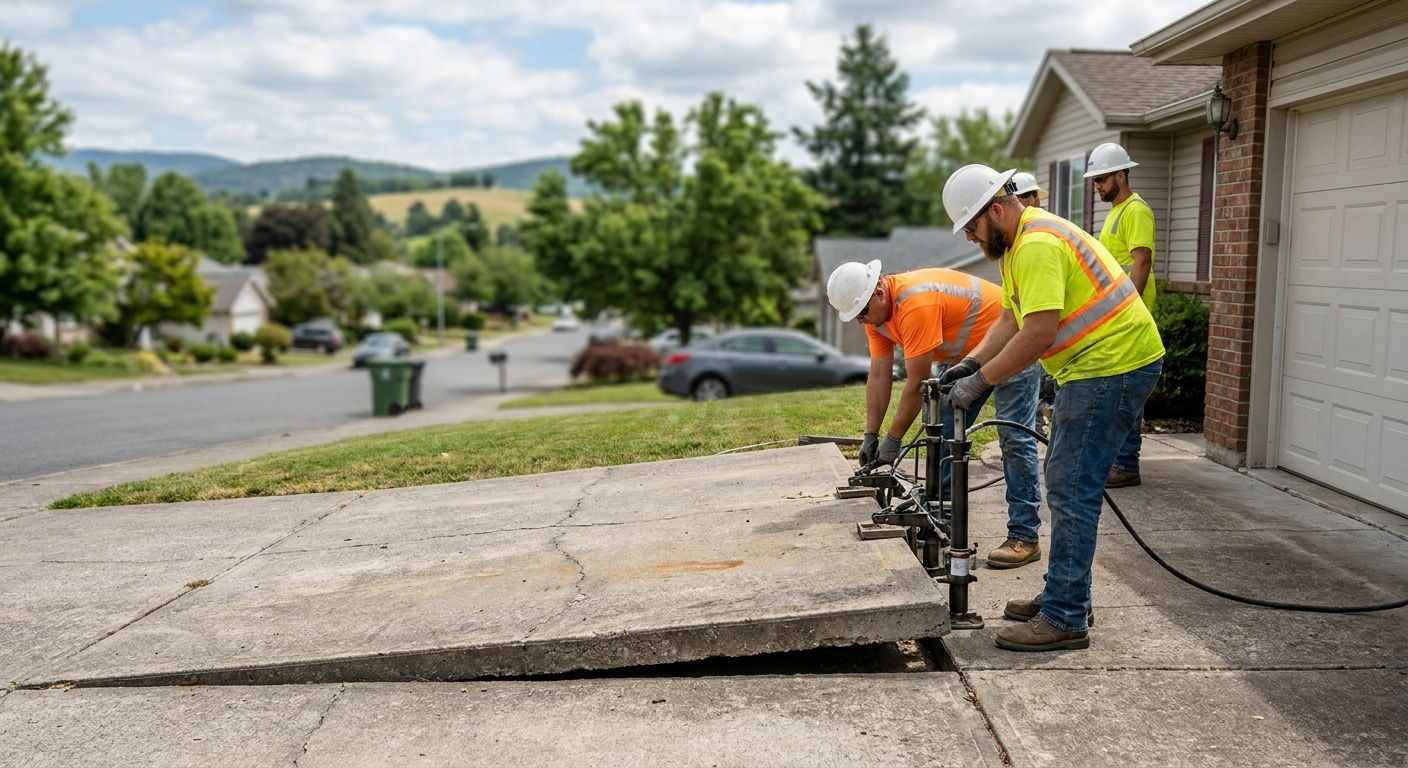
Cochrane concrete lifting solves sunken slabs, tilted walkways, and settled garage floors caused by the freeze-thaw cycles and expansive clay soils common across the foothills west of Calgary. Property owners here deal with faster soil movement than flatter parts of the region, so lifting decisions need to account for that pattern instead of a one-size-fits-all fix.
- Concrete lifting cochrane fixes sunken slabs without full replacement; Aztec Spray Systems handles assessment and lifting for Cochrane properties.
- Cochrane’s clay-heavy soil and freeze-thaw cycles move concrete faster than in flatter Calgary neighborhoods.
- Mudjacking and polyurethane foam injection are the two common lifting methods; each fits different slab types.
- Active foundation settling needs a structural check before any slab lifting starts in 2026.
- Ignoring a 1-inch drop at a slab edge in 2026 often means a 3-inch drop by 2027.
Why concrete lifting matters for Cochrane properties
Cochrane sits on a mix of glacial till and bentonitic clay that expands when wet and contracts hard when it dries out or freezes. That swing pushes and pulls on slabs poured directly on grade — garage floors, walkways, patios, and driveway aprons — more aggressively than soil types found in central Calgary.
A slab that drops an inch in Cochrane during one wet spring can drop another inch by the next thaw cycle if the void underneath isn't filled. Waiting past 2026 to address a settling driveway or sidewalk usually means a bigger repair bill, not a smaller one, because water keeps washing more soil out from under the slab every season.
Verdict: concrete lifting is the right call for a sunken slab with a stable base underneath it; it is the wrong call when the drop is caused by ongoing foundation movement, which needs a structural fix first.
Inspect your slab for settling patterns
Start with a walk-around before calling anyone. Cochrane properties on newer subdivisions built on fill dirt tend to settle differently than older acreages on native clay.
- Look for a gap between the slab and the foundation wall or door threshold
- Check for pooling water on a patio or walkway after rain
- Note any diagonal cracking that runs from a corner — this often signals more than one settled section
- Photograph the slab edge against a fixed reference point (a door frame, a fence post) so you can track movement over a season
- Check garage floors near the overhead door track, since that's the most common Cochrane settling point
Measure the drop with a level or string line
A rough number tells you whether this is a cosmetic annoyance or a real problem.
- Lay a 4-foot level across the low spot and measure the gap underneath with a tape measure
- For longer runs like driveways, stretch a string line between two stakes and measure the sag at the midpoint
- Anything under half an inch is usually cosmetic; anything over an inch and a half typically needs lifting
- Record the measurement date so you can compare again in six months
- If the drop is uneven across the slab rather than uniform, check whether your garage floor needs concrete lifting before assuming it's a simple sink
Rule out active foundation movement first
This is the step most Cochrane homeowners skip, and it's the one that causes callbacks. A slab lift on top of an actively settling foundation just sinks again.
- Check the foundation wall itself for stair-step cracking, not just the slab
- Look for doors and windows sticking on the same side of the house as the sunken slab
- Watch for new cracks appearing over a few months rather than staying static
- Compare interior drywall cracks to exterior slab movement — matching patterns point to foundation settling, not just slab sinking
- Review the signs at how to identify foundation settling before it worsens if any of this sounds familiar
If the foundation itself is moving, a licensed assessment from Aztec Spray Systems or a structural engineer needs to happen before any concrete lifting quote makes sense.
Compare lifting methods for your slab type
Once you've confirmed the slab settling is isolated and not tied to foundation movement, the method choice depends on slab thickness, soil condition underneath, and how much precision the fix needs.
- Mudjacking pumps a cement-based slurry under the slab to raise it — heavier mix, works well on thick driveway slabs
- Polyurethane foam injection uses a lightweight expanding foam through small ports — faster set time, less added weight on soft soil
- Full slab replacement removes and repours the concrete — the only option when the slab itself is cracked beyond repair, not just settled
- DIY mortar patching around edges only masks the problem and doesn't address the void underneath
- Compare the tradeoffs at best concrete lifting method for sunken slabs before picking a method
Time the job around Cochrane's freeze-thaw calendar
Lifting work needs workable ground temperature and soil that isn't saturated from spring runoff.
- Late spring through early fall gives the most predictable working conditions in Cochrane
- Avoid scheduling during a hard freeze — foam and slurry both need stable ground temperature to cure properly
- Book ahead of the fall rush; contractors across the region get backed up once temperatures start dropping
- If the slab is a safety hazard (a tripping edge, a garage floor gap), don't wait for ideal weather — get it assessed now
Prep the site before crews arrive
A little prep on your end keeps the job moving and keeps the quote accurate.
- Clear vehicles, planters, and furniture off the slab area
- Mark any buried irrigation lines or low-voltage wiring near the work zone
- Note any recent water issues (sump pump backups, downspout drainage) so the crew can address the cause, not just the symptom
- Confirm access for equipment if the slab is in a fenced backyard or narrow side yard
Maintain the slab after lifting
Lifting fixes the settling, but drainage habits determine whether it stays fixed.
- Redirect downspouts at least 6 feet away from the lifted slab
- Grade soil next to the slab so water runs away from the edge, not toward it
- Check injection or fill ports annually for the first two years after the work
- Reseal control joints if the original sealant cracked during the settling
Get a concrete lifting assessment
Aztec Spray Systems serves Cochrane, Calgary, Okotoks, and Lethbridge properties.
Comparing your options
| Option | Best for | Key limitation |
|---|---|---|
| Mudjacking | Thick driveway and patio slabs with a stable base | Adds weight to the soil underneath, which can be an issue on already-soft ground |
| Polyurethane foam injection | Garage floors, walkways, and slabs needing precise, lighter lift | Smaller ports leave less visible patching, but material cost runs higher per job |
| Full slab replacement | Slabs with cracking, spalling, or damage beyond the settling itself | Highest cost and longest downtime of the three |
| DIY edge patching | Cosmetic gaps under a quarter inch with no drainage issue | Doesn't address the void causing the settling; usually a temporary fix |
Verdict: for most Cochrane slabs with an isolated void and a sound structure, polyurethane foam injection or mudjacking through a licensed and insured contractor like Aztec Spray Systems is the right call — full replacement is only worth it when the concrete itself has failed.
Common mistakes Cochrane property owners make
- Treating a sunken slab as cosmetic — a half-inch drop in 2026 on Cochrane's clay soil rarely stays a half-inch drop through 2027
- Skipping the foundation check — lifting a slab tied to active foundation settling wastes the repair cost when it sinks again
- Ignoring drainage after the fix — downspouts still dumping water next to a freshly lifted slab reintroduce the same void within a season or two
- Comparing quotes without comparing methods — a mudjacking quote and a foam injection quote aren't apples to apples; ask what's actually being used
- Waiting until the driveway is a trip hazard — insurance and liability exposure go up once a settled walkway or garage floor becomes a fall risk
FAQ
How much does concrete lifting cost in Cochrane in 2026?
Cost depends on slab size, the lifting method, and how much void needs filling underneath. A licensed contractor can give an accurate number after seeing the specific slab and its settling pattern.
Is concrete lifting better than replacement for a sunken driveway?
Lifting is usually cheaper and faster when the concrete itself is still sound and only the base underneath has settled. Replacement makes sense only when the slab is cracked, spalled, or structurally compromised.
How long does concrete lifting take?
Most residential slab lifting jobs finish in a single day, with the slab usable again within hours depending on the method used. Larger driveways or commercial areas take longer.
Can concrete lifting fix a garage floor that’s pulling away from the foundation?
Yes, if the gap is caused by slab settling and not active foundation movement. A foundation check should happen first to confirm the cause before scheduling the lift.
Does concrete lifting work in cold weather?
Both mudjacking slurry and polyurethane foam need stable, unfrozen ground to cure properly, so late spring through early fall gives the most reliable results in Cochrane.
Will concrete lifting stop future settling?
Lifting fills the existing void, but future settling depends on drainage and soil conditions around the slab. Redirecting downspouts and grading soil away from the edge protects the fix.
Is polyurethane foam injection better than mudjacking?
Foam injection is lighter and better for soft soil or precision lifts like garage floors, while mudjacking suits thicker slabs on a stable base. The right choice depends on the specific slab and soil condition.
Who should I call for concrete lifting in Cochrane?
A licensed and insured contractor with concrete lifting experience in the local soil conditions, such as Aztec Spray Systems, which also serves Calgary, Okotoks, and Lethbridge.
One last thing
The detail most Cochrane homeowners miss: a slab that sinks unevenly on one side almost always points to a drainage problem on that same side, not a random weak spot in the soil. Fix the downspout or grading issue at the same time as the lift, or you'll be booking the same repair again in a year or two.
Related guides
- Best concrete lifting method for sunken slabs
- How to identify foundation settling before it worsens
- Concrete lifting for Okotoks properties
- Concrete lifting for Lethbridge properties
- How to tell if your garage floor needs concrete lifting