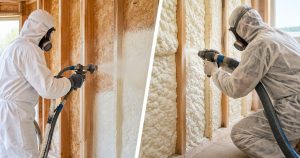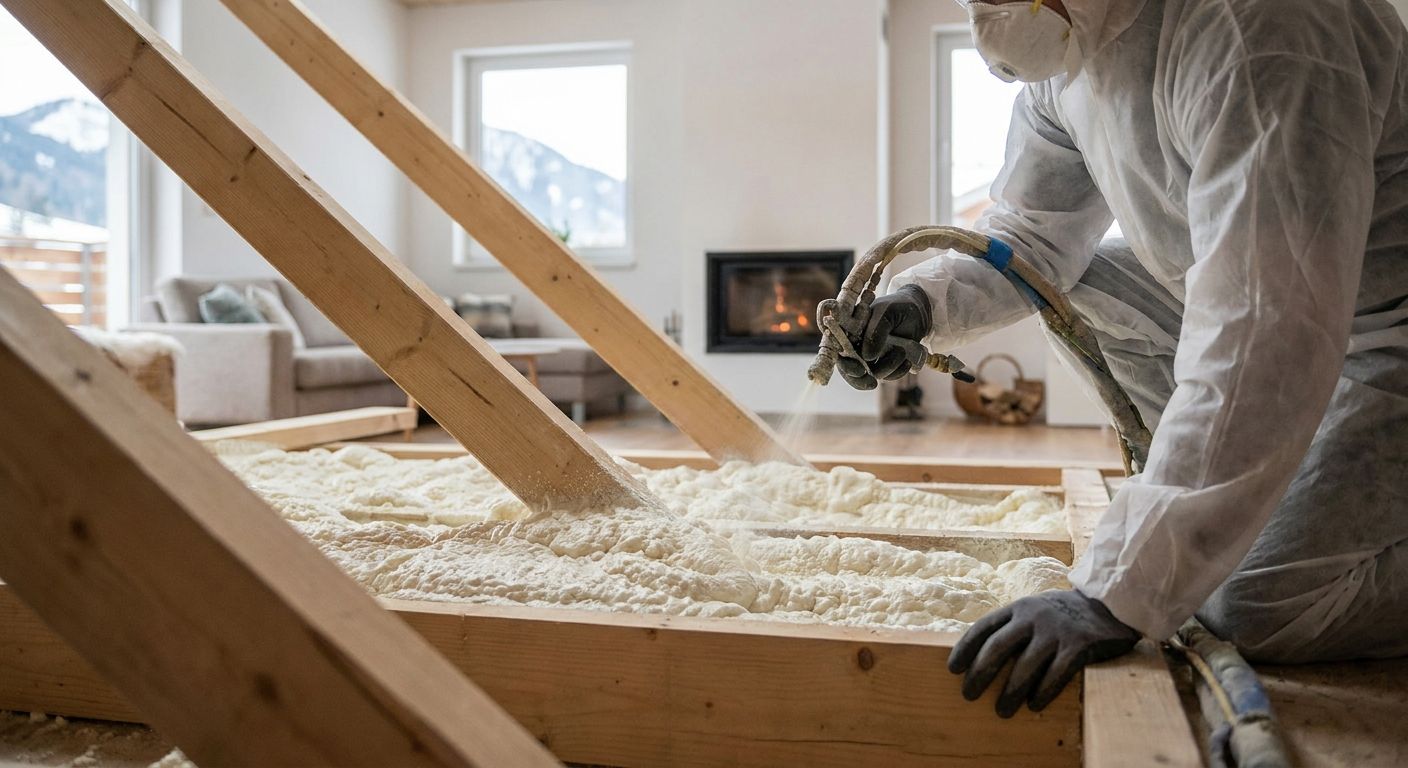
Cochrane sits in a wind corridor between the foothills and Calgary, and that geography means local attics, rim joists, and older wall cavities bleed heat faster than insulation built for milder regions can handle. Spray foam insulation solves that problem when it's specified and installed correctly for Cochrane's climate, not just copied from a generic Calgary quote.
- Closed-cell spray foam insulation at R-6 to R-7 per inch outperforms batt insulation through Cochrane’s chinook temperature swings — Buy for attics and rim joists.
- A typical 1,600 sq ft Cochrane attic needs roughly 5-6 inches of closed-cell foam to approach Alberta’s R-50 attic target in 2026.
- Open-cell foam is fine for interior sound-dampening but Skip it in below-grade crawl spaces where moisture control matters more than R-value per dollar.
- Canada Greener Homes Grant projects can offset part of a 2026 retrofit — confirm eligibility before you book install day.
Why this matters
Cochrane's mix of older acreage-style builds and newer subdivisions means insulation needs vary block by block. A house built in the 1990s with batt insulation and a leaky attic hatch loses heat completely differently than a 2020s build with a bonus room over the garage. Alberta winters push wall assemblies through repeated freeze-thaw cycles thanks to chinooks, and that cycling is what separates a spray foam job that lasts 20+ years from one that fails at the seams within five.
Getting this right up front matters more than most homeowners realize until a February heating bill arrives. The insulation decision you make in 2026 determines your energy costs through the 2030s.
Who this is for
This guide is for Cochrane homeowners weighing spray foam against batt or blown-in insulation for an attic retrofit, a renovation, a bonus room over the garage, or a crawl space that never quite feels dry. It's written for people replacing insulation in an existing home, not builders speccing new construction from scratch — though the criteria below apply to both.
What to look for in spray foam insulation for Cochrane homes
R-value matched to the assembly, not a flat number
Attics, rim joists, and crawl spaces each carry different R-value targets, and a contractor quoting one flat number across your whole house is cutting corners. Closed-cell foam runs R-6 to R-7 per inch — dense enough to hit Alberta's roughly R-50 attic benchmark in 5 to 6 inches rather than the 14+ inches loose-fill insulation needs to match it.
Air sealing before insulating value
Spray foam's real advantage over batt insulation is that it seals air leaks and adds R-value in the same pass. If a quote treats insulation and air sealing as two separate line items, you're paying twice for something spray foam does once.
Moisture handling in crawl spaces and rim joists
Cochrane's freeze-thaw cycling pushes moisture through rim joists and crawl space walls more aggressively than a stable-climate region. Closed-cell foam's vapor-retarder properties matter here far more than in a dry attic, where open-cell foam's lower cost per inch is harder to justify.
Installer experience with your specific build era
A 1970s Cochrane bungalow with knob-and-tube remnants or a home with no vapor barrier needs different prep than a 2015 build. Ask any contractor how many jobs they've done in homes your era before you sign.
Cure time and off-gassing window
Spray foam needs a clear cure and ventilation window before the space is safely reoccupied. Any contractor who can't tell you the exact cure time for your job's foam type and square footage hasn't done the math yet.
Total installed cost versus long-term energy savings
Spray foam costs more upfront than batt insulation, but the air-sealing effect cuts heating and cooling losses that batt insulation simply can't touch. Run the numbers against your current energy bills before you decide what the payback period actually looks like for your house.
Top picks for Cochrane applications
The attic retrofit — the highest-payback pick. Attics lose more heat than any other part of a Cochrane home during chinook swings, and closed-cell foam at R-6 to R-7 per inch closes that gap fastest. Expect 5-6 inches of foam depth to approach the R-50 target most Alberta homes should carry into 2026. Buy if your attic has visible frost lines or ice damming along the eaves.
Rim joists — the quiet energy leak. Rim joists are one of the most commonly missed insulation points in Cochrane homes, and they're responsible for a disproportionate share of basement drafts. A few inches of closed-cell foam here seals the sill plate-to-foundation gap that batt insulation never fully closes. Rim joist spray foam is a small job with an outsized comfort return. Buy for any home built before 2010.
Crawl space encapsulation — the moisture fix. Crawl spaces in Cochrane's freeze-thaw belt trap moisture that rots joists and feeds mold if left alone. Crawl space spray foam combined with proper vapor barriering solves the moisture and the R-value problem at once. Buy if your crawl space smells damp or shows visible condensation in winter.
Bonus room over the garage — the comfort fix. These rooms run 10-15 degrees colder than the rest of the house in most builds because the garage below isn't heated and the floor assembly is under-insulated. Spray foam on the garage ceiling closes that gap directly. Consider this pick if you already use the room year-round; Skip it if the space sits mostly unused in winter.
Grant-assisted whole-home retrofit — the long-game pick. Homeowners planning a bigger 2026 retrofit across attic, rim joists, and walls should check whether a Canada Greener Homes Grant project applies before booking, since eligibility rules affect scheduling and documentation requirements. Consider this route if you're already planning a multi-area job rather than a single room.
What to avoid
- Flat-rate whole-house quotes that skip a per-area breakdown. Attic, rim joist, and crawl space needs differ enough that a single number across all three usually means one area is over-quoted and another is under-insulated.
- Open-cell foam in crawl spaces or below-grade walls. It costs less per inch but doesn't handle moisture the way closed-cell foam does, and Cochrane's freeze-thaw cycling punishes that shortcut within a few winters.
- DIY spray foam kits for anything beyond a small gap fill. Cure times, ratios, and ventilation requirements are easy to get wrong at scale, and a bad seal traps moisture instead of blocking it.
Verdict comparison
| Area | Foam Type | Typical Depth | Priority | Verdict |
|---|---|---|---|---|
| Attic | Closed-cell | 5-6 in | High | Buy |
| Rim joists | Closed-cell | 2-3 in | High | Buy |
| Crawl space | Closed-cell | 2-4 in | High | Buy |
| Bonus room ceiling | Closed-cell | 4-5 in | Medium | Consider |
| Interior sound walls | Open-cell | Full cavity | Low | Consider |
FAQ
How much does spray foam insulation cost in Cochrane in 2026?
Cost depends on square footage, foam type, and which areas of the home are treated, since attic, rim joist, and crawl space jobs price differently. A per-area quote from a licensed contractor gives a more accurate number than a flat per-square-foot estimate.
Is spray foam insulation better than batt insulation for Cochrane homes?
Spray foam seals air leaks and adds R-value in one step, which batt insulation can’t do on its own. In a chinook-cycling climate like Cochrane’s, that combined effect usually outperforms batt insulation over the life of the home.
What R-value does an attic need in Cochrane, Alberta?
Alberta building targets generally call for attic insulation around R-50 in 2026, which closed-cell spray foam reaches in roughly 5 to 6 inches. Loose-fill or batt insulation needs significantly more depth to match the same R-value.
Does spray foam insulation qualify for the Canada Greener Homes Grant?
Certain spray foam retrofit projects can qualify for Canada Greener Homes Grant funding, but eligibility depends on the specific scope and documentation of the job. Confirm your project’s eligibility before scheduling install day.
Can spray foam insulation fix a cold crawl space in Cochrane?
Yes, closed-cell spray foam combined with a vapor barrier addresses both the temperature and moisture problems that make crawl spaces feel cold and damp. This matters more in freeze-thaw regions where moisture cycling is constant through winter.
How long does spray foam insulation last?
Properly installed closed-cell spray foam commonly lasts 20 years or longer without significant R-value loss. Poor installation or moisture intrusion from an unrelated source is the usual cause of early failure, not the foam itself.
Do I need to insulate rim joists separately from the attic?
Yes, rim joists are a distinct thermal weak point that attic insulation doesn’t cover, and they’re commonly missed in older Cochrane homes. Sealing them closes one of the most common sources of basement drafts.
Is open-cell or closed-cell spray foam better for a Cochrane garage?
Closed-cell foam is the stronger choice for garage ceilings and walls because it handles temperature swings and moisture better than open-cell foam. Open-cell foam works fine for interior sound-dampening walls where R-value and moisture aren’t the priority.
One last thing
The detail most Cochrane homeowners miss isn't the attic — it's the rim joist band around the foundation, since it's invisible from inside the house and almost never gets checked during a routine home inspection. Sealing that one area often costs less than a bonus-room retrofit and closes a draft source that's been quietly running up heating bills since the day the house was built in whatever decade that was.
Related guides