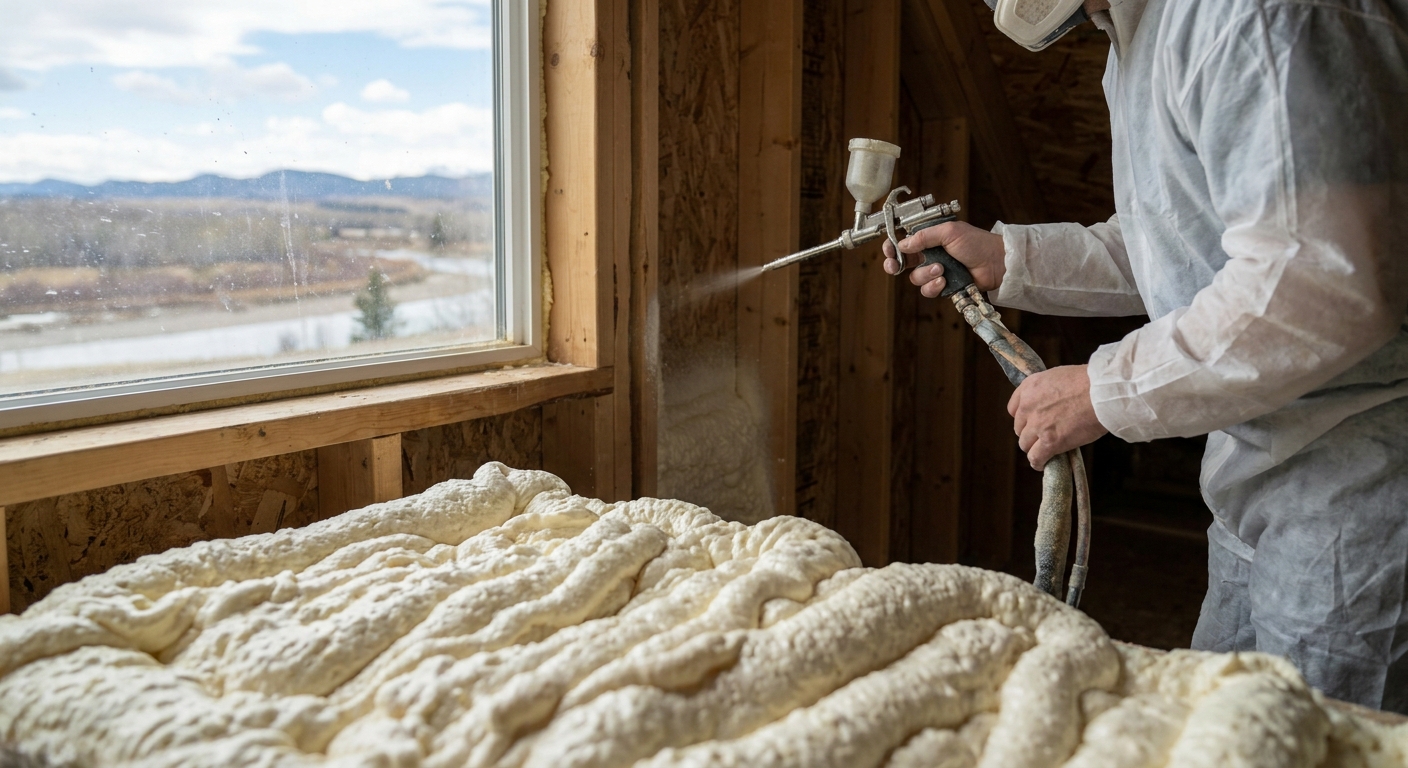
Spray foam insulation for High River homeowners means picking the right foam type, R-value, and application point for a town that swings from +30°C summer heat to -30°C chinook-broken winters. This guide breaks down what actually matters for your attic, rim joists, and crawl space before you sign a contract.
- Closed-cell spray foam at R-6.5 per inch is the workhorse pick for High River attics and rim joists — Buy.
- Open-cell spray foam works for interior walls but underperforms in exposed rim joists — Consider only with a vapor strategy.
- Alberta Building Code sets a minimum R-50 for attic insulation; spray foam plus a blown-in top-up hits that faster than batts alone.
- DIY spray foam kits and uninsured installers are the two biggest ways High River homeowners waste money in 2026.
Why this matters
High River sits in a wind corridor between the foothills and the prairie, and that wind finds every gap in a building envelope. A poorly sealed attic or rim joist loses heat fast when a chinook breaks and temperatures drop 20 degrees overnight.
Spray foam closes those gaps and adds insulating value in one step, which is why it’s replaced batt-only setups in a lot of rebuilds and retrofits across southern Alberta since 2020. Aztec Spray Systems installs spray foam and attic insulation for homeowners in High River, Okotoks, Calgary, and Lethbridge, and the same climate logic applies across all four markets — but the application details change by room.
Who this is for
This guide is for High River homeowners dealing with cold floors, ice damming on the roofline, or a heating bill that spikes every January. It’s also for anyone renovating a rim joist, crawl space, or attic before winter 2026 and trying to figure out which spray foam type is worth the cost versus a cheaper batt-and-vapor-barrier fix.
What to look for in spray foam insulation for High River homes
R-value per inch, not just total R-value
Closed-cell spray foam delivers roughly R-6.5 per inch, while open-cell lands around R-3.6 to R-3.7 per inch. For a High River attic where Alberta Building Code sets a minimum of R-50, closed-cell reaches that target in less depth — which matters in tight roof assemblies with limited clearance.
Vapor and air barrier performance
Chinook cycles mean freeze-thaw happens dozens of times a winter, and moisture trapped in a wall cavity during that cycle causes rot before you ever see a stain. Closed-cell foam acts as its own vapor barrier at 2 inches or more; open-cell needs a separate poly or smart vapor retarder to do the same job.
Licensed and insured installation
Spray foam off-gasses during cure, and a botched mix ratio leaves a soft, shrinking foam that fails inspection. A licensed, insured contractor carries liability coverage for the application and stands behind the cure — an uninsured installer working out of a truck doesn’t.
Application point matches the heat-loss problem
An attic top-up doesn’t fix a cold rim joist, and rim joist foam doesn’t stop an ice dam caused by attic air leakage. Match the foam application to where the heat is actually escaping, not just to the cheapest square footage.
Local code compliance for Alberta
Alberta Building Code requirements differ from what you’ll read in U.S.-based insulation guides. Confirm any quote references current Alberta code minimums for attic, wall, and basement assemblies before work starts in 2026.
Cure time and off-gassing window
Closed-cell foam typically needs 24 hours before the space is safely re-occupied; open-cell cures faster but still needs ventilation during application. Ask for the exact cure schedule in writing, especially if you’re insulating a room you’ll sleep in that week.
Top picks for High River applications
Closed-cell spray foam for attics — the workhorse pick. At R-6.5 per inch, closed-cell hits Alberta’s R-50 attic minimum in about 7.7 inches of foam, versus significantly more depth with fiberglass batts alone. Buy for any High River attic dealing with ice damming or exposed roof trusses.
Rim joist and band board spray foam — the easy win. Rim joists lose more heat per square foot than almost any other part of a High River foundation, and most builds from before 2010 have zero foam here. A 2-inch closed-cell application seals air leaks and adds a vapor barrier in one pass. Buy — this is usually the fastest payback point in the house.
Open-cell spray foam for interior walls — the budget pick. Open-cell costs less per board foot and works fine for interior partition walls where moisture isn’t a factor. It’s a weaker choice for exterior walls without a separate vapor strategy. Consider for interior soundproofing and non-exterior walls only.
Crawl space spray foam — the moisture fix. Crawl spaces in High River sit closer to grade and pick up ground moisture that batt insulation traps against the joists. Closed-cell foam on the foundation walls and rim joist stops that moisture path and typically brings crawl space temperatures up by a noticeable margin in winter. Buy if your crawl space feels colder than the rest of the house or shows any condensation.
Blown-in attic top-up over existing batts — the wildcard. If your attic already has batts but falls short of R-50, a blown-in cellulose or fiberglass top-up combined with rim joist spray foam closes the gap without a full tear-out. Consider as a lower-cost middle step before committing to full spray foam replacement.
Get a spray foam quote for High River
Licensed, insured attic and rim joist spray foam service across southern Alberta.
What to avoid
- DIY spray foam kits — box-store kits max out around R-4,000 board feet and rarely achieve the mix ratio a professional rig delivers, leaving soft spots that shrink within a year.
- Uninsured or unlicensed installers — spray foam off-gassing is a real health consideration during cure, and an uninsured job leaves you with no recourse if the foam fails inspection.
- Over-insulating a roof deck without ventilation — closed-cell foam applied directly to roof sheathing without a ventilation plan can trap moisture in the wood itself; this needs an assembly-specific approach, not a blanket spray job.
Verdict comparison
| Application | R-value per inch | Best use in High River | Verdict |
|---|---|---|---|
| Closed-cell attic foam | R-6.5 | Attics, ice dam prevention | Buy |
| Rim joist / band board foam | R-6.5 | Foundation-to-frame gaps | Buy |
| Open-cell wall foam | R-3.6–3.7 | Interior partitions | Consider |
| Closed-cell crawl space foam | R-6.5 | Foundation walls, moisture control | Buy |
| Blown-in top-up | R-3.2–3.8 per inch | Existing batt attics | Consider |
Cost varies by square footage, foam type, and how much of the existing insulation needs removal first — see the full spray foam cost breakdown for the current 2026 pricing ranges before you request a quote.
FAQ
What is the R-value of spray foam insulation?
Closed-cell spray foam delivers about R-6.5 per inch, and open-cell delivers roughly R-3.6 to R-3.7 per inch. Alberta Building Code sets a minimum of R-50 for attic assemblies in 2026.
Is spray foam insulation worth it in High River, Alberta?
Yes, for attics, rim joists, and crawl spaces where chinook freeze-thaw cycles and wind exposure cause the biggest heat loss. The air-sealing effect matters as much as the R-value in a wind corridor like High River.
How much does spray foam insulation cost in High River?
Cost depends on foam type, square footage, and whether old insulation needs removal first. Current 2026 pricing ranges are broken down by application in Aztec Spray Systems’ cost guide.
Closed-cell vs open-cell spray foam — which is better for Alberta homes?
Closed-cell wins for exterior walls, attics, and rim joists because it acts as its own vapor barrier at R-6.5 per inch. Open-cell works fine for interior partition walls where moisture isn’t a factor.
How long does spray foam insulation last?
Properly cured spray foam typically lasts 20 to 30-plus years without settling or losing R-value, unlike batt insulation which compresses over time. Installation quality determines most of that lifespan.
Does spray foam insulation help with ice damming in Alberta winters?
Yes, because ice dams form when attic air leaks melt snow unevenly on the roof. Sealing the attic floor with closed-cell foam stops that leak path at the source.
Is spray foam insulation safe for older homes?
Yes, when installed by a licensed contractor who accounts for existing wiring, moisture conditions, and ventilation in the original build. Older High River homes often need the rim joist and crawl space addressed first.
One last thing
Most High River homeowners fix the attic first and skip the rim joist entirely — but the rim joist is where uninsulated homes lose the most heat per square foot, and it’s usually the cheapest fix in the whole house. Ask any quote to include it before you approve attic-only work in 2026.