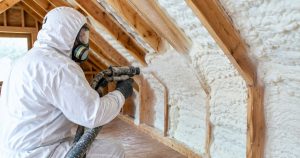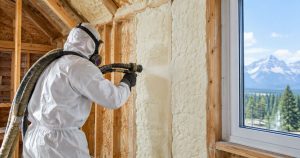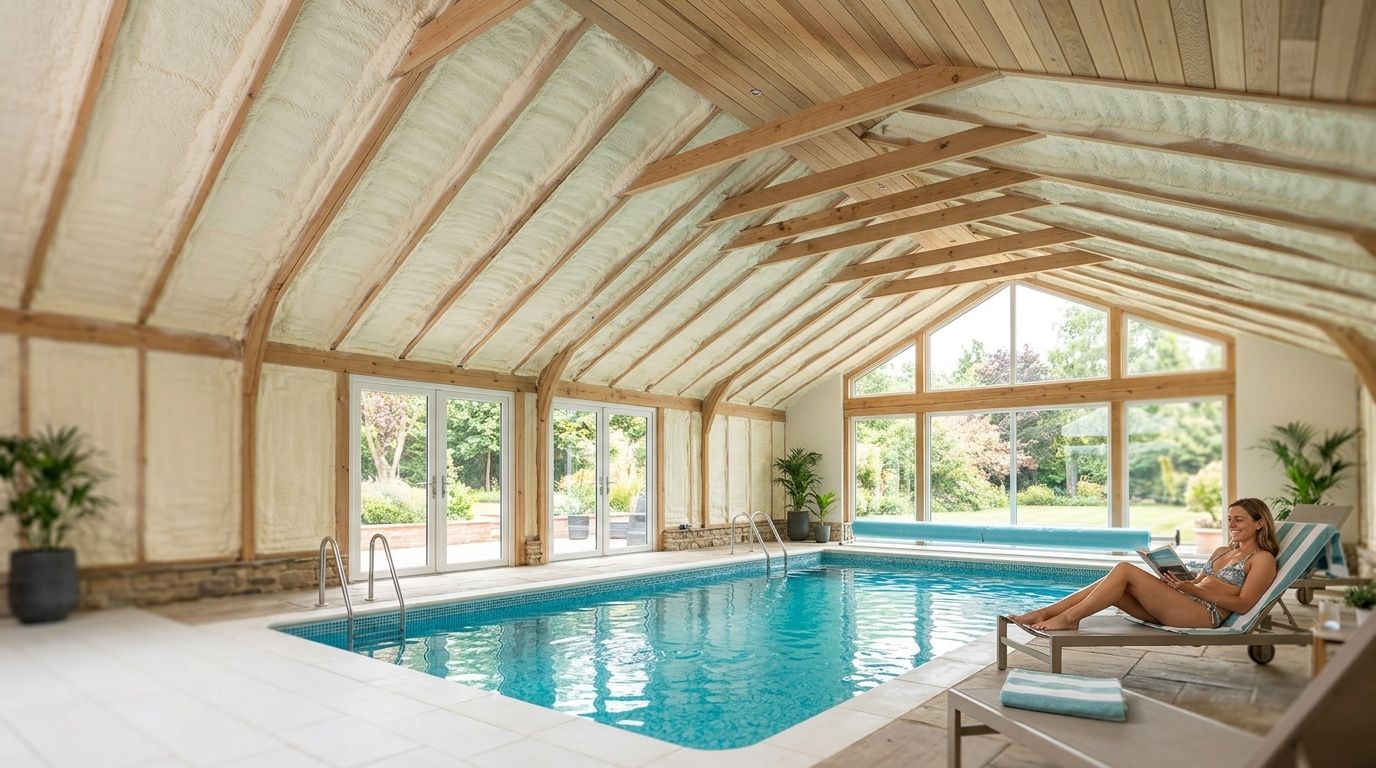
Spray foam insulation for pool houses is a moisture-control and thermal-performance upgrade built specifically for the humidity, chlorine off-gassing, and temperature swings that come with an indoor pool. A standard attic or wall insulation job assumes dry indoor air; a pool house never has dry air, and that single difference changes almost every material choice in the room.
- Closed-cell spray foam is the right call for pool houses because it blocks vapor from moving into wall and ceiling cavities.
- Alberta pool houses need an air and vapor barrier more than they need raw R-value — humidity failure happens before heat loss does.
- Fiberglass batt insulation absorbs moisture in a pool house and loses most of its R-value within a season.
- Aztec Spray Systems installs closed-cell foam for Calgary, Okotoks, High River, and Lethbridge pool houses and attached pool rooms.
- Ventilation still matters — spray foam insulation pool house projects fail without a working dehumidification plan.
Why spray foam insulation matters for pool houses
An indoor pool runs at 50-60% relative humidity or higher, and that moisture is constantly pushing outward through walls, ceilings, and any gap in the building envelope looking for a cold surface to condense on. In Calgary and southern Alberta, where outdoor temperatures swing from +20°C to -30°C within the same winter, that cold surface sits right inside an uninsulated or poorly sealed wall cavity.
Once condensation forms inside a wall, wood framing, drywall, and batt insulation start absorbing water. Mold growth follows within weeks, not months, and by the time it's visible on a ceiling tile the framing behind it has usually been wet for a while. Moisture and mold control is the actual reason pool house owners call an insulation contractor before they ever think about heating bills.
Closed-cell spray foam solves this because it's a vapor retarder and an air barrier in the same layer. At roughly 2 inches thick, closed-cell foam achieves a vapor permeance low enough to function as a Class II vapor barrier, which is what stops humid pool air from migrating into the wall assembly in the first place. Fiberglass batt does none of this on its own — it's air-permeable and does nothing to block vapor.
How to insulate a pool house or indoor pool room
Assess the humidity load before picking materials
Every pool house project starts with understanding how much moisture the space is actually generating, because that number drives the vapor barrier strategy more than the R-value target does.
- Measure pool surface area and water temperature — larger, warmer pools evaporate more water into the air
- Check whether the pool has a cover used between swims, which cuts evaporation significantly when in place
- Note the current ventilation setup: exhaust fans, dehumidifier, or none
- Identify existing moisture damage on drywall, trim, or window frames as a baseline
- Confirm whether the room is heated year-round or seasonally, since that changes the vapor drive direction
Seal the building envelope first
Air leaks move far more moisture into a wall cavity than vapor diffusion through the material itself, so sealing gaps around windows, doors, electrical penetrations, and the top and bottom plates of framed walls comes before any insulation goes in.
- Caulk or foam-seal every penetration for wiring, plumbing, and pool equipment lines
- Check window and door flashing for gaps that let humid air track into the wall cavity
- Seal the rim joist area where the pool room meets the foundation or an attached garage
- Inspect any shared wall with the main house, since pool humidity migrates into adjoining rooms through unsealed penetrations
- Confirm exhaust fan ducting is sealed at every joint, not just taped
Choose closed-cell foam for walls and ceilings
Open-cell spray foam and fiberglass batt both let vapor pass through, which defeats the purpose in a pool room. Closed-cell foam is denser, costs more per board foot, but it's the only common insulation type that also functions as a vapor barrier.
- Specify closed-cell foam at 2 inches minimum on exterior walls facing the pool
- Apply closed-cell foam to the ceiling or roof deck if the pool room has a vaulted or cathedral-style ceiling
- Foam directly over metal framing members if the structure uses steel studs, since metal is a strong thermal bridge in a humid room
- Avoid mixing open-cell and closed-cell foam in the same cavity unless a vapor barrier is added separately
- Confirm the right R-value for the assembly based on whether the room is heated continuously or intermittently
Protect metal components from corrosion
Chlorine off-gassing combined with humidity accelerates corrosion on any exposed metal — fasteners, HVAC ductwork, light fixtures, and structural steel connectors all corrode faster in a pool room than anywhere else in a house.
- Use stainless steel or coated fasteners in any assembly exposed to pool air
- Route HVAC ductwork outside the humid zone where possible, or use corrosion-resistant duct materials
- Foam around structural steel connections to reduce direct exposure to humid air, not just for thermal performance
- Inspect and replace any existing corroded fasteners before spraying foam over them
Plan mechanical ventilation alongside insulation
Spray foam insulation pool house projects fail when the room has no active way to remove moisture, because sealing the envelope tightly without exhaust just traps humidity indoors instead of losing it to the outside air.
- Size a dedicated dehumidifier or pool-room ventilation unit for the pool's square footage and water surface area
- Confirm exhaust fans vent directly outdoors, never into an attic or adjoining unconditioned space
- Set humidity control to keep indoor relative humidity below 60% year-round
- Coordinate ventilation runs with the insulation contractor before foam goes in, since duct penetrations need to be sealed as part of the same job
Insulate the pool deck and slab edge
Heat loss through a pool deck slab and its perimeter is easy to overlook, but a cold slab edge is a common condensation point along the base of pool room walls.
- Insulate slab perimeters with rigid foam board before pouring or as a retrofit where accessible
- Check for cracked or settled concrete around the pool deck, since gaps let cold air and moisture track under the slab
- Coordinate with concrete lifting for patios and pool decks if the deck has settled and created uneven joints where water pools
- Confirm deck drainage directs water away from the building foundation, not toward it
Get a licensed, insured contractor to spray the job
Pool room spray foam is not a DIY-friendly project. Closed-cell foam requires controlled mixing ratios, correct ambient temperature during application, and experience working around pool equipment, electrical, and finished surfaces without damaging them.
- Confirm the contractor carries WCB coverage and liability insurance before booking
- Ask for pool-room or high-humidity project references specifically, not just general attic jobs
- Get a written scope covering wall thickness, ceiling thickness, and any areas excluded from foam coverage
- Review Calgary spray foam pricing factors so the quote makes sense relative to square footage and foam type
Get a pool house insulation quote
Closed-cell spray foam for Calgary, Okotoks, High River, and Lethbridge pool rooms.
Comparing insulation options for pool houses
| Option | Best for | Key limitation |
|---|---|---|
| Closed-cell spray foam | Walls and ceilings in humid pool rooms | Higher material density means more product needed per square foot |
| Open-cell spray foam | Interior walls not exposed to pool humidity | Vapor-permeable, so it doesn't block moisture on its own |
| Fiberglass batt | Dry, unheated storage areas adjacent to the pool room | Absorbs moisture and loses R-value fast in a humid room |
| Rigid foam board | Slab perimeters and below-grade edges | Requires careful seam sealing to work as a vapor barrier |
Verdict: closed-cell spray foam is the correct choice for any wall or ceiling directly exposed to indoor pool humidity, and fiberglass batt should not be used in that same zone.
Common mistakes pool house owners make
- Skipping ventilation because the room is now well-insulated. Sealing the envelope without exhaust traps humidity instead of removing it, and mold shows up faster in a tightly sealed, unventilated pool room than in a leaky one.
- Using open-cell foam to save on material cost. Open-cell foam doesn't block vapor, so the humidity problem the insulation was supposed to fix keeps happening inside the wall cavity where nobody sees it until drywall bubbles or discolors.
- Ignoring the slab edge and pool deck. Heat and vapor move through concrete just like framing does, and a cold, uninsulated slab perimeter is a common spot for condensation to start even when the walls are done correctly.
- Reusing corroded fasteners or hardware during a renovation. Chlorine-humid air accelerates rust, and foaming over already-corroded metal doesn't stop the corrosion, it just hides it until it fails.
- Treating a pool house like a standard bonus room. A pool room's humidity load is fundamentally different from any other space in an Alberta home, and applying standard attic or garage insulation specs to it produces mold problems within a year or two.
FAQ
What’s the best insulation for an indoor pool room?
Closed-cell spray foam is the best insulation for an indoor pool room because it acts as both insulation and a vapor barrier in one layer. Fiberglass batt and open-cell foam let humid pool air pass through, which leads to condensation and mold inside wall cavities.
Is spray foam insulation pool house work different from regular home insulation?
Yes, spray foam insulation pool house projects need a vapor barrier strategy that standard homes don’t require, because indoor pools run at 50-60% relative humidity or higher year-round. Material choice, fastener corrosion resistance, and ventilation planning all differ from a typical attic or wall job.
How thick should spray foam be for pool house walls?
Closed-cell spray foam at 2 inches minimum on exterior walls generally provides both adequate R-value and vapor barrier performance for a pool room in Alberta’s climate. Ceilings and roof decks in vaulted pool rooms may need more depending on the assembly.
Can fiberglass insulation work in a pool house?
Fiberglass batt is not recommended for walls or ceilings directly exposed to indoor pool humidity because it absorbs moisture and loses most of its R-value within a season. It can work in dry, unheated storage areas adjacent to the pool room where humidity exposure is minimal.
Does spray foam prevent mold in pool rooms?
Closed-cell spray foam reduces mold risk by blocking vapor migration into wall cavities, but it doesn’t replace ventilation. A pool room still needs a dehumidifier or exhaust fan system to keep indoor relative humidity below 60% year-round.
Why does pool humidity corrode metal fasteners faster?
Chlorine off-gassing combined with high humidity accelerates oxidation on exposed metal, which is why stainless steel or coated fasteners are recommended in any pool room assembly. Standard fasteners can corrode within a few years in that environment.
Do I need a permit for spray foam insulation in a pool house in Alberta?
Permit requirements depend on the municipality and whether the pool house is a new structure or a retrofit, so checking with the local building authority in Calgary, Okotoks, High River, or Lethbridge before work starts is standard practice. A licensed contractor can confirm what applies to a specific project.
One last thing
The detail most pool house owners miss is that vapor drives outward from the pool room in winter but can reverse direction in summer if the space is air-conditioned while outdoor humidity is high — closed-cell foam handles both directions because it blocks vapor movement regardless of which way it's trying to travel, which is exactly why it outperforms a standard poly vapor barrier in a room with two-way humidity pressure.
Related guides
- How much does spray foam insulation cost in Calgary
- How to reduce moisture and mold with spray foam insulation
- Concrete lifting for patios and pool decks
- How to choose the right spray foam R-value for your attic