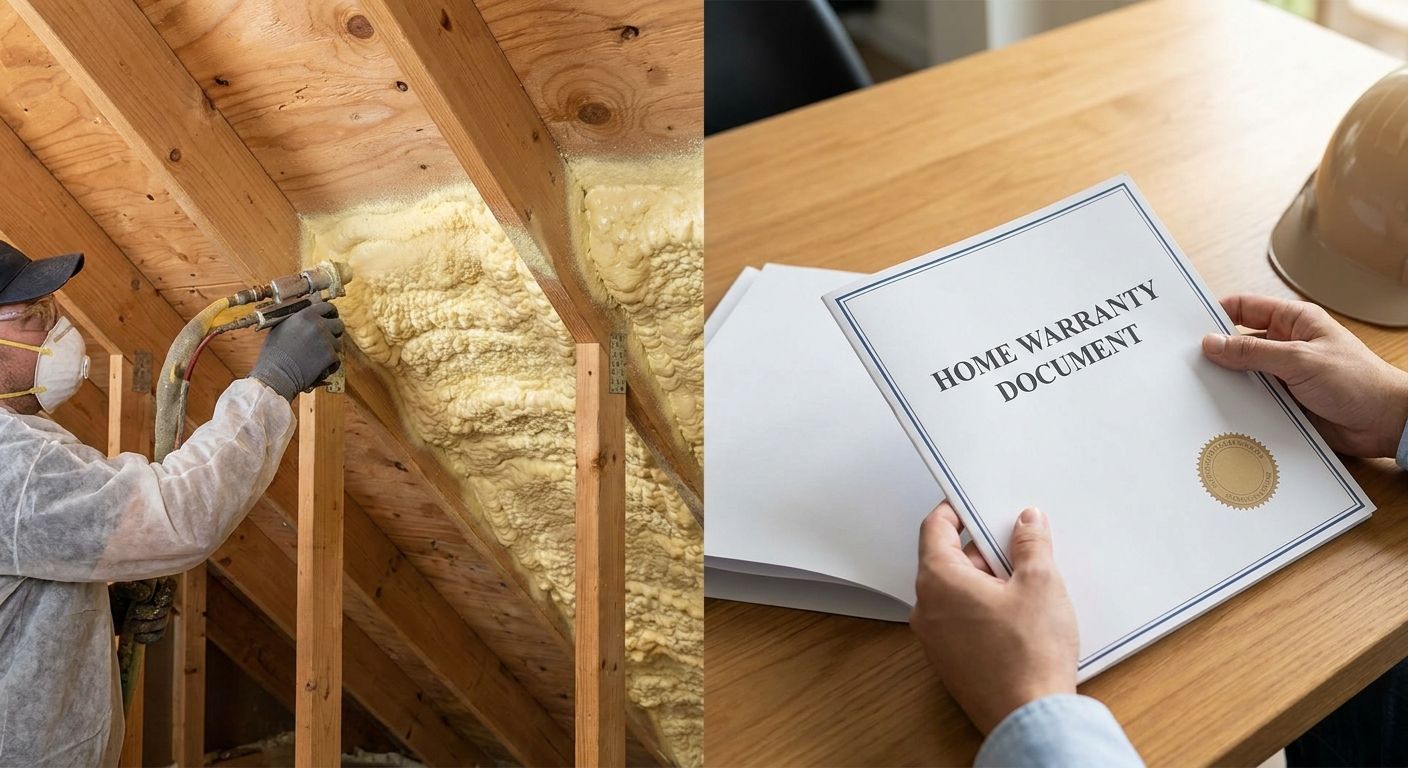
A new home warranty gets voided by spray foam insulation only when the install falls outside code — wrong thickness, no thermal barrier over exposed foam, or a non-certified applicator signing off on the job. Get spray foam installed to CAN/ULC-S705.1/S705.2 standards and Alberta Building Code specs, keep the paperwork, and the warranty stays intact in 2026 the same way it did in prior years.
- Spray foam insulation home warranty coverage survives when the install meets CAN/ULC-S705.1/S705.2 standards and Alberta Building Code Part 9.
- A missing 15-minute thermal barrier over exposed foam in living space is the single most common reason warranty providers deny a claim.
- Keep the installer’s certification, invoice, and thickness/R-value documentation for the life of the warranty — not just the install day.
- Retrofit jobs on older Calgary and Okotoks homes get more scrutiny than new construction because the original wall assembly wasn’t designed for foam.
- Aztec Spray Systems documents every job to Alberta Building Code spec across Calgary, Okotoks, High River, and Lethbridge.
Why this matters
Warranty providers in Alberta don't test insulation performance after the fact — they ask for paperwork. No compliance documentation, no certified installer signature, no invoice showing product and thickness, and a claim gets denied even if the foam is performing exactly as it should.
That's the trap most homeowners fall into. They assume a warranty dispute over insulation is about R-value or air sealing. It's almost always about whether the job can be proven compliant on paper, months or years after the crew has left.
Getting this right the first time costs nothing extra — it's a matter of hiring an installer who documents to code and keeping that file somewhere you can find it. Choosing the right spray foam insulation contractor up front is the cheapest insurance against a warranty headache down the road.
How do you keep spray foam insulation from voiding a new home warranty?
Follow these steps in order, whether the job is on a new build or a retrofit:
- Confirm the foam product is CAN/ULC-S705.1 certified. This is the manufacturing standard for spray polyurethane foam sold in Canada — uncertified product is the fastest way to lose warranty protection.
- Confirm the installer is CAN/ULC-S705.2 certified. This is the applicator standard. A warranty provider can deny a claim on installer credentials alone, regardless of how the foam performs.
- Cover exposed foam with an approved thermal barrier. Alberta Building Code requires a 15-minute-rated barrier — typically drywall — over spray foam in any occupied living space. Foam left exposed in a finished room is a code violation, not a style choice.
- Match thickness to the R-value the design calls for. Underspraying to save product cost is one of the most common corners cut on retrofit jobs, and it shows up immediately in a code inspection.
- Get the compliance paperwork in writing before drywall goes up. Product data sheet, thickness measurement, and installer certification number — this is the file a warranty provider or building inspector asks for first.
- File everything with your home warranty registration, not just your own records. A homeowner who can't produce the documentation loses the argument even when the install was done correctly.
New construction spray foam: what warranty providers check
On new construction homes, the builder's warranty provider usually reviews insulation as part of the pre-drywall inspection. The foam has to be signed off before it's covered, and the inspection report becomes part of the permanent file tied to the home's warranty registration.
Retrofit spray foam in an existing home: what changes
Retrofit work carries more risk because the original wall or attic assembly wasn't built with foam in mind. A warranty provider looking at a retrofit claim will ask whether the foam interfered with existing ventilation, whether knob-and-tube or older wiring was properly addressed, and whether the thermal barrier was added after the fact rather than built in from the start.
| Factor | New construction | Retrofit |
|---|---|---|
| Inspection timing | Pre-drywall, part of build sequence | After-the-fact, often homeowner-initiated |
| Thermal barrier | Installed as part of the build | Must be added separately, often forgotten |
| Warranty scrutiny | Standard | Higher — assembly wasn't designed for foam |
| Documentation trail | Held by builder | Homeowner must request and keep it |
Best for: new construction buyers rely on the builder's process; retrofit homeowners need to drive the documentation themselves — Best for: proactive homeowners who ask for the paper trail before the crew leaves.
Why warranty claims get denied
- No CAN/ULC-S705.2 certified installer — the applicator credential matters as much as the foam brand.
- Missing or delayed thermal barrier — foam left exposed for even a short renovation window is a code gap.
- Underspray relative to design R-value — thin coats save material cost but fail inspection.
- No paper trail — an undocumented job is treated as unverifiable, not innocent until proven otherwise.
- Ventilation conflicts on retrofits — sealing an assembly that depended on airflow without addressing moisture management.
- DIY or unlicensed install — most warranty programs explicitly exclude self-installed insulation work.
“A warranty provider almost never tests the foam — they ask for the paperwork, and no paperwork means automatic denial.”
Does spray foam insulation void a manufacturer's home warranty?
Spray foam insulation does not void a manufacturer's home warranty when it's installed by a CAN/ULC-S705.2 certified applicator using CAN/ULC-S705.1 certified product. The exclusion clauses in most Alberta new home warranty programs target uncertified installers and non-code-compliant assemblies, not spray foam as a category.
Can I install spray foam myself without voiding the warranty?
DIY spray foam installation voids most new home warranties outright, because warranty programs require a certified installer's documentation as proof of compliance. Even a technically sound DIY job fails the claim process without that paperwork trail.
Does spray foam insulation need a vapor barrier under Alberta code?
Closed-cell spray foam applied at code-minimum thickness can satisfy the vapor barrier requirement under Alberta Building Code Part 9, replacing traditional poly sheeting in many assemblies. Open-cell foam is more permeable and typically still needs a separate vapor barrier layer — confirm the assembly with your installer before drywall goes up.
Get a code-compliant spray foam quote
Serving Calgary, Okotoks, High River, and Lethbridge homeowners since day one.
Aztec Spray Systems documents thickness, product certification, and installer credentials on every job across Calgary, Okotoks, High River, and Lethbridge, so the paperwork exists before a warranty question ever comes up. That's the difference between a spray foam insulation job that protects a home warranty and one that quietly puts it at risk.
FAQ
Does spray foam insulation void a new home warranty in Alberta?
Spray foam insulation only voids a new home warranty when the install falls outside Alberta Building Code — missing thermal barrier, wrong thickness, or an uncertified installer. Code-compliant foam with documentation is fully covered.
What certification should a spray foam installer have?
A spray foam installer should hold CAN/ULC-S705.2 certification, the Canadian standard for spray polyurethane foam applicators. This credential is what most warranty providers ask for first during a claim review.
Does spray foam need to be covered by drywall?
Spray foam exposed in an occupied living space needs a 15-minute-rated thermal barrier, typically drywall, under Alberta Building Code. Foam left uncovered in a finished room is a code violation regardless of how well it performs.
Is retrofit spray foam riskier for a home warranty than new construction?
Retrofit spray foam carries more warranty scrutiny than new construction because the original wall or attic assembly wasn’t designed around foam. Ventilation conflicts and delayed thermal barriers are the two most common flags on a retrofit claim.
Can spray foam insulation replace a vapor barrier under Alberta code?
Closed-cell spray foam at code-minimum thickness can replace a traditional poly vapor barrier under Alberta Building Code Part 9. Open-cell foam is more permeable and usually still needs a separate vapor barrier layer.
What documentation should I keep after a spray foam install?
Keep the installer’s CAN/ULC-S705.2 certification number, the product’s CAN/ULC-S705.1 data sheet, thickness measurements, and the invoice. This file is what a warranty provider or building inspector requests first.
Does DIY spray foam installation void a home warranty?
DIY spray foam installation voids most new home warranties because the claim process requires a certified installer’s compliance documentation. A technically sound DIY job still fails without that paper trail.
One last thing
The insulation itself is rarely the reason a warranty claim gets denied — the missing paperwork is. Homeowners who ask their installer for the compliance file the same day the job wraps up, rather than months later during a dispute, are the ones who never have a warranty problem with spray foam in the first place.
Related guides
- Spray foam insulation for new construction homes
- How to maintain spray foam insulation after installation