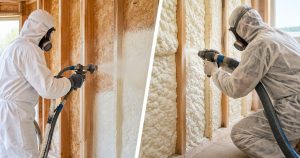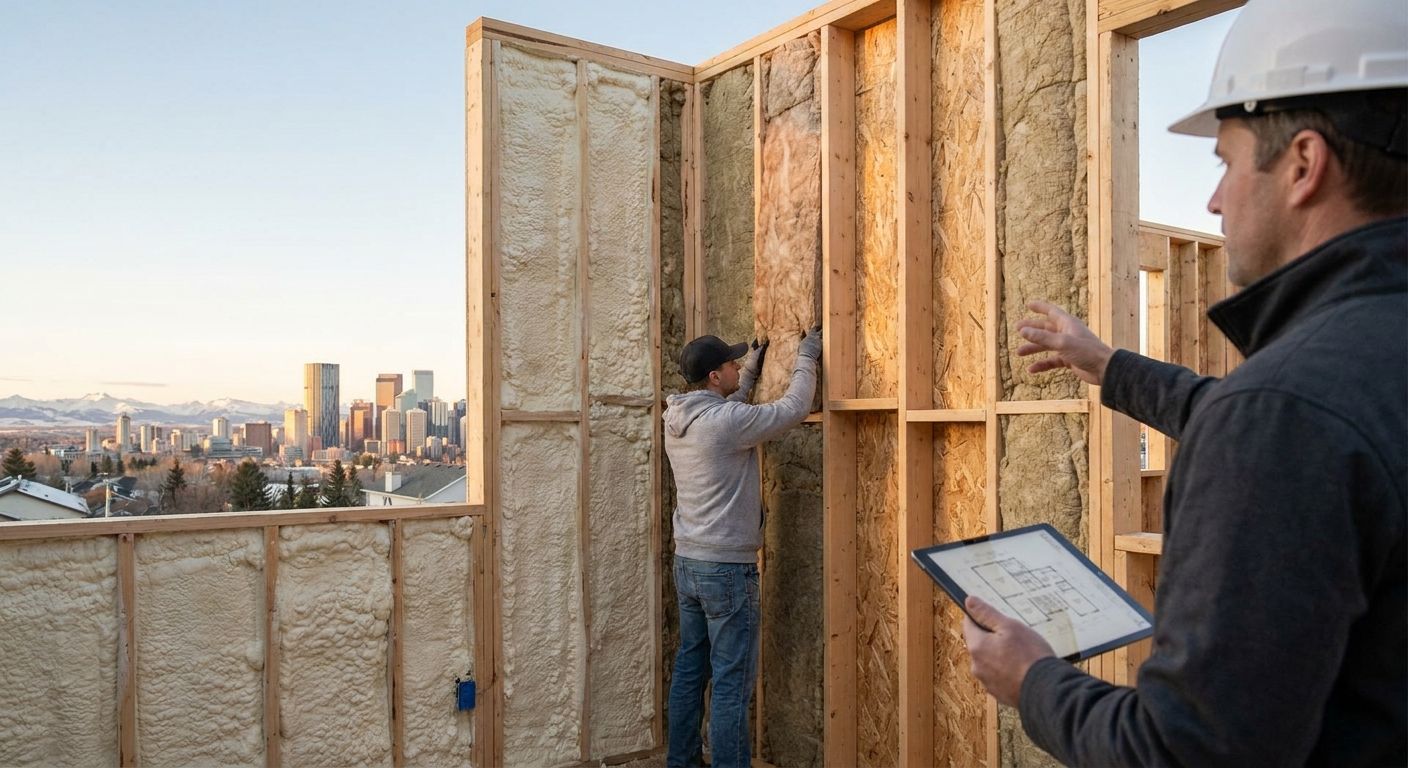
Closed-cell spray foam insulation is the best overall pick for best insulation for new construction builders calgary projects in 2026, open-cell spray foam wins for interior sound control between units, and fiberglass batt insulation is the best budget option for stud-cavity walls on tight-margin builds. This guide ranks five insulation solutions builders spec across Calgary, Okotoks, High River, and Lethbridge, with the criteria, tradeoffs, and code fit behind each pick.
- Closed-cell spray foam is the best insulation for new construction builders calgary crews spec for an air-sealed envelope in 2026.
- Open-cell spray foam is the pick for interior partition walls needing sound dampening between units.
- Blown-in attic insulation stays standard for open attic spaces and ice dam prevention on pitched roofs.
- Fiberglass batt insulation is the budget option for stud cavities when spray foam isn’t in the budget.
- Calgary sits in climate zone 7A, and NBC 9.36 sets minimum R-values builders must hit before occupancy.
Why this matters
A builder who guesses on insulation ends up either over-spending on assemblies that don't need it or under-spending on ones that fail an air-tightness test before occupancy. Calgary's climate zone 7A rating under the National Building Code's 9.36 energy provisions means every new build has a minimum R-value threshold to clear, and the insulation choice affects HVAC sizing, trade schedules, and callback risk for the next decade.
The five solutions below cover what's actually specced on Calgary-area builds in 2026, including spray foam insulation for new construction homes, where closed-cell foam has become the default envelope choice for builders trying to hit code on the first inspection.
What makes the best insulation for new construction builders
- R-value per inch and whole-assembly R-value — how much thermal resistance the material delivers per unit of cavity depth
- Air sealing performance — whether the material forms a continuous air barrier on its own or needs a separate pass
- Moisture and vapor control — critical in Alberta's freeze-thaw cycles, where trapped moisture rots framing
- Code compliance fit — how easily the assembly clears NBC 9.36 minimums without extra layers
- Installation speed — how the material fits a build schedule with multiple trades stacked back-to-back
- Cost per square foot relative to the build's budget tier
Insulation solutions at a glance
| Solution | Best for | Standout feature | Key limitation |
|---|---|---|---|
| Closed-cell spray foam | Air-sealed envelope, rim joists, foundation walls | Air seal and vapor barrier in one pass | Higher material cost than batt |
| Open-cell spray foam | Interior partition walls, sound control | Expands fully around wiring and plumbing | Not a vapor barrier on its own |
| Blown-in attic insulation | Open attic spaces, ice dam prevention | Fast, even coverage over large areas | Settles over time, no air seal alone |
| Rigid foam board (XPS/EPS) | Foundation walls, exterior sheathing | Continuous insulation, cuts thermal bridging | Needs taped seams for air sealing |
| Fiberglass batt | Stud cavities on budget builds | Lowest material cost | Gaps around wiring leak air |
1. Closed-cell spray foam insulation: best insulation for new construction builders calgary needing an air-sealed envelope
Closed-cell spray foam expands and rigidifies inside stud cavities, rim joists, and foundation walls, forming a continuous air and vapor barrier as it cures. It's the material most Calgary builders default to when the goal is clearing NBC 9.36 air-leakage targets without stacking three separate products.
Closed-cell spray foam pros:
- Delivers R-6 to R-7 per inch, the highest of any material on this list
- Air-seals and vapor-controls in a single application
- Adds rigidity to the wall assembly, useful on rim joists and foundation walls
Closed-cell spray foam cons:
- Costs more per square foot than batt or blown-in material
- Requires a licensed, insured applicator — not a trade a general crew self-installs
- Needs proper ventilation during cure before drywall can go up
Getting the depth right matters more here than with any other material on this list — see how to choose the right spray foam R-value for the depth-to-R-value math before locking a spec. Verdict: Buy for envelope assemblies where air sealing is the priority.
2. Open-cell spray foam insulation: best for interior partition walls and sound control
Open-cell spray foam expands more than closed-cell and cures softer, landing at R-3.5 per inch. It's not built to be a vapor barrier, which is exactly why it's the right call on interior partition walls where sound dampening matters more than moisture control.
Open-cell spray foam pros:
- Costs less per board foot than closed-cell
- Fills irregular gaps around wiring and plumbing runs completely
- Noticeably reduces sound transfer between rooms and shared walls
Open-cell spray foam cons:
- Lower R-value per inch means thicker cavities are needed to hit code on exterior walls
- Absorbs moisture if a roof or plumbing leak reaches it
- Doesn't replace a vapor barrier on exterior assemblies
Verdict: Buy for interior walls and multi-unit sound separation, not as the primary exterior envelope material.
3. Blown-in attic insulation: best for attic spaces and ice dam prevention
Blown-in fiberglass or cellulose gets loaded into a hopper and blown across the attic floor to a target depth, covering irregular truss layouts faster than any batt install. It's still the standard pick for open attic spaces on new builds where the geometry doesn't call for spray foam.
Blown-in attic insulation pros:
- Fast coverage across large, open attic floors
- Lower cost per square foot than spray foam
- Easy to top up later if depth settles below code minimums
Blown-in attic insulation cons:
- Settles over time, gradually losing R-value
- Doesn't air-seal penetrations, pot lights, or the attic hatch on its own
- Underperforms on rim joists and other tight, irregular spaces
On roofs prone to uneven snowmelt, depth and air sealing both matter — see best attic insulation for ice dam prevention for the combination that actually stops the problem. Verdict: Buy for open attic floors, Hold as a standalone solution anywhere air sealing is the bigger issue.
4. Rigid foam board (XPS/EPS): best for foundation walls and exterior sheathing
Rigid foam board panels install against foundation walls or as a continuous layer over exterior sheathing, adding insulation outside the stud line where thermal bridging happens. XPS runs roughly R-5 per inch and holds up well against ground moisture.
Rigid foam board pros:
- Doesn't compress or settle the way batt insulation does
- Cuts thermal bridging at studs by adding a continuous outer layer
- Resists moisture better than fiberglass in below-grade applications
Rigid foam board cons:
- Seams need to be taped to actually air-seal the assembly
- Adds a separate labor step compared to spray-applied products
- Doesn't fill irregular cavities or penetrations the way spray foam does
Verdict: Buy for foundation walls and exterior sheathing layers, Skip on framing with a lot of irregular penetrations.
5. Fiberglass batt insulation: best budget option for stud cavities
Fiberglass batt is the material most builders default to when the budget doesn't stretch to spray foam. It fits standard stud and joist cavities at R-3.1 to R-3.4 per inch and is the fastest material to source in volume.
Fiberglass batt pros:
- Lowest material cost of any option on this list
- Widely available in standard cavity depths
- Fast to install without specialized equipment
Fiberglass batt cons:
- Leaves air leaks around wiring, outlet boxes, and irregular framing
- Provides no air or vapor barrier on its own
- Compresses and loses R-value over years if installed loosely
Verdict: Hold for budget-tier builds only. Skip it when the spec calls for an air-sealed envelope on the first inspection.
Spec the right insulation before framing
Talk through your build’s assemblies and code targets with Aztec Spray Systems.
How we ranked these insulation solutions
Each material was weighed against the same six criteria: R-value per inch, air sealing performance, moisture control, code compliance fit, installation speed, and cost per square foot. Closed-cell spray foam scored highest because it's the only material that clears air sealing, vapor control, and R-value in one pass — the other four materials each trade off one of those for a lower cost or faster install.
Which insulation solution should you choose?
For a Calgary new-construction envelope where the goal is passing an air-tightness test on the first try, closed-cell spray foam is the default in 2026. Builders working interior partition walls or multi-unit sound separation should spec open-cell spray foam instead. Tight-budget builds still lean on fiberglass batt for stud cavities, paired with blown-in insulation on the attic floor and rigid foam board at the foundation. Alberta's winters punish assemblies that skip air sealing, so whatever combination gets specced, the air barrier detail matters as much as the R-value on paper.
FAQ
What is the best insulation for new construction builders in Calgary?
Closed-cell spray foam is the best overall choice for Calgary new construction in 2026 because it air-seals, vapor-controls, and delivers R-6 to R-7 per inch in a single application. Open-cell spray foam, blown-in attic insulation, rigid foam board, and fiberglass batt each fit narrower use cases within the same build.
Is spray foam better than fiberglass batt for new builds?
Spray foam beats fiberglass batt on air sealing and R-value per inch, but batt costs less and installs faster on a tight budget. Most Calgary builds use batt in secondary cavities and spray foam on the primary envelope.
How much R-value does Calgary require for new construction?
Calgary sits in climate zone 7A, where the National Building Code’s 9.36 energy provisions set attic insulation minimums around R-50, with wall assemblies held to separate effective R-value targets. The exact requirement depends on the assembly type and compliance path chosen.
Does open-cell or closed-cell spray foam work better on exterior walls?
Closed-cell spray foam works better on exterior walls because it forms its own vapor barrier at R-6 to R-7 per inch. Open-cell spray foam is better suited to interior partition walls where sound control matters more than vapor control.
Can blown-in attic insulation prevent ice dams on new builds?
Blown-in attic insulation reduces heat loss into the attic, which is one factor in ice dam formation, but it needs to be paired with proper air sealing around penetrations to actually stop uneven snowmelt. Depth alone without air sealing leaves the problem unresolved.
What insulation should go on foundation walls in a new build?
Rigid foam board or closed-cell spray foam both work on foundation walls, with rigid board offering continuous insulation outside the stud line and spray foam offering a combined air seal in one pass. The choice usually comes down to schedule and whether the wall has irregular penetrations.
Is fiberglass batt still used in Calgary new construction in 2026?
Yes, fiberglass batt is still common in secondary stud cavities on budget-tier builds, though most builders now pair it with spray foam or rigid board on the primary envelope to meet air sealing requirements. It rarely gets specced as the sole insulation material on a full build in 2026.
One last thing
Most builders on tight schedules assume they have to pick one insulation material for the whole build. The Calgary projects that pass inspection on the first try usually mix two or three: closed-cell spray foam on the envelope and rim joists, batt or blown-in fill on secondary cavities, and rigid board at the foundation — matching the material to the assembly instead of forcing one product to do every job.
Related guides