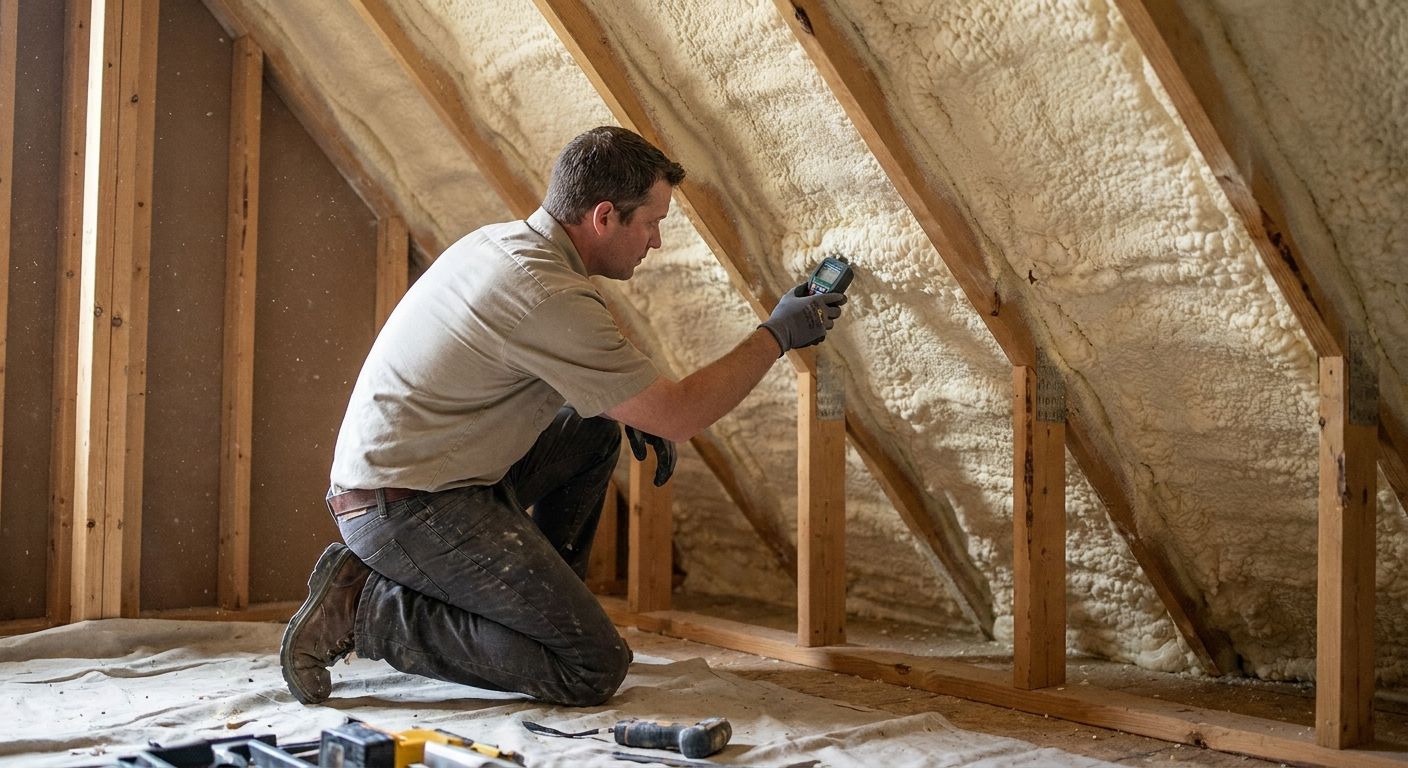
Spray foam insulation in a Calgary or Lethbridge home does most of its job quietly for decades, but a few checks each year keep the air seal, the R-value, and the structure behind it in the shape it was installed in.
- Closed-cell spray foam needs almost no upkeep, but a 10-minute visual check twice a year catches gaps, pests, and moisture early.
- Never paint over exposed foam in a garage or crawl space without a fire-rated coating — it’s a code requirement, not a suggestion.
- UV exposure breaks down uncoated foam within months, which is the #1 avoidable failure Aztec Spray Systems sees on rim joists and garage ceilings.
- Knowing how to maintain spray foam insulation properly means checking penetrations, vents, and seams — not the foam itself, which rarely degrades on its own.
- Spray foam holds its R-value for 20-30+ years when the substrate stays dry and the seal isn’t punctured by renovation work.
Why this matters
Spray foam is sold as a permanent air seal, and for the most part it is. The foam itself doesn't sag, settle, or off-gas its insulating properties the way loose-fill fiberglass can over 15-20 years.
What fails is everything around it: a new cable run punched through a rim joist, a leaking roof vent that soaks the foam from above, a rodent chewing a gap near a soffit. Alberta's swing from -30°C winters to +30°C summers puts real stress on penetrations and seams, and that's where maintenance actually matters in 2026.
Homeowners who skip the annual check usually find the problem when energy bills creep up or a musty smell shows up in the attic. Catching it early is a 20-minute fix. Catching it late is a re-insulation job.
What you'll need
- A flashlight and a phone camera for documenting problem areas
- A step ladder rated for attic or crawl space access
- A moisture meter (optional, under $40 at most hardware stores)
- A caulking gun and fire-rated intumescent coating if any foam is exposed indoors
- 20-30 minutes twice a year — spring and fall are the ideal windows
The steps
1. Do a visual walk-through of every accessible foam area
Start in the attic, then the crawl space or basement rim joists, then the garage if it's foamed. You're looking for discoloration, sagging, gaps at the edges, or anything that looks chewed or disturbed. This is the single fastest way to catch a problem before it spreads.
Common mistake: people only check the attic and skip the rim joists, which is where most moisture and pest issues actually start.
2. Check for gaps around new penetrations
Any time a plumber, electrician, or HVAC tech runs a new line through a foamed wall or joist bay, the seal around that penetration needs to be redone. A gap the width of a pencil is enough to undo the air-seal benefit of an entire wall cavity.
Seal small gaps yourself with a can of closed-cell foam sealant rated for the same application. Anything larger than a fist-sized hole should go back to a licensed contractor — that's a structural or fire-code question, not a caulk-gun fix.
3. Look for signs of moisture intrusion
Spray foam doesn't rot, but wood framing behind it can if water gets trapped against the foam instead of drying out. Look for staining, a musty smell, or foam that feels damp to the touch near roof valleys, plumbing stacks, or bath fan exhausts.
If you're unsure whether an older home's foam job included proper venting, the details matter more in older Calgary homes where original roof assemblies weren't designed around a foam retrofit.
4. Confirm exposed foam still has its protective coating
Building code in Alberta requires a thermal or ignition barrier over exposed spray foam in living spaces, garages, and some crawl spaces — usually drywall or an intumescent paint coating. Check that the coating hasn't cracked, peeled, or worn thin, especially near garage ceilings where vehicle heat and exhaust hit it directly.
Expected outcome: a solid, unbroken coating with no bare foam showing. Bare foam exposed to UV light or open flame risk is a code violation and a real fire-safety issue.
5. Inspect attic ventilation and baffles
Spray foam changes how a roof assembly breathes compared to traditional batt insulation. If your attic uses a vented assembly with baffles at the eaves, confirm they're still clear and not blocked by foam overspray or debris. Blocked baffles trap moisture at the roof deck.
Common mistake: assuming a spray foam attic doesn't need any ventilation check at all — vented and unvented assemblies have different rules, and mixing them up causes condensation problems.
6. Check crawl spaces and rim joists for pest activity
Rodents and insects occasionally tunnel along the foam-to-framing seam looking for warmth, particularly in crawl spaces with exterior access points. A flashlight scan for droppings, chew marks, or fresh tunneling twice a year is enough to catch it before it becomes an infestation.
7. Track energy bills against last year's numbers
A properly maintained spray foam job holds its performance for decades. If your heating bill jumps noticeably year over year with no change in usage, that's a signal something changed in the seal — a gap, a compressed section, or a ventilation issue — not that the foam itself has worn out.
Not sure if your foam needs a repair or a refresh?
Aztec Spray Systems inspects and re-seals existing spray foam across Calgary, Okotoks, High River, and Lethbridge.
Troubleshooting
Foam looks yellowed or brittle near a window or vent. That's UV degradation from sunlight hitting exposed foam. It doesn't spread to covered sections, but the exposed patch should get an opaque coating or trim cover to stop further breakdown.
Musty smell in the attic despite dry-looking foam. Check the roof deck above the foam line first — moisture often condenses on the wood before it's visible in the foam itself. This usually points to a ventilation mismatch rather than a foam failure.
A section of foam feels soft or compressed. This is rare with closed-cell foam but can happen if something heavy was stored against it for a long stretch. Light compression usually self-corrects; anything that stays flattened after weight is removed should be flagged for a professional look.
Higher heating bills with no obvious cause. Rule out a punctured seal first — check any area where new wiring, plumbing, or a satellite mount went in since the last check. A single unsealed penetration in a rim joist can account for a noticeable bill increase.
Pest droppings near the foam-to-framing seam. Seal the entry point from outside first, then treat the interior. Foam itself isn't a food source for rodents or insects, but they'll tunnel along it if there's an opening.
Ice damming along the roofline despite spray foam in the attic. This is almost always a ventilation or partial-coverage issue rather than a foam defect — worth reviewing against the specifics in how to know if your attic needs more insulation if it's a recurring problem.
Tools and resources
- Flashlight, moisture meter, and a step ladder for the twice-yearly walk-through
- Fire-rated intumescent coating for any exposed foam in garages or basements
- A licensed contractor for any repair beyond a pencil-width gap or a coating touch-up
- Aztec Spray Systems for inspection, re-sealing, and coating work across Calgary, Okotoks, High River, and Lethbridge
What to do next
If the walk-through turns up anything beyond a small gap you can seal yourself — soft spots, moisture staining, missing coating, or a bill spike you can't explain — get it looked at before the next Alberta winter puts more stress on the seal. A 20-minute inspection now is cheaper than a re-insulation job in February.
FAQ
How do I maintain spray foam insulation after installation?
Check accessible foam areas twice a year for gaps, moisture, and coating wear, and reseal any penetration made by later plumbing, electrical, or HVAC work. Spray foam itself needs almost no upkeep — the maintenance is really about protecting the seal around it.
Does spray foam insulation need to be recoated over time?
Only if the exposed protective coating cracks, peels, or thins, which happens more in garages exposed to heat and vehicle exhaust. Foam that’s fully enclosed behind drywall or framing never needs recoating.
Can spray foam insulation get moldy?
Closed-cell spray foam doesn’t absorb water or support mold growth the way organic materials do, but wood framing behind it can if moisture gets trapped against the foam. A musty smell usually points to a ventilation issue, not the foam itself.
How long does spray foam insulation last in Alberta homes?
Properly installed closed-cell spray foam holds its R-value for 20-30+ years with no meaningful degradation. Alberta’s temperature swings don’t shorten that lifespan as long as the seal stays intact and uncompromised.
Is it safe to run new wiring through spray foam insulation?
Yes, but the penetration needs to be resealed afterward with a matching foam sealant or professional patch. An unsealed gap around new wiring or plumbing is the most common cause of reduced performance after installation.
Why does my garage spray foam look yellow?
Yellowing is UV degradation from sunlight or heat exposure on uncoated foam, common on garage ceilings and near windows. It’s cosmetic and doesn’t spread, but the exposed area should get a proper coating to stop further breakdown.
Do I need to check spray foam insulation for pests?
A twice-yearly check for droppings or chew marks near the foam-to-framing seam is enough. Foam isn’t a food source, but rodents will tunnel along an existing gap if one exists.
What’s the difference between maintaining open-cell and closed-cell spray foam?
Closed-cell foam is denser and more moisture-resistant, so it needs less monitoring in damp areas like crawl spaces and rim joists. Open-cell foam is more vapor-permeable, which means ventilation checks matter more to prevent trapped moisture.
One last thing
The foam almost never fails on its own — every service call Aztec Spray Systems takes for a "failed" spray foam job traces back to something done after installation: a punctured seal, a missing coating, or a ventilation mismatch introduced during a later renovation. Protect the seal, not the foam, and it'll outlast the mortgage.
Related guides
- How to prepare your home for spray foam insulation day
- How to reduce energy bills with attic insulation