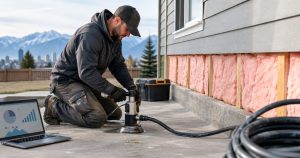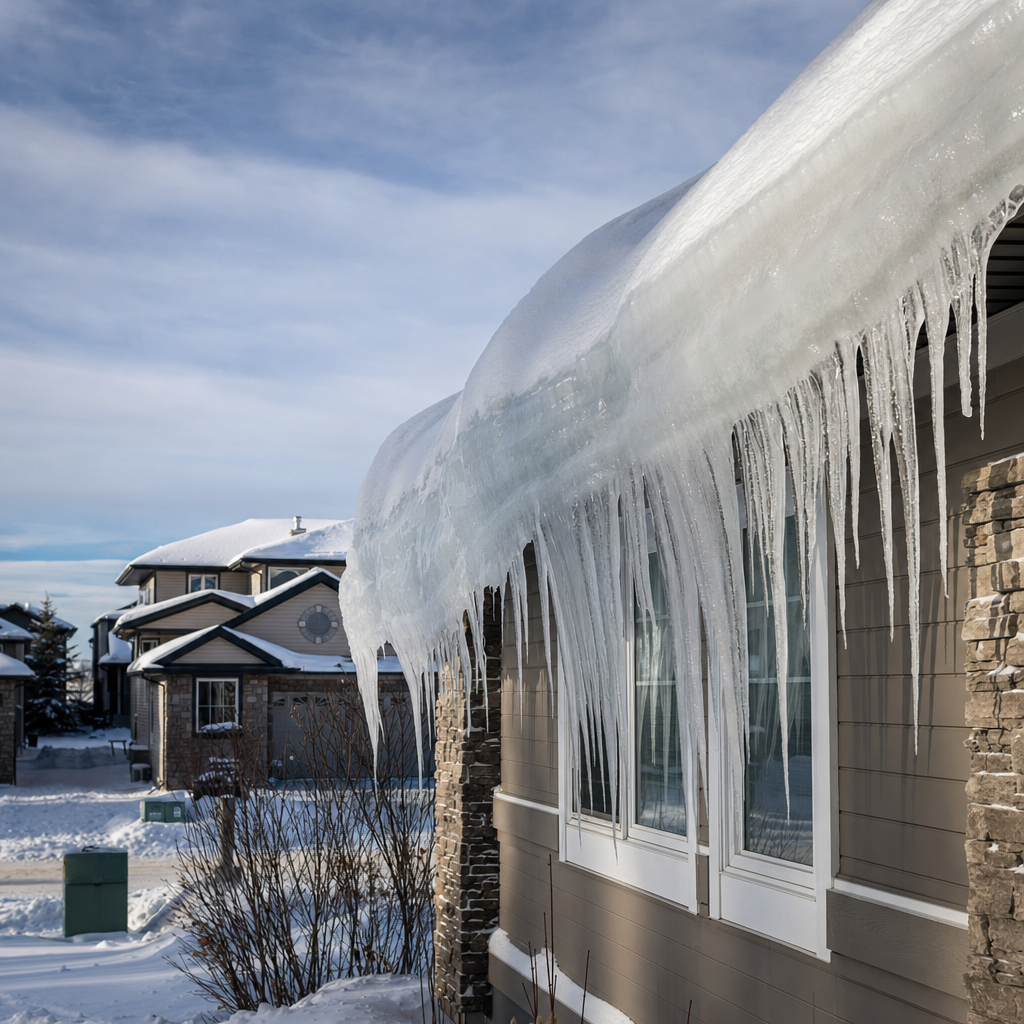
Every January, Calgary homeowners call roofers, plumbers, and contractors about the same problem: water stains on the ceiling, ice hanging off the eaves in menacing ridges, and — in the worst cases — actual leaks dripping through the drywall during a Chinook warm-up. The culprit is almost always an ice dam. And the frustrating truth is that ice dams are not a roofing problem. They are an insulation and air-sealing problem — one that starts in the attic and ends at your ceilings.
Calgary’s unique climate — combining brutal -30°C cold snaps with rapid Chinook temperature swings of 25–30°C within 24 hours — creates the most aggressive ice-dam conditions of any major Canadian city. If your attic insulation is inadequate or your air barrier is compromised, that cycling will punish your roofline every single winter. Closed-cell spray foam insulation, applied to the attic floor or the underside of the roof deck, is one of the most effective permanent solutions available — because it stops the heat escape that creates ice dams in the first place.
Quick Answer
Ice dams in Calgary form when heat escaping your attic melts rooftop snow, which refreezes at the cold eaves. Calgary’s Chinook freeze-thaw cycles make this worse than almost any other Canadian city. Closed-cell spray foam at the attic plane or roofline eliminates ice dams by sealing air leaks and insulating simultaneously — addressing the root cause rather than the symptom.
Why Do Calgary Rooftops Get So Many Ice Dams?
Ice dams are fundamentally caused by an uneven roof temperature. When your attic is poorly insulated or leaky, heat from your living space escapes upward into the attic and warms the underside of the roof deck. The roof surface above the living area rises above 0°C, even when the outdoor temperature is well below freezing. Snow on that warmed section melts and flows down toward the eaves — which sit above the unheated soffit and overhang and stay at or below the outdoor temperature. When that meltwater hits the cold eave, it refreezes. Over repeated melt cycles, that re-frozen water builds into a ridge — an ice dam — that blocks further meltwater from draining off the roof. The water pools behind the dam, gets forced up under the shingles by capillary action, and eventually finds its way through the roof deck and into your home.
What makes Calgary uniquely vulnerable to this cycle is the Chinook effect. Calgary averages 30–35 Chinook events per winter, according to Environment Canada climate data. A single Chinook can swing outdoor temperatures from -25°C to +10°C within hours. Every time that happens, any ice accumulated at the eave partially melts and then re-freezes when the Chinook passes and the temperature drops again. Over a typical Calgary winter, your roofline may experience hundreds of freeze-thaw cycles — far more than a stable cold-climate city like Edmonton or Winnipeg, where temperatures hold low for longer stretches without the dramatic Chinook-driven warming events. This is why Calgary homeowners with marginal attic insulation see ice dam damage that homeowners in similar climates simply don’t encounter.
The cascade effect extends beyond the immediate water damage. Ice dams grow heavier as each melt cycle adds to them, stressing gutters and the edge of the roof structure. When a large dam eventually dislodges — often during a Chinook when the bond between the ice and the shingles softens — it can tear away gutters, flashing, and even shingles with it. Calgary roofing companies report that Chinook-related ice dam damage is one of the most common insurance claims they see each year. Addressing the source of the problem — heat loss through the attic — is significantly less expensive than repeated storm-damage repairs.
How Ice Dams Form — and Why Your Attic Is the Root Cause
Natural Resources Canada’s authoritative guide Keeping the Heat In is direct on this point: the preferred solution for ice dams is “to keep house heat out of the attic by air sealing and insulating.” NRCan notes that large masses of ice collect at the lower edge of the roof because the attic temperature is being driven by warm air from below — and that the fix is not better drainage or heating cables, but eliminating the heat loss pathway entirely. Heating cables are an emergency measure; they treat the symptom while the underlying cause continues damaging your home every winter.
What makes attic heat loss worse than most homeowners realize is the distinction between conductive heat loss (which fibreglass batts address) and convective heat loss through air leakage. Air leakage — warm household air escaping through gaps around pot lights, plumbing stacks, electrical boxes, attic hatches, and partition top plates — can account for 5 to 30 percent of a building’s total heat load, and in older Calgary homes with unsealed attic penetrations, it is often the dominant pathway. A perfectly installed R-60 fibreglass batt ceiling does relatively little if there are 20 unsealed pot-light boxes in the living room below, each acting as a chimney for warm air into the attic. This is why NRCan specifies that the air barrier “must be continuous; holes or tears must be repaired, and penetrations sealed” — and why spray foam, which addresses both pathways simultaneously, is so effective.
How Does Spray Foam Insulation Actually Stop Ice Dams?
Closed-cell spray polyurethane foam (ccSPF) stops ice dams by eliminating the two failure modes that create them: air leakage and inadequate thermal resistance. When applied to the underside of the roof deck (creating what building scientists call a “hot roof” or conditioned attic), or when used to air-seal all attic penetrations before blown-in insulation is installed, spray foam closes the pathways through which warm household air escapes into the attic. Without that heat source, the roof deck stays at or near the outdoor temperature across its entire surface — the eaves stay no colder than the field of the roof, and the melt-refreeze gradient that creates ice dams never develops.
The Canadian Urethane Foam Contractors Association (CUFCA) highlights that properly installed closed-cell spray foam provides thermal performance that fibreglass and cellulose cannot match at the eave area — the most critical location for ice dam prevention. In a typical Calgary attic, the depth of insulation at the perimeter (above the wall plate) is constrained by the sloping roof structure, making it impossible to achieve adequate R-values with blown-in insulation alone. Spray foam applied to the underside of the roof deck at the eave provides insulating value even in a one- to two-inch space where no batt or blown-in product would perform adequately.
Beyond the eave, a full conditioned-attic spray foam installation eliminates the ventilation gap required in conventional cold-roof construction. In a conventional vented attic, the insulation is on the attic floor and the attic space itself is kept cold by soffit-to-ridge ventilation. This works well when the air barrier below the insulation is continuous — but in practice, Calgary homes with decades of accumulated penetrations (pot lights, kitchen exhausts, bathroom fans, ceiling fans, plumbing stacks) have numerous gaps. A conditioned attic — where spray foam is applied to the underside of the roof deck from eave to ridge — eliminates the dependency on a perfect air barrier at the ceiling plane, because the attic itself becomes part of the conditioned building envelope. Explore our attic insulation services page to learn which approach suits your home.
Calgary’s Chinook Climate: Why Standard Attic Insulation Falls Short
Many Calgary homeowners discover that their attic insulation meets or exceeds Alberta Building Code minimums on paper, yet they still get ice dams every winter. This is not a contradiction — it reflects the gap between compliant insulation and genuinely continuous, airtight insulation. Blown-in cellulose or fibreglass at R-60 performs beautifully as a thermal barrier when it is lying flat in a well-sealed attic. But Calgary homes, particularly those built before 2000, were constructed before air-sealing requirements were tightened under the NBC Alberta Edition’s Section 9.36 energy code, and they typically have dozens of unsealed attic penetrations. Code-compliant insulation depth with poor air sealing is significantly less effective than the nominal R-value suggests.
The Chinook dimension amplifies every weakness in the assembly. When a Chinook raises outdoor temperatures from -20°C to +5°C in an afternoon, the temperature gradient across your roof assembly reverses: suddenly the outdoor air is warmer than your attic, and any condensation that accumulated during the cold period now has the opportunity to migrate. Homes with vapour barrier deficiencies — a common issue in Calgary attics where the poly sheet was stapled to the ceiling joists but never taped at seams or sealed at penetrations — experience accelerated moisture accumulation over a winter of repeated Chinook cycling. Over years, this leads to discoloured insulation, mould on the underside of the roof deck, and prematurely degraded sheathing.
Spray foam addresses both the thermal and moisture dimensions. Closed-cell spray foam at 2 inches or more acts as a Class II vapour retarder, meeting Alberta’s vapour barrier requirements without a separate polyethylene sheet. Applied to the underside of the roof deck, it creates a continuous, monolithic barrier that Chinook-driven pressure differentials cannot compromise. Unlike poly sheeting — which requires every penetration to be individually taped and sealed, and which can tear or shift during attic access — spray foam remains intact indefinitely and requires no maintenance. Our article on how attic insulation boosts year-round comfort covers the seasonal dynamics in more detail.
What Does Alberta Building Code Require for Attic Insulation?
The National Building Code — Alberta Edition mandates a minimum of RSI 10.43 (approximately R-60) for attic insulation in residential construction. A continuous vapour barrier on the warm side of the insulation assembly is also mandatory under the code. These requirements exist precisely because Calgary’s Climate Zone 7A demands high insulation levels to prevent the heat loss that drives condensation, moisture damage, and — relevant to this discussion — ice dam formation.
It is worth noting that R-60 is a code minimum, not an optimal target. Building science research, including guidance from the City of Calgary’s Climate Ready Measures: Insulation resources, consistently recommends exceeding the code minimum in Climate Zone 7A, particularly for attic assemblies where the cost of adding more insulation is relatively low. Upgrading from R-40 to R-60 in an existing attic, for example, typically costs $1,000–$2,500 in blown-in cellulose or fibreglass — a modest investment compared to the cumulative cost of ice dam remediation, roof tear-offs, and mould treatment over a 15-year period.
If your home was built before 2012 — when the current energy code requirements came into full effect in Alberta — there is a high probability that your attic does not meet the current R-60 minimum. A quick check involves measuring the insulation depth in your attic: fibreglass batts at 12 inches deep deliver approximately R-30 to R-38; blown-in cellulose at 12 inches delivers approximately R-42 to R-48. If your insulation is less than 14–16 inches deep, you are likely below R-60 and below the current code minimum. For detailed guidance on our insulation top-up services and how spray foam air sealing integrates with a blown-in upgrade, contact our team for a free assessment.
The Financial Case: What Does Ice Dam Damage Actually Cost?
Ice dam remediation is not cheap. Emergency ice dam removal by a roofing contractor typically runs $300–$800 per occurrence in Calgary — and that does not include any repair to the underlying damage. Water infiltration behind an ice dam commonly causes damage to ceiling drywall, attic insulation (saturated fibreglass must be replaced), and in some cases the roof deck and structural framing. A moderate ice dam event — water staining, wet insulation, and minor drywall repair — typically costs $1,500–$4,000 to remediate. A severe event involving roof deck damage, mould remediation, and interior ceiling and finish replacement can exceed $15,000–$25,000.
Over the lifespan of a Calgary home, homeowners with chronically inadequate attic insulation and air sealing often spend more on ice dam damage than they would have on a properly executed attic spray foam and insulation upgrade. CUFCA data suggests that spray foam insulation reduces annual heating and cooling costs by 30–50 percent for properly treated building envelopes — a figure that does not include the avoided cost of water damage claims, which are among the leading reasons for increases in home insurance premiums in Alberta.
For Calgary homeowners eligible for energy-efficiency rebates, the economics improve further. Check our guide to Alberta spray foam insulation rebates to see which programs may offset a portion of your attic upgrade cost. And if you have questions about whether your current attic situation is likely contributing to ice dams, our spray foam FAQ covers the most common diagnostic questions.
Frequently Asked Questions
Can spray foam insulation really prevent ice dams on a Calgary roof?
Yes. Ice dams form because heat escaping your attic warms the roof deck unevenly. Spray foam applied to the attic floor or the underside of the roof deck eliminates both air leakage and heat conduction through that plane — keeping the roof deck at a uniform temperature close to the outdoors, which eliminates the melt-refreeze gradient that creates ice dams. It is the root-cause fix, not a surface treatment.
What does it cost to spray foam an attic for ice dam prevention in Calgary?
A spray foam air-sealing treatment for a Calgary attic — targeting penetrations before blown-in insulation is added — typically runs $800–$2,500 depending on attic size and the number of penetrations. A full conditioned-attic application (spray foam on the underside of the roof deck) for a 1,500 sq ft bungalow typically costs $4,000–$9,000. Both approaches deliver permanent ice dam prevention and reduce heating costs by 20–40 percent annually.
Why does Calgary get more ice dams than other Canadian cities?
Calgary’s 30–35 annual Chinook events create dramatically more freeze-thaw cycles than stable cold-climate cities. A single Chinook raises temperatures by 25–30°C in hours, melting rooftop snow that then refreezes at the eaves when the Chinook passes. Over a winter, Calgary rooftops may experience hundreds of these cycles — far more than Edmonton or Winnipeg, where temperatures hold consistently cold for longer periods.
Is spray foam the only way to stop ice dams in Calgary?
No — but it is the most effective single solution for most homes. Alternatives include: adding blown-in insulation to reach R-60 (effective if air sealing is already adequate), manually air-sealing all attic penetrations before adding insulation (labour-intensive and difficult to do completely), and improving soffit-to-ridge ventilation (helps but does not address air leakage from below). For homes with numerous penetrations or complex roof geometry, spray foam air sealing combined with blown-in insulation is typically the recommended approach.
How long does spray foam last in a Calgary attic?
Closed-cell spray foam in an attic or roofline application is rated for the life of the building — CUFCA-registered contractors typically provide 25-year thermal performance warranties, and functional life is commonly cited as 80–100 years. It will not settle, compress, or shift, and unlike fiberglass batts, it will not lose R-value when exposed to Chinook-driven humidity swings. Once installed, it requires no maintenance or re-application.
How Aztec Spray Systems Helps
Aztec Spray Foam Insulation Systems specializes in exactly the kind of attic and roofline work that eliminates ice dams in Calgary homes permanently. Whether your house needs a targeted spray foam air-sealing pass before a blown-in insulation top-up, or a full conditioned-attic closed-cell application on the underside of the roof deck, our team will assess your situation and recommend the right approach for your budget and your home’s construction.
We serve residential homeowners across Calgary and the surrounding area with spray foam insulation and attic insulation services. Every assessment includes a free look at your current attic situation, an honest evaluation of whether ice dams are likely, and a clear quote for the most cost-effective solution. We also work with commercial clients — if you manage a warehouse, agricultural building, or industrial facility in the Calgary area, our commercial spray foam team can assess your roof assembly and condensation risks as well.
Stop paying for ice dam repairs every winter. Call us at (403) 830-7669 or use our contact page to book your free, no-obligation assessment. We will tell you honestly whether spray foam is the right solution for your home — and exactly what it will take to make your Calgary roof ice-dam-proof for good.