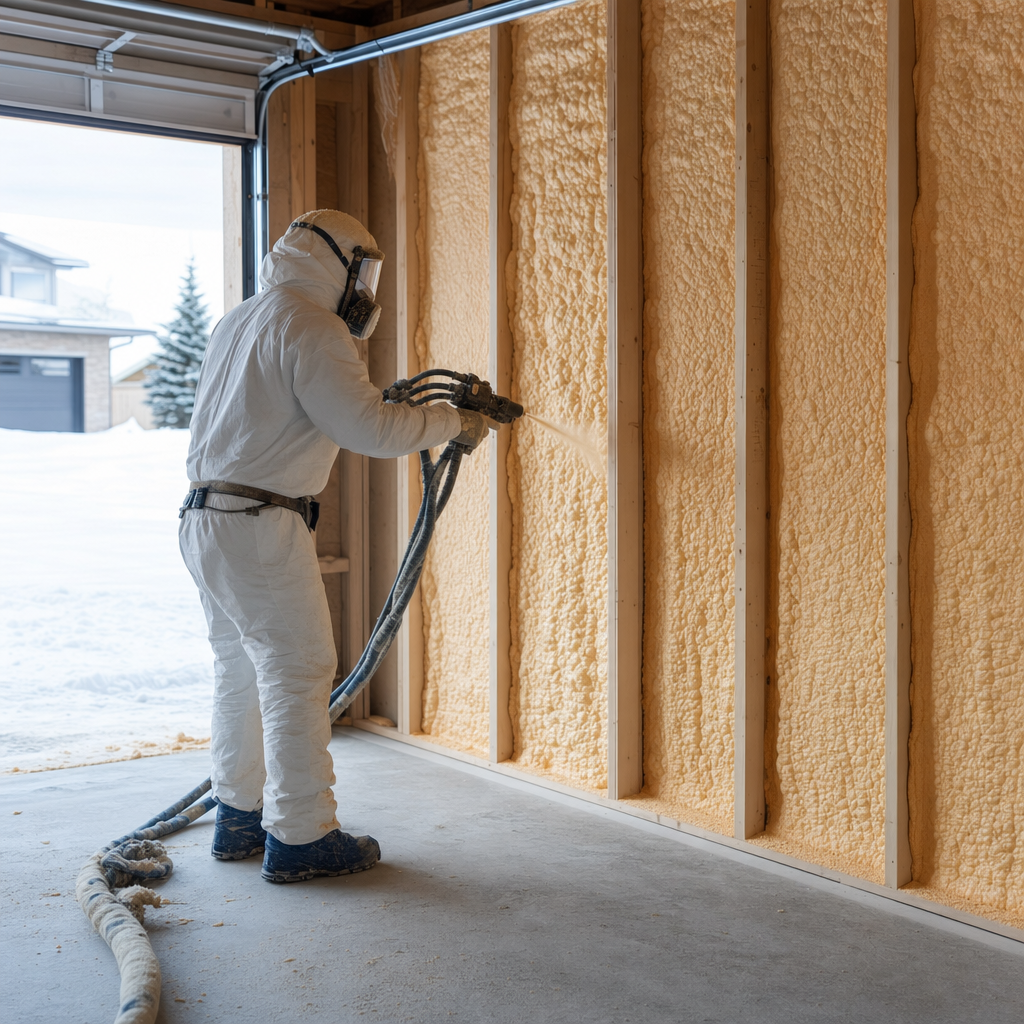
Calgary winters regularly hit -30°C, and when they do, an uninsulated detached garage becomes a glorified freezer. Tools seize up. Car engines struggle to turn over. A weekend woodworking project becomes unthinkable before October and not again until May. Yet most Calgary detached garages are built with bare stud walls and zero insulation — because it saves money at the time of construction, and because the homeowner figures they will “deal with it later.” Later has a way of becoming never, until the first January cold snap reminds you just how uncomfortable later costs.
The better path is closed-cell spray foam insulation — applied to walls, ceiling, and around penetrations in a single day — which transforms a drafty, unheated shell into a comfortable, year-round workspace. Unlike fibreglass batts, closed-cell spray foam bonds directly to the structure, seals every air leak, acts as its own vapour barrier, and delivers roughly R-6 per inch of thickness. In a Calgary climate rated Climate Zone 7A, that combination is not just convenient — it is the most effective solution available for a heated detached garage.
Quick Answer
Closed-cell spray foam is the best insulation for a heated detached garage in Calgary. At R-6 per inch, it meets Alberta Building Code minimums — RSI 3.08 (R-22) for walls and RSI 6.0 (approx. R-34) for ceilings — in a single application while simultaneously creating an airtight seal and vapour barrier that fiberglass batts cannot match.
Why Are Calgary Homeowners Spray-Foaming Their Detached Garages?
A detached garage is one of the most underutilized assets on a Calgary property — not because homeowners do not want to use it, but because it is simply too cold for too long. According to Environment Canada climate normals, Calgary averages around 5,000 heating degree-days per year, placing it firmly in Climate Zone 7A. That means five to six months of temperatures cold enough to make an uninsulated space completely inhospitable for anything other than frozen storage. A garage that cost $40,000 or more to build sits idle more than half the year because $3,000–$8,000 worth of insulation was never installed.
The shift toward home workshops, home gyms, and multi-use spaces has made this calculation even more visible. Calgarians are converting their detached garages into heated shops, studios, and hobby spaces at a growing rate — and the first question any contractor asks is: “What’s the insulation situation?” The answer, in most Calgary detached garages built before 2010, is “nothing, or minimal fibreglass batts that sag and compress.” Spray foam changes that equation permanently. A properly spray-foamed garage with a modest heater can maintain a comfortable working temperature even on -30°C nights, because the foam eliminates the air infiltration and heat loss that a batt-and-poly system cannot prevent.
There is also a moisture dimension that Calgary’s climate makes particularly relevant. Chinook events — the warm, dry western winds that raise Calgary temperatures by 20–30°C in a matter of hours — cycle the garage through dramatic swings in temperature and relative humidity. Fibreglass batts, when exposed to this cycling, trap moisture between the batt and the vapour barrier, encouraging condensation, mould, and eventually the degradation of the wall assembly. Closed-cell spray foam bonds to the sheathing, eliminating the gap where condensation forms. The result is a garage that stays healthier as well as warmer. For more information on how spray foam handles Calgary’s unique climate, see our spray foam insulation services page.
What Does Alberta Building Code Require for a Heated Detached Garage?
The National Building Code — Alberta Edition (NBC AE) is clear on this point: if a detached garage is to be heated, it must be insulated. An unheated detached garage carries no insulation requirement, but the moment you install any form of heating — whether a gas-fired unit heater, electric baseboard, or in-floor radiant system — the building must meet the energy performance standards of Section 9.36. The City of Calgary’s Alberta Energy Code guide for houses and small buildings outlines the applicable requirements for your permit application.
For roof and ceiling assemblies above a heated detached garage, NBC AE Section 9.25.2.1 requires a minimum effective thermal insulation value of RSI 6.0 — roughly R-34. For above-grade framed walls, the code minimum is RSI 3.08 (R-22). These are floor-level requirements, not targets. In a Climate Zone 7A environment with -30°C cold snaps and Chinook-driven humidity swings, building to code minimum means your heater will run continuously on cold days and your energy bill will reflect it. Most spray foam contractors and building scientists recommend targeting RSI 8–10 (R-45 to R-57) for ceilings and RSI 4–5 (R-24 to R-30) for walls in Calgary garages to achieve genuine comfort and reasonable operating costs.
Closed-cell spray foam makes it easy to exceed these minimums even in constrained stud cavities. In a standard 2×6 wall with a 5.5-inch cavity, closed-cell foam at full depth delivers approximately R-33 — well above the R-22 wall minimum — without any additional layers of board insulation. For the ceiling, two to three inches of closed-cell foam applied to the underside of the roof deck, combined with the air-sealing benefit, achieves both thermal and moisture performance that far exceeds what a blown-in or batt approach can deliver in the same space. If you have questions about what your specific garage project requires, our spray foam FAQ covers many of the most common permit and specification questions.
Closed-Cell vs. Open-Cell Spray Foam for Calgary’s Climate
Both closed-cell and open-cell spray polyurethane foam are legitimate insulation materials, but for a Calgary detached garage, closed-cell is the clear recommendation — and the Canadian Urethane Foam Contractors Association (CUFCA) consistently advocates for closed-cell in applications where moisture control and high R-value-per-inch are critical. The difference matters enormously in a garage context.
Open-cell spray foam is a softer, lower-density material with an R-value of approximately R-3.5 to R-4 per inch and an open-cell structure that allows water vapour to pass through. In a heated interior space — a finished basement, for example — this is manageable, because a separate vapour barrier can be applied. In a garage, where the wall assembly is often exposed and where Chinook swings produce dramatic humidity fluctuations, open-cell foam’s vapour permeability becomes a liability. Without a properly installed, continuous polyethylene vapour barrier, moisture can migrate into the wall assembly during cold periods, condense on the cold sheathing, and create the same rot and mould risk you were trying to avoid.
Closed-cell spray foam solves both problems simultaneously. At R-6 per inch — nearly double the open-cell R-value — it hits Alberta Building Code minimums in thinner applications, leaving more of the stud cavity available. More importantly, closed-cell foam at 2 inches or more acts as a Class II vapour retarder, meeting Alberta’s vapour barrier requirements without a separate poly sheet. The Natural Resources Canada guide Keeping the Heat In explicitly recognizes spray foam as an effective combined insulation and air-barrier system — a designation that no batt product can claim. For a detached garage in Calgary, that all-in-one performance profile is exactly what the application demands.
Where Should You Apply Spray Foam in Your Garage? A Priority Guide
Not every square foot of a detached garage delivers the same return on insulation investment. Understanding where heat is lost most aggressively lets you prioritize — though for a garage you plan to heat year-round, a whole-envelope approach is almost always the right call. The table below outlines the key areas and the rationale for each.
| Area | Why It Matters | Recommended Approach |
|---|---|---|
| Ceiling / Roof Deck | Heat rises; uninsulated ceilings lose more BTUs per hour than any other surface in winter. | 3–5 inches of closed-cell foam on underside of roof deck (RSI 6.0 minimum per code). |
| Exterior Walls | Exposed studs and sheathing in a Calgary winter are a major thermal bridge and air leakage pathway. | 2–4 inches of closed-cell foam in stud cavities; exceeds RSI 3.08 minimum at 3.5 inches (R-21). |
| Rim Joists & Band Joists | Gap between the wall framing and the foundation; a significant source of air infiltration and cold-floor effect. | 2 inches of closed-cell spray foam seals and insulates in one step. |
| Around Overhead Door Frame | The overhead door itself is a weak point; the frame and header above it often have large gaps and cold bridges. | Spray foam around the door frame perimeter; upgrade door seals. The door panel itself requires a separate insulated door upgrade. |
| Concrete Slab | An uninsulated concrete slab in a -30°C Calgary winter is a massive thermal sink; in-floor radiant or insulated subfloor is most effective, but slab edge insulation helps. | Spray foam at the perimeter slab edge where it meets the framing; consider rigid board under a floating subfloor if a finished floor is planned. |
One area that surprises many Calgary homeowners is the overhead door frame. The garage door itself — especially an older single-skin steel door — is a significant heat-loss source, but it is the frame around it that spray foam addresses most effectively. Large gaps between the rough opening framing and the door jamb are common in older garages and can account for as much heat loss as a missing section of wall insulation. Two inches of closed-cell spray foam applied around that perimeter seal these gaps permanently and add thermal resistance to the header above the door — the coldest part of most garage openings.
What Does It Cost to Spray Foam a Detached Garage in Calgary?
Closed-cell spray foam for a garage in Calgary typically runs $3.00–$5.00 per square foot of surface area, depending on the thickness specified, the complexity of the space (attic trusses vs. flat ceiling, exposed vs. finished walls), and current material costs. For a standard 24×24 foot (576 sq ft) two-car garage, spraying the ceiling at three inches and the four walls at two inches covers roughly 1,400–1,600 square feet of surface, putting the installed cost in the $4,200–$8,000 range for most Calgary projects in 2026.
That figure looks different when weighed against the alternative. An unheated, uninsulated garage that you cannot use for six months a year is a sunk cost every single winter. A garage that you can heat to a comfortable temperature — but are doing so through poorly insulated walls and a leaky ceiling — pays its heating cost twice: once at the gas meter, and again every time a freeze-thaw cycle works moisture into the wall assembly. The City of Calgary’s Climate Ready Measures: Insulation page also notes that improved building envelope insulation is one of the highest-ROI investments available to Calgary homeowners — reducing energy consumption while improving comfort simultaneously.
Spray foam insulation for a detached garage is generally not eligible for the Canada Greener Homes Grant on its own (the program targets the primary residence), but if your garage is attached to your home or if you are completing a broader home retrofit, some measures may qualify. Our Alberta Homeowners’ Guide to Spray Foam Insulation Rebates walks through the current rebate landscape in detail. And because the insulation investment improves the thermal performance of the entire property, many homeowners find that the energy savings on the garage — particularly on a heated shop with a separate gas meter — justify the cost outright within five to seven years.
Frequently Asked Questions
How much does it cost to spray foam a two-car detached garage in Calgary?
For a typical 24×24 foot (two-car) detached garage in Calgary, closed-cell spray foam for the ceiling and walls typically runs $4,200–$8,000 installed in 2026, depending on insulation thickness and the complexity of the ceiling structure. Closed-cell foam costs $3.00–$5.00 per square foot of surface area. Request a free on-site quote for an accurate number — garage layouts vary significantly.
Do I need a building permit to insulate my detached garage in Calgary?
If you are adding a heating system to a previously unheated detached garage, a building permit is typically required in Calgary, and the insulation must meet National Building Code — Alberta Edition minimums (RSI 3.08 for walls, RSI 6.0 for the ceiling). For insulation-only work in an already-heated space, permit requirements vary — check with the City of Calgary’s Development Services before starting.
Is closed-cell spray foam safe for a garage workshop I use regularly?
Yes — once cured (typically 24 hours after application), closed-cell spray foam is inert, non-toxic, and safe for occupied spaces. During installation, the garage must be vacated and ventilated. Aztec Spray Systems follows CUFCA-certified installation protocols and will advise on the appropriate re-entry time for your specific project.
Can spray foam be installed in a metal or steel-frame garage in Calgary?
Absolutely. Closed-cell spray foam adheres directly to steel framing, metal wall panels, and corrugated roof decks — making it ideal for steel-building workshops and agricultural shops common on Calgary acreages. The foam bonds to the metal surface, eliminating the air gaps that cause condensation on cold steel, which is one of the most common moisture problems in uninsulated metal buildings.
How long does spray foam last in a garage environment?
Properly installed closed-cell spray foam is one of the most durable insulation materials available — CUFCA members typically offer 25-year thermal performance warranties, and the material’s functional lifespan in a stable wall or ceiling assembly is often cited as 80–100 years. It will not sag, compress, or settle like fibreglass batts, and it does not absorb moisture or support mould growth.
How Aztec Spray Systems Helps
Aztec Spray Foam Insulation Systems has been transforming Calgary detached garages, backyard shops, and agricultural buildings into comfortable, year-round workspaces for years. We install closed-cell spray polyurethane foam that meets and exceeds Alberta Building Code requirements — addressing ceiling assemblies, exterior walls, rim joists, and door frame perimeters in a single crew visit. Every project is custom-scoped to your garage’s layout, your intended use, and your budget.
We serve Calgary and the surrounding area for both residential spray foam projects — garages, basements, attics, and new construction — and commercial and agricultural buildings including large steel-frame shops and warehouses. If you are ready to stop losing your garage to the Calgary winter, we would love to help. Quotes are free and come with no obligation.
Call us at (403) 830-7669 or visit our contact page to request your free, no-obligation quote. Our team will assess your garage, recommend the right foam type and thickness for your goals, and give you a clear, detailed estimate — usually within 24 to 48 hours.