You’ve done your research on spray foam insulation for your Calgary home — the R-6 per inch closed-cell performance, the air-sealing that eliminates -30°C cold snap drafts, the single-step vapour barrier that satisfies Alberta’s building code. Then a neighbour mentions “toxic fumes” or shares a headline about people who had to abandon their homes after a bad installation, and the confidence evaporates. The truth about spray foam safety is more nuanced than either camp suggests. This guide gives you the actual facts, what to ask your contractor, and why professional installation makes all the difference.
Quick Answer
Professionally installed spray foam insulation is safe for Calgary homes and families. Off-gassing of isocyanates and VOCs occurs during the 24–72-hour curing window immediately after application — occupants must stay out during this time. Once fully cured, spray foam becomes chemically inert and poses no ongoing health risk. Nearly all documented safety problems trace back to improper DIY installation.
What Chemicals Are in Spray Foam Insulation, and Why Do They Matter?
Spray foam insulation is a two-component product — commonly called the A-side and B-side — that must be mixed in precisely calibrated proportions at the spray gun tip. The A-side contains methylene diphenyl diisocyanate (MDI), an isocyanate compound. The B-side contains polyols, blowing agents, catalysts, and flame retardants. When both sides are mixed at the correct 1:1 ratio and at the proper application temperature, they react to form a stable, inert polyurethane foam that adheres to framing and substrate and cures in seconds to minutes depending on ambient conditions.
The chemical that raises the most legitimate safety questions is the isocyanate on the A-side. Isocyanates are known respiratory sensitizers: at sufficient airborne concentrations, they can irritate the eyes, nose, throat, and lungs, and in some cases trigger asthma-like responses in people who are sensitized to them. This is not a theoretical concern — isocyanates are among the leading causes of occupational asthma worldwide when workers are repeatedly exposed without adequate respiratory protection. However, this risk is specific to the uncured material during and immediately after application. The Canadian Urethane Foam Contractors Association (CUFCA) sets clear safety standards: occupants — including pets — must not re-enter the home until at least 24 hours after spray foam work is complete.
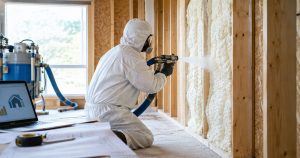
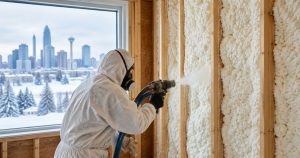
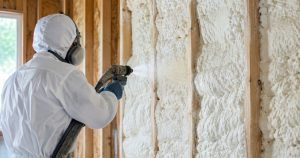
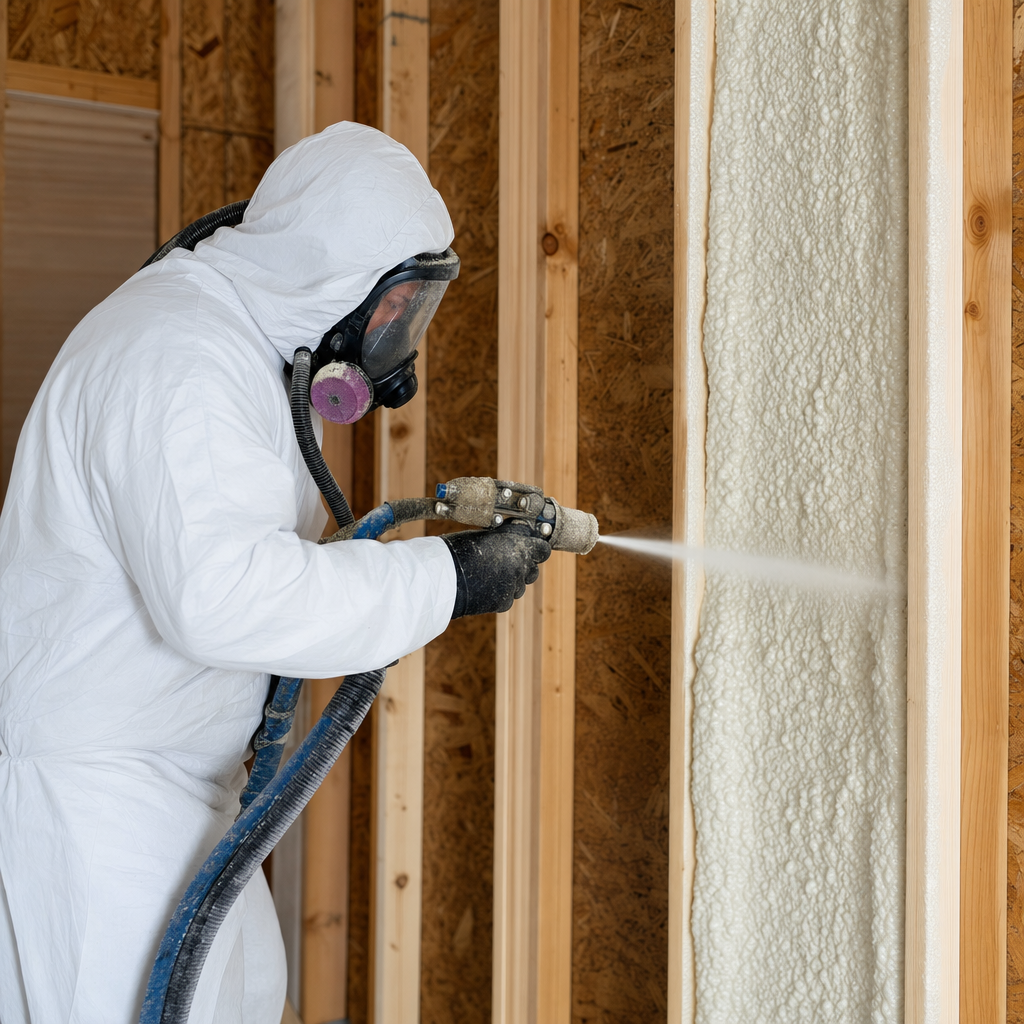
Professional spray foam contractors are required to wear supplied-air respirators (full-face airline or SCBA units), Tyvek full-body suits, and chemical-resistant gloves throughout every application. This is not equipment a homeowner can approximate with a hardware store respirator. The protection required is industrial-grade, and it exists precisely because the chemicals are potent during application — and entirely harmless once the reaction is complete.
Is Spray Foam Insulation Safe Once It Has Cured?
Yes — once spray foam has fully cured, it is chemically inert. The polyurethane matrix is a stable polymer that does not continue to off-gas, does not emit VOCs into the living space, and does not react with the water vapour, temperature swings, or humidity cycles that Calgary homes experience year-round. The U.S. Environmental Protection Agency has noted that the primary concern with spray foam is the off-gassing window during the first 24–72 hours of curing; after that, properly cured foam is considered safe for residential occupancy.
The critical qualifier is “properly cured.” If the A-side and B-side chemicals are mixed in the wrong ratio — which happens when equipment is poorly calibrated or when consumer-grade DIY kits are used in cold conditions — unreacted MDI isocyanate can remain in the foam matrix indefinitely, continuing to off-gas long after the foam looks and feels set. This is the source of virtually every documented case of spray foam-related indoor air quality problems that has received media attention in Canada. Calgary’s winter climate adds a specific wrinkle: spray foam chemicals must be maintained within a precise temperature range during storage, transport, and application — typically between 15°C and 35°C for both components and the substrate. Professional contractors use heated hoses, temperature-controlled proportioning rigs, and calibrated equipment that maintains these parameters regardless of outdoor conditions. A homeowner working from a hardware store kit in a -10°C unheated basement is operating well outside the parameters the chemistry requires for safe, complete curing.
Once fully cured, closed-cell spray foam also improves indoor air quality by sealing the infiltration pathways that allow outdoor pollutants, pollen, soil gases, and — critically in many Calgary neighbourhoods — radon to enter living spaces. Calgary’s geology creates elevated radon potential in communities across the city; spray foam’s continuous air barrier at the rim joist, basement walls, and foundation penetrations is a meaningful radon mitigation tool in addition to its insulating function. For more on this, see our guide on how spray foam controls condensation and indoor air quality in Calgary.
How Long Do You Need to Stay Out of Your Calgary Home After Spray Foam?
The minimum re-entry window is 24 hours from the completion of spray foam work, per CUFCA guidelines — and many contractors and health authorities recommend 48–72 hours for larger projects, closed spaces, or homes with limited natural ventilation. The reasoning is straightforward: off-gassing is most intense in the first hours after application, and the rate of chemical release drops sharply as the foam cures. By 24 hours, the vast majority of VOC release is complete for a properly mixed and applied installation. By 72 hours, any residual off-gassing has dissipated to levels that ambient ventilation easily handles.
Professional installers typically take active steps to accelerate this process: they open windows and run exhaust fans during and immediately after application to flush the space, and many will set up temporary ventilation equipment to draw air through the treated area. Your contractor should give you a specific re-entry time recommendation based on your project — a rim joist job in a vented crawlspace is very different from a basement wall application in a tightly built newer Calgary home where mechanical ventilation is the only air exchange available.
Plan your schedule around the re-entry window. Most Calgary homeowners arrange to stay with family or at a hotel for one to two nights around the project. Timing also matters seasonally: summer and fall projects allow for easy window ventilation and milder outdoor conditions. If you schedule a fall project before freeze-up, you’ll also see the benefit of a fully sealed and insulated basement before the first hard cold snap. During the quoting process, your contractor at Aztec Spray Systems can walk you through exactly what to expect — including timing and any preparation steps before the crew arrives.
What Makes Professional Spray Foam Safer Than DIY Foam Kits?
Two-component spray foam kits are available at home improvement stores, and they appear to offer a less expensive path to air sealing and insulation. But for Calgary homeowners weighing safety, performance, and long-term results, several concrete factors make professional installation the clearly superior choice.
Chemical ratio control: Professional proportioning rigs pump A-side and B-side in precisely calibrated ratios and heat both components and the substrate to the required reaction temperature. Consumer kits have no temperature control and are highly susceptible to cold-weather ratio drift, clogged mixing tips, and uneven pressure — all of which produce off-ratio foam that remains partially unreacted and continues emitting isocyanates. In a Calgary January, achieving the 15–25°C substrate temperature required for proper reaction is essentially impossible with a consumer kit in an unheated space. Thickness and coverage uniformity: Professional installers use spray patterns, pass gauges, and experience to apply consistent thickness across the entire surface. DIY application tends to be uneven, producing thin spots that compromise both R-value and air sealing — potentially below the minimum values required by Alberta’s building code. Worker safety: Applying spray foam without supplied-air respiratory protection carries genuine occupational risk. Isocyanates are among the most potent respiratory sensitizers known; a single high-exposure event can permanently sensitize the respiratory system, making any future isocyanate exposure a trigger for severe reactions. An N95 dust mask provides zero protection against isocyanate vapour.
For a complete breakdown of where professional installation matters most and why the cost difference is justified, see our article on DIY versus professional spray foam in Calgary. The short version: the cost difference between DIY and professional spray foam is real, but so is the performance and safety gap — and the documented failure modes of DIY installation in cold climates are exactly the cases that make headlines about spray foam being “unsafe.”
Does Spray Foam Affect Long-Term Indoor Air Quality in Calgary Homes?
Once fully cured, closed-cell spray foam does not emit VOCs, off-gas, or degrade in ways that affect indoor air quality. This is consistent with decades of documented use in residential construction across Canada’s cold climate zones. The foam is also mould-resistant by nature: closed-cell spray foam does not absorb moisture, which eliminates the damp substrate that mould requires to establish. In Calgary’s climate — where spring thaw and summer humidity can cause condensation on cold basement surfaces — this is a significant advantage over fiberglass batts, which can absorb and hold moisture against framing and create ideal conditions for mould growth.
For homeowners concerned about long-term indoor air quality, the most important post-installation consideration is balanced mechanical ventilation. When you seal a home tightly with spray foam, you reduce the uncontrolled air infiltration that previously (and inefficiently) provided some fresh air exchange. A properly sized heat recovery ventilator (HRV) ensures that fresh air exchange continues in a controlled, energy-efficient way. Most professional spray foam contractors in Calgary will raise the HRV question during the assessment — if they don’t, ask. Health Canada’s indoor air quality guidance recommends mechanical ventilation in tightly sealed homes precisely to maintain healthy air exchange rates.
For commercial buildings — warehouses, agricultural facilities, and industrial spaces — spray foam safety requirements scale with project size, but the underlying chemistry and re-entry principles are identical. Commercial spray foam installations use the same professional two-component systems as residential work, with enhanced safety protocols appropriate to larger application runs. The structural and condensation-control benefits discussed in our guide to closed-cell foam structural benefits apply equally to commercial applications.
Frequently Asked Questions
Is spray foam insulation safe for my family and pets in Calgary?
Yes — professionally installed spray foam is safe once it has cured. Occupants and pets must stay out of the home for a minimum of 24–72 hours after application while off-gassing occurs. Once fully cured, the foam is chemically inert and has no ongoing impact on indoor air quality. Professional installation with correct chemical ratios and substrate temperature is the key to safe results.
How long does spray foam off-gassing last in a Calgary home?
The most intensive off-gassing occurs in the first 24 hours after application, with most VOC release complete by 48–72 hours for a properly mixed installation. Professional contractors actively ventilate the space during and after application to accelerate clearance. Staying out of the home for at least 24–48 hours after a professional job — and up to 72 hours for larger projects — is the standard re-entry recommendation under CUFCA guidelines.
Why is professional spray foam safer than DIY kits for Calgary homes?
Professional rigs control chemical ratios precisely and heat both components to the correct reaction temperature — essential in Calgary’s cold climate. Consumer kits are prone to ratio errors, clogged tips, and cold-weather failures that leave unreacted isocyanates in the foam, causing ongoing off-gassing. Professional applicators also wear supplied-air respirators that consumer DIYers cannot safely replicate. Improper DIY installation is the root cause of virtually all documented spray foam safety problems.
Does spray foam insulation cause mould in Calgary homes?
No — properly installed closed-cell spray foam is mould-resistant. It does not absorb moisture, which eliminates the damp substrate mould needs to grow. In Calgary’s climate, where spring thaw creates condensation risk on cold basement surfaces, closed-cell spray foam is actually a mould-prevention measure compared to fiberglass batts, which can hold moisture against wood framing. Correct installation seals the air and vapour pathway that drives condensation in the first place.
Do I need extra ventilation after spray foam insulation is installed in my Calgary home?
Yes — a tightly air-sealed home needs a mechanical ventilation system (typically an HRV — heat recovery ventilator) to maintain healthy fresh air exchange. When spray foam closes off the uncontrolled air leakage pathways that previously brought in outdoor air, controlled mechanical ventilation takes over that function efficiently. Your contractor should assess your existing ventilation during the quote; Health Canada recommends mechanical ventilation for all tightly sealed homes.
How Aztec Spray Systems Keeps Your Calgary Home Safe and Warm
At Aztec Spray Systems, we install spray foam insulation using professional two-component rigs, calibrated to the correct ratio and temperature regardless of Calgary’s outdoor conditions. Every project includes a re-entry protocol briefing so your family knows exactly when it’s safe to return home — and our crew actively ventilates the space before leaving. We carry full insurance and follow CUFCA safety standards on every job, residential or commercial.
Whether you’re insulating a basement, rim joists, attic, detached garage, or a commercial building, we bring the expertise and equipment to do the job safely and correctly. Serving Calgary and the surrounding area — call us for a free, no-obligation quote at (403) 830-7669 or reach us through our contact page. You can also find answers to common spray foam questions in our FAQ section.