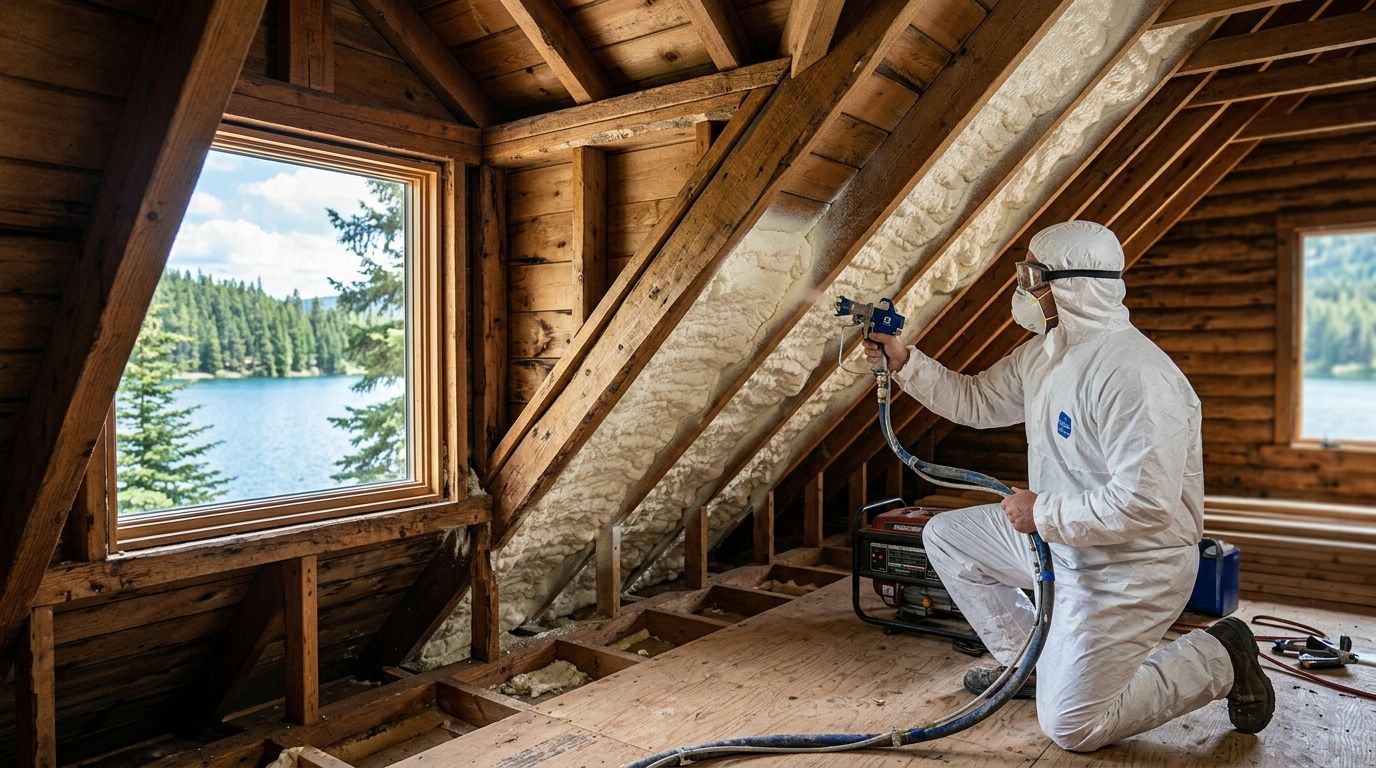
Cottage and cabin spray foam insulation is a two-part polyurethane spray applied to rim joists, crawl spaces, attics, and exterior walls with the aim of sealing air leaks that cause freeze-thaw damage, pipe bursts, and mold in seasonally-used properties. Unlike a full-time house, a cottage sits empty and unheated for weeks at a stretch, so the insulation has to hold performance through repeated freeze-thaw cycles rather than a steady indoor climate, and it has to work with older, often unfinished framing.
- Spray foam insulation for cottages seals rim joists and crawl spaces where cabins lose the most heat between visits.
- Closed-cell foam resists moisture at R-6 to R-7 per inch, the better choice for crawl spaces and foundations.
- Open-cell foam runs R-3.5 to R-4 per inch and works well in attics and interior stud walls.
- Aztec Spray Systems services rural and acreage properties across Calgary, Okotoks, High River, and Lethbridge, Alberta in 2026.
- Skipping air sealing before winter shutdown is the most common mistake cottage owners make.
Why spray foam insulation matters for cottages and cabins
A cottage that sits unheated from October through April behaves differently than a full-time home. Pipes freeze when there's no continuous heat load pushing back against outside temperatures, and unsealed rim joists let cold air pour straight into the crawl space where the water lines run. Fiberglass batts sag and lose R-value once moisture gets behind them, which happens often in cabins with no vapor control and seasonal humidity swings between a closed-up winter and a damp spring opening.
Rural and acreage properties around Calgary, Okotoks, High River, and Lethbridge share this problem even without a lake view — rural properties with irregular occupancy patterns lose heat the same way a lake cabin does. Spray foam air-seals and insulates in a single application, which matters more for a building that isn't monitored daily than it does for a house someone lives in year-round.
Assess your cottage's insulation gaps first
Before any foam goes on, find out where the building is actually losing heat. A cottage built in stages over 20 or 30 years often has three or four different insulation types stacked on top of each other, none of them sealed to the next.
- Walk the crawl space or foundation with a flashlight looking for daylight around the rim joist
- Check the attic hatch and any pot lights for gaps around the framing
- Feel for drafts at window and door casings on a cold, windy day
- Look for water staining or frost on the underside of roof sheathing
- Note any spots where mice or squirrels have chewed insulation or wiring
Seal the building envelope before adding insulation
Air sealing has to happen before or during insulation, not after. A cabin with new batts over an unsealed rim joist still loses heat at the same rate, because the air simply moves around the insulation instead of through it.
- Caulk sill plates and top plates where framing meets foundation
- Weatherstrip exterior doors and any hatch covers to the attic
- Foam-fill gaps around plumbing and electrical penetrations
- Where the gaps are irregular or numerous, spray foam closes them and insulates in the same pass, which is faster than caulking dozens of individual joints by hand
Choose the right spray foam for cabin framing
Open-cell and closed-cell foam behave differently, and cottages usually need both in different spots. Closed-cell foam runs R-6 to R-7 per inch and resists water, which makes it the right call for crawl spaces, rim joists, and any wall facing ground contact. Open-cell foam runs R-3.5 to R-4 per inch, costs less per board foot, and works well in attic roof decks and interior stud cavities where moisture exposure is lower.
- Use closed-cell foam below grade or anywhere ground moisture is a factor
- Use open-cell foam for attic roof decks and above-grade wall cavities
- Match foam thickness to the spray foam R-value needed for the framing depth you have
- Confirm the foam formulation is rated for unconditioned or intermittently-heated spaces, common in cabin builds
Insulate the rim joist and crawl space against freeze-thaw
The rim joist band around the foundation perimeter is where most cottages bleed heat fastest, because it's framed lumber sitting directly on top of concrete with almost no insulation in older builds. Freeze-thaw cycling at this band also stresses the wood and any plumbing routed through it.
- Spray closed-cell foam directly to the rim joist band, sealing wood-to-concrete gaps
- Insulate crawl space walls rather than just the floor above, which keeps plumbing in a semi-conditioned zone
- Address any standing moisture or poor drainage in the crawl space before foam goes in
- Check for existing vapor barrier and remove damaged sections rather than foaming over wet material
Protect plumbing and mechanical areas for winterization
A cottage that gets closed up for winter needs its plumbing either fully drained or kept in a zone warm enough to avoid bursting. Insulation decides which of those is realistic.
- Insulate any pipe runs in exterior walls or unheated crawl spaces
- Keep water heaters and pumps inside the insulated envelope, not in an unheated add-on room
- Seal around pipe penetrations through rim joists and subfloor
- Confirm freeze protection heat tape is inside the insulated boundary, not outside it
Insulate the attic and roofline for four-season comfort
Cottages converted from seasonal to four-season use almost always need attic work, since original construction assumed the building would sit cold and empty most of the year. A vaulted or cathedral ceiling common in cabin designs needs a different approach than a standard flat attic.
- Measure current attic insulation depth against the R-value target for year-round use
- Address any knob-and-tube or older wiring before foam goes over it
- Seal bypasses around chimneys, plumbing stacks, and light fixtures before adding foam or batts
- For cathedral ceilings, confirm ventilation channels are maintained where required by code
Plan installation around shoulder season and access
Most lake and mountain cottages have narrow access windows — spring thaw, fall before freeze-up, or whenever the road in is passable. Scheduling around that window, rather than around convenience, avoids a wasted trip.
- Book installation during spring or fall shoulder season when the cabin is accessible but not in peak-use months
- Confirm power availability on-site, since spray rigs need it for mixing and heating components
- Clear stored items from crawl spaces and attics before the crew arrives
- Review how to prepare for insulation day so the property is ready when the crew shows up
Comparing insulation options for cottages and cabins
| Option | Best for | Key limitation |
|---|---|---|
| Closed-cell spray foam | Crawl spaces, rim joists, below-grade walls | Higher material cost per board foot than open-cell |
| Open-cell spray foam | Attic roof decks, interior wall cavities | Lower moisture resistance, not suited to ground contact |
| Fiberglass batts | Budget-limited retrofits with accessible cavities | Loses R-value once compressed or damp, common in cabins |
| Rigid foam board | Exterior continuous insulation over sheathing | Requires careful seam taping to avoid air leaks |
Verdict: closed-cell spray foam wins for rim joists and crawl spaces in seasonal cabins, where moisture exposure and freeze-thaw cycling punish anything less water-resistant.
Get your cottage insulation assessed
Licensed contractor serving rural and acreage properties across Alberta.
Common mistakes cottage owners make
- Insulating the attic and ignoring the crawl space. Heat loss at an unsealed rim joist can outpace anything gained upstairs.
- Closing up for winter without checking for air gaps first. A cabin left unheated all winter with unsealed penetrations invites pipe freezing regardless of thermostat settings.
- Using fiberglass batts in areas that see seasonal moisture. Batts that get damp during spring thaw lose R-value and don't recover.
- Skipping ventilation planning on cathedral ceilings. Foam applied without maintaining required airflow channels can trap moisture in the roof assembly.
- Treating a four-season conversion like a simple insulation top-up. A cabin meant for year-round use needs the same envelope planning as new construction, not a partial retrofit.
FAQ
Is spray foam insulation good for cottages and cabins?
Yes, spray foam insulation works well for cottages because it air-seals and insulates in one application, which matters most in buildings that sit unheated for weeks between visits. Closed-cell foam at rim joists and crawl spaces resists the moisture and freeze-thaw cycling that damages fiberglass batts.
What’s the best insulation for a seasonal cabin in Alberta?
Closed-cell spray foam at R-6 to R-7 per inch is the best option for crawl spaces, rim joists, and below-grade walls in a seasonal cabin. Open-cell foam at R-3.5 to R-4 per inch works for attic roof decks and interior wall cavities where moisture exposure is lower.
Can spray foam prevent frozen pipes in a cottage?
Spray foam reduces the risk by sealing air leaks around rim joists and plumbing penetrations that let cold air reach pipe runs. It doesn’t replace draining plumbing or using heat tape in a cabin left unheated all winter, but it keeps mechanical areas closer to a semi-conditioned state.
Do I need to insulate a cottage crawl space if the floor already has batts?
Yes, insulating the crawl space walls rather than just the floor above keeps plumbing and mechanical equipment in a warmer zone. Floor-only insulation leaves the crawl space itself exposed to outside temperatures, which does little to protect pipes.
How much spray foam does a cabin conversion to four-season use need?
The amount depends on current attic depth, wall cavity size, and rim joist condition, which is why an on-site assessment matters more than a general rule. Cabins converting from seasonal to year-round use typically need attic, rim joist, and wall work together, not a single area.
Is open-cell or closed-cell foam better for a cabin attic?
Open-cell foam at R-3.5 to R-4 per inch is usually the right choice for attic roof decks where moisture exposure is lower and cost matters more. Closed-cell foam is reserved for crawl spaces and below-grade areas where its higher moisture resistance earns its higher cost.
When is the best time to schedule spray foam insulation for a cottage?
Spring or fall shoulder season works best, when the cabin is accessible but not in peak-use months. Scheduling around a narrow road-access window, common for lake and mountain properties, avoids a wasted trip in 2026.
Does spray foam insulation stop mold in a cottage?
Spray foam reduces mold risk by sealing air leaks that let humid outside air condense inside wall or crawl space cavities. It doesn’t fix an existing moisture or drainage problem, so standing water in a crawl space needs addressing before foam goes in.
One last thing
The rim joist band is the single most overlooked spot in cottage insulation, and it's usually a two- to three-hour fix compared to a full attic retrofit. Owners planning a 2026 season opening should have that band checked before deciding whether the attic even needs work — fixing the rim joist alone often changes how the whole building holds heat.
Related guides
- Spray foam insulation for crawl spaces
- Spray foam insulation for basement rim joists
- Spray foam insulation for acreages and rural properties