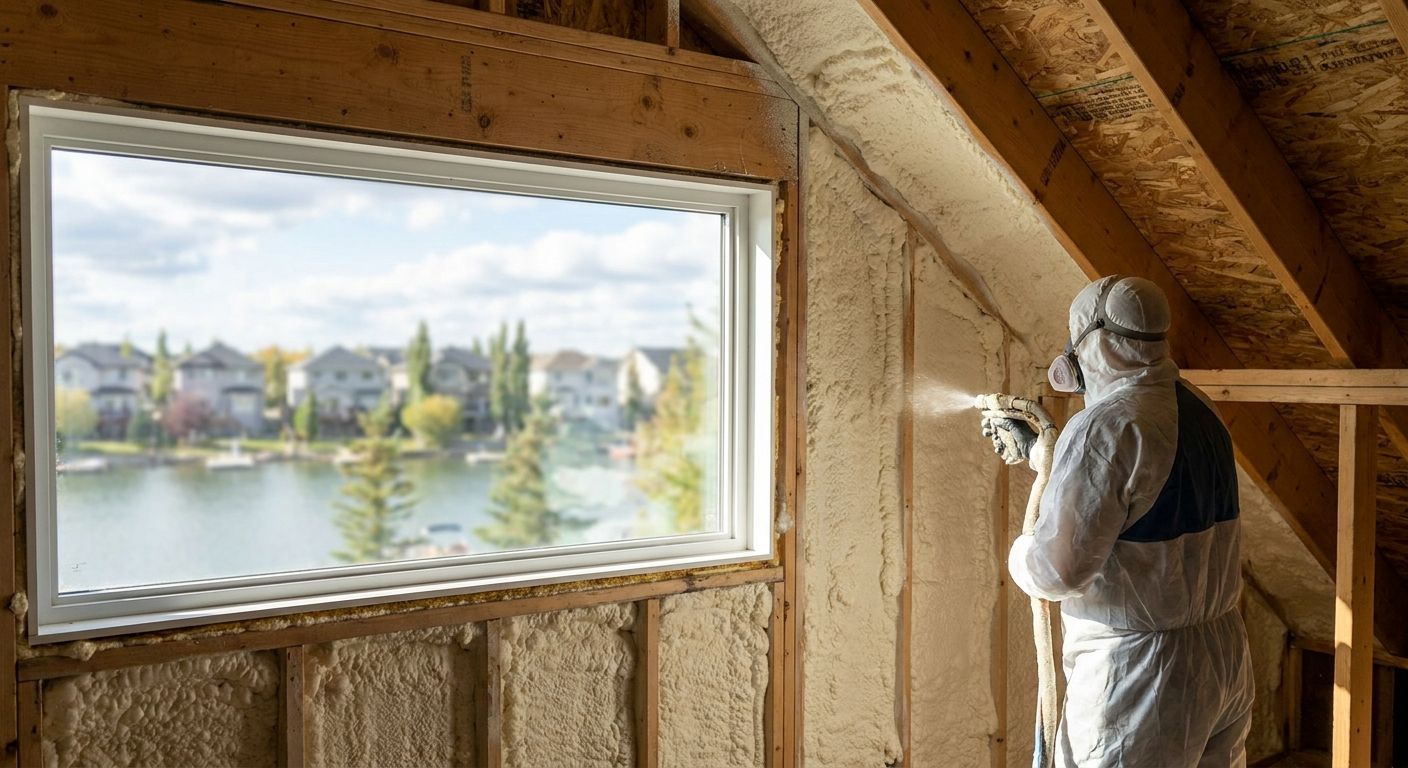
Chestermere sits close enough to Calgary to share its winters but far enough out that lake-effect humidity and newer subdivision construction change what your home actually needs from insulation. This guide breaks down what Chestermere homeowners should look for in spray foam insulation in 2026, which applications make sense for this area, and which upsells you can skip.
- Closed-cell spray foam at R-6 to R-7 per inch is the right call for Chestermere rim joists and crawl spaces near the lake.
- Attics in this climate zone need R-50 minimum — open-cell spray foam gets there without breaking a renovation budget.
- Newer Chestermere builds (post-2010) often have thin builder-grade attic insulation that underperforms by 2026 standards.
- Garage and bonus-room-over-garage gaps are the most common heat-loss complaint from Chestermere homeowners — verdict: Buy spray foam here first.
Why this matters
Chestermere's growth since the early 2000s means a lot of housing stock is newer than Calgary's, but "newer" doesn't mean well insulated. Builder-grade fiberglass batt in walls and blown-in attic insulation installed to minimum code at the time of construction routinely falls short of what southern Alberta winters demand by 2026. Add the lake's humidity load on homes near the water, and you get a specific combination of problems: ice damming at the eaves, cold garage walls that bleed heat into attached living space, and rim joists that sweat in February.
Spray foam insulation solves these problems differently than batt or blown-in product because it air-seals and insulates in one pass. That matters more in Chestermere than in a drier inland climate, because moisture that gets trapped behind vapor-permeable insulation near the lake has more opportunity to condense.
Who this is for
This guide is built for Chestermere homeowners in three situations: owners of post-2005 subdivision homes with builder-grade attic insulation, owners of lakefront or near-lake properties dealing with humidity and rim joist condensation, and anyone renovating a garage, bonus room, or basement who wants the space to actually hold heat through an Alberta winter.
What to look for in spray foam insulation for Chestermere homes
R-value matched to the assembly, not a flat number
Attics, walls, and rim joists all need different R-values, and a contractor quoting one flat number across your whole house is cutting corners. Alberta's climate zone 7A calls for roughly R-50 in attics, which is achievable with 14 to 16 inches of open-cell foam or a thinner layer of closed-cell foam given its higher per-inch rating. Rim joists and crawl spaces do better with closed-cell foam specifically because of its vapor-resistance, not just its R-value.
Closed-cell vs. open-cell for your specific application
Closed-cell foam runs R-6 to R-7 per inch and acts as its own vapor barrier, which is why it's the right pick for rim joists, crawl spaces, and anywhere moisture is a concern. Open-cell foam runs closer to R-3.5 to R-4 per inch, costs less per board foot, and is the practical choice for large open attic areas where you have room to build up thickness. Getting this wrong — open-cell in a damp crawl space, for instance — means redoing the work within a few years.
Air sealing before foam goes in
Spray foam only performs to spec if the crew has actually sealed the gaps first — top plates, wiring penetrations, plumbing stacks, and the attic hatch itself. A contractor who skips this step and just sprays over existing gaps is leaving thermal bridges in place, and you'll see it show up as an ice dam pattern on the roof the following winter.
Local humidity handling near the lake
Properties within a few blocks of Chestermere Lake see higher ambient humidity than inland Calgary neighborhoods, which raises the stakes on vapor management in rim joists and crawl spaces. Closed-cell foam's vapor-resistance isn't optional here — it's the detail that keeps a crawl space from smelling musty by year two.
Cure time and off-gassing window
Spray foam needs a defined cure period before the space is safely re-occupied, typically measured in hours, not days, but the exact window depends on the product and ambient temperature during application. Ask the contractor for the specific re-entry time for your job rather than accepting a generic answer.
Contractor licensing and insurance
Spray foam installation is a trade where a bad install (wrong ratio, wrong thickness, poor ventilation during cure) creates real problems, so licensing and insurance aren't paperwork formalities. Confirm the crew doing the work, not just the company name on the quote, carries current coverage.
Top picks for Chestermere applications
The attic retrofit — the highest-return pick. Post-2010 Chestermere subdivisions frequently ship with attic insulation below the R-50 climate-zone target, and topping up to spec with open-cell foam is the single highest-payback project for most homeowners here. Check current attic depth against the right spray foam R-value for your attic before committing to a spec. Verdict: Buy.
The rim joist and crawl space seal — the moisture fix. For homes within walking distance of the lake, closed-cell foam at the rim joist stops the cold-and-damp cycle that shows up as condensation on foundation walls every fall. This is a smaller job, usually completed in a single day, and it targets the exact spot where heat loss and moisture converge. Verdict: Buy.
The garage and bonus-room package — the comfort pick. Attached garages and the bonus rooms above them are the most common cold-spot complaint from Chestermere homeowners, especially in two-storey builds where the garage sits under a kids' bedroom or home office. Spray foam on garage walls and ceiling closes that gap without touching drywall in the living space above. Verdict: Buy if you use the garage as a workspace or the room above it year-round; Consider if the garage is unheated storage only.
The whole-home deep retrofit — the wildcard. Full-envelope spray foam replacement across an entire older home is the most expensive option and makes sense mainly for pre-2000 acreage-style properties around Chestermere with original batt insulation and no air sealing anywhere. For most 2010-and-newer subdivision homes, this is overkill next to a targeted attic-plus-rim-joist approach. Verdict: Consider for older properties only; Skip for newer builds where a targeted retrofit gets you most of the benefit at a fraction of the cost.
Spray foam for basement suite or bonus space conversions — the value-add pick. If you're finishing a basement or converting space into a rentable suite, spray foam at the rim joist and exterior walls handles both insulation and air sealing in the same pass, which matters for occupancy comfort and moisture control in a below-grade space. Verdict: Buy if the space will be occupied year-round.
What to avoid
- A single flat R-value quote across the whole house. Attics, walls, and rim joists have different targets — a one-number quote signals the contractor isn't assessing your actual assemblies.
- Open-cell foam in a crawl space or rim joist near the lake. It lacks the vapor resistance closed-cell foam provides, and in a humid microclimate that's the wrong tradeoff.
- Skipping air sealing to save on labor time. Foam sprayed over unsealed penetrations still leaves thermal bridges, and you'll pay for it in the next ice-dam season.
Get a spray foam quote for your Chestermere home
See what R-value and application makes sense for your property.
Verdict comparison
| Application | Foam type | Typical R-value | Best for | Verdict |
|---|---|---|---|---|
| Attic top-up | Open-cell | R-50 target | Post-2010 subdivision homes | Buy |
| Rim joist / crawl space | Closed-cell | R-6 to R-7 per inch | Homes near the lake | Buy |
| Garage walls and ceiling | Closed-cell or open-cell | Varies by depth | Attached garages with living space above | Buy / Consider |
| Whole-home envelope | Closed-cell | Full assembly rebuild | Pre-2000 acreage properties | Consider |
| Basement suite conversion | Closed-cell | Rim joist + walls | Rentable or year-round space | Buy |
For a full cost breakdown by square footage and application, see how much spray foam insulation costs in Calgary, which applies to the wider Calgary-region market Chestermere sits inside.
FAQ
What’s the best spray foam insulation for Chestermere homes?
Open-cell foam works best for attic top-ups aiming at the R-50 climate-zone target, while closed-cell foam is the right choice for rim joists and crawl spaces where lake humidity is a factor. Matching foam type to the assembly matters more than picking one product for the whole house.
Is spray foam better than batt insulation for Alberta winters?
Spray foam air-seals and insulates in a single application, which batt insulation does not do on its own. In a climate that regularly hits -30°C, that combined air-sealing effect reduces drafts and ice damming more reliably than batt alone.
How much does spray foam insulation cost in the Chestermere area?
Costs vary by square footage, foam type, and which assemblies are being treated (attic, rim joist, garage, or full envelope). A full breakdown by application is available in the Calgary-area cost guide, since Chestermere pricing tracks closely with the wider region.
Do newer Chestermere homes need spray foam insulation?
Many post-2010 subdivision homes were built to minimum code attic insulation levels, which fall short of the R-50 target recommended for Alberta’s climate zone 7A by 2026 standards. A targeted attic top-up is often worthwhile even in newer builds.
Does living near Chestermere Lake change the insulation needs?
Yes. Properties near the water see higher ambient humidity, which raises the importance of closed-cell foam’s vapor resistance at rim joists and crawl spaces compared to inland Calgary neighborhoods.
How long does a spray foam attic retrofit take?
A standard attic top-up on a typical Chestermere home is usually completed within a day, though timing depends on attic size, existing insulation removal needs, and access. Confirm the specific timeline with your contractor before scheduling.
Can spray foam fix ice damming on a Chestermere roof?
Spray foam addresses the heat-loss and air-leakage causes of ice damming by sealing attic penetrations and bringing insulation up to the R-50 target. It works best paired with proper attic ventilation rather than as a standalone fix.
Is closed-cell or open-cell foam better for a garage ceiling under a bonus room?
Closed-cell foam is generally preferred here because it adds rigidity and a higher per-inch R-value in a shallower cavity, which matters when garage ceiling joist depth is limited. Open-cell can work if there’s enough cavity depth to hit the target R-value.
One last thing
The detail most Chestermere homeowners miss isn't the attic — it's the garage-to-house shared wall. Even with a fully insulated attic, an unsealed garage wall lets cold air migrate into the mudroom and any room above it, which is why homeowners who fix the attic first sometimes still feel a draft the following winter. Check that shared wall before you sign off on any insulation job as "done."
Related guides
- Best insulation type for Alberta winters
- Best spray foam insulation contractor for Calgary homeowners
- Spray foam insulation for Airdrie homeowners
- How to choose the right spray foam R-value for your attic