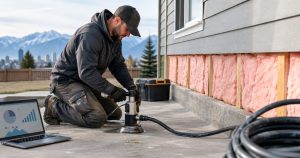
Walk down almost any Calgary street in spring and you’ll see it: a driveway slab that has dropped an inch at the garage door, a front sidewalk panel tilting toward the house, a garage floor with a step where there shouldn’t be one. The instinctive reaction is dread — “we’re going to have to rip it all out.” For a typical Calgary driveway, replacement can run $6,000 to $10,000 once you count demolition, disposal, new concrete, and a week or more of keeping cars off it while it cures. But here’s what most homeowners don’t know: if the slab itself is still in one piece, you can usually lift it back to level in a single morning — for a fraction of the cost — using the same polyurethane chemistry we spray into walls and attics every day.
Why Calgary Concrete Sinks in the First Place
Concrete slabs almost never fail on their own. They sink because the ground underneath them gives way — and Calgary’s ground is uniquely good at giving way. City infrastructure data reported by LiveWire Calgary shows the city averages about 16 freeze-thaw cycles every winter, driven largely by Chinooks that can swing temperatures from +10°C to -30°C in a matter of days. Each cycle, water in the soil beneath your slab freezes and expands roughly 9 percent, heaving the ground upward; each thaw, the soil settles back down — rarely into exactly the same place. Repeat sixteen-plus times a winter, year after year, and voids open up under the slab.
Layer on Calgary’s clay-heavy soils, which can swell dramatically when saturated in spring and shrink away from foundations during dry summers, and a frost line that reaches 6 to 8 feet below grade, and you have a near-perfect recipe for sunken driveways, tilted sidewalks, and settled garage floors. Downspouts that discharge next to the slab and poorly compacted backfill around newer homes accelerate the process by washing fines out from underneath. None of this is a defect in your concrete — it’s the ground moving beneath it. Which is exactly why pouring new concrete on the same disturbed soil often just restarts the clock.
How Polyurethane Concrete Lifting Works
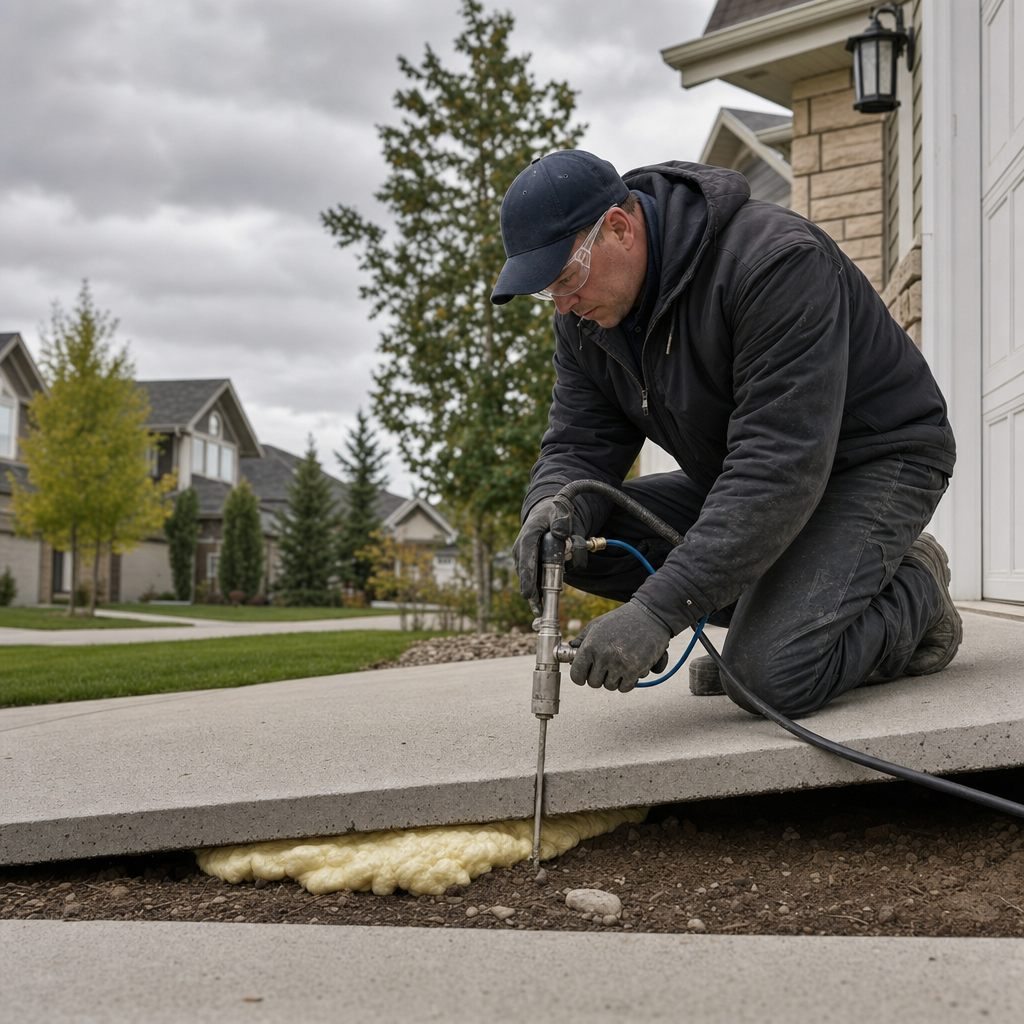
Polyurethane lifting (also called foam jacking or poly jacking) borrows the expanding two-part chemistry of spray foam insulation and puts it to structural work. The process is remarkably tidy:
- Drill: Small holes — about the diameter of a dime (5/8 inch) — are drilled through the sunken slab at strategic points.
- Inject: A two-part, high-density polyurethane is injected through the holes into the void below. It expands within seconds, filling gaps and compacting loose soil.
- Lift: As the foam expands, it generates controlled hydraulic pressure that raises the slab precisely back to grade — the technician monitors elevation in real time and stops at level.
- Patch and go: The holes are patched with matching material, and the slab can carry foot and vehicle traffic in about 15 minutes.
The cured foam is a rigid, closed-cell, waterproof polymer weighing just 2–4 pounds per cubic foot — strong enough to support a driveway, light enough that it adds essentially no new load to the soil that was already struggling. That’s the critical advantage over traditional mudjacking, which pumps a cement-and-soil slurry weighing 100+ pounds per cubic foot under the slab. Mudjacking material is also water-soluble, so Calgary’s spring melt gradually erodes it — which is why mudjacked slabs commonly re-settle within 2 to 5 years, while properly installed polyurethane lifts are typically rated for 20 years or more. Same foam family, different job — you can see how we use it for buildings on our spray foam insulation page and for slabs on our concrete lifting service page.
Lifting vs. Replacement: The Numbers
For a slab that is structurally sound but sunken, the cost gap is dramatic. Here’s how the two options typically compare for Calgary properties:
| Factor | Polyurethane Lifting | Full Replacement |
|---|---|---|
| Typical cost | Often 50–80% less than replacement | Roughly $12–$22 per sq ft installed in Alberta |
| Time on site | 1–3 hours for most residential jobs | Several days of work, plus 7–28 days curing |
| Usable again | ~15 minutes | About a week minimum for vehicles |
| Disruption | A truck and a hose; landscaping untouched | Jackhammers, bin rentals, hauling, permits |
| Waste | None — existing slab is preserved | Tonnes of broken concrete to landfill |
There’s an environmental case too. Cement production is one of the most carbon-intensive industries on the planet — the journal Nature reports that concrete is responsible for around a quarter of all human CO2 emissions from industry, with roughly one pound of CO2 released for every pound of cement made. Lifting a sound slab instead of demolishing and repouring it keeps tonnes of material out of the landfill and skips the manufacture of several cubic yards of new concrete entirely.
And beyond money, there’s liability: a sidewalk panel that has settled even a couple of centimetres is a trip hazard, and uneven slabs that slope toward the house channel meltwater straight at your foundation — the same water that feeds next winter’s freeze-thaw damage and the basement moisture problems we’re often called to deal with on the insulation side of our business. Re-levelling the slab restores proper drainage away from the house.
When Lifting Is the Right Call — and When It Isn’t
Polyurethane lifting is honest technology with honest limits, and a good contractor will tell you which side of the line your slab is on. Lifting is the right choice when the slab is settled but structurally intact — one solid piece, or a few large pieces, with nothing worse than hairline cracking. That describes the majority of sunken driveways, sidewalks, garage pads, patios, and front steps we see around Calgary.
Replacement is the better answer when the concrete itself has failed: slabs shattered into many small pieces, deep structural cracks that would let foam escape rather than lift, badly spalled or scaled surfaces from years of road salt and freeze-thaw attack, or settlement so extreme (more than 15–20 cm) that it signals a serious soil failure underneath. If you want a new look, more thickness, or a different layout, lifting can’t deliver that either — it restores level, not appearance.
The same technology scales up for commercial properties: warehouse floors with dips at the loading dock, settled aprons and entranceways, and uneven interior slabs can all be lifted overnight with the facility back in full operation by morning — a scheduling advantage replacement simply can’t match. If your business is fighting settled concrete alongside heat loss, our guide to commercial spray foam for Alberta businesses covers the building envelope side of the equation.
What a Calgary Homeowner Should Check This Spring
A five-minute walk around your property after the snow melts tells you most of what you need to know. Look for: slab corners that have dropped relative to their neighbours; gaps opening between the driveway and the garage slab; sidewalk panels that no longer meet flush; steps pulling away from the landing; and — the most telling sign — water pooling on the slab or flowing toward the house instead of away after a rain. Catching settlement early matters, because a slab that’s sunk 2 cm lifts easily and cheaply, while one left to sink for five more winters may crack under its own unsupported weight and graduate into a replacement job.
While you’re at it, redirect downspouts at least 1.5–2 metres away from any slab, and fill soil gaps at slab edges so meltwater can’t run straight underneath. Those two free fixes slow down the erosion that causes settling in the first place.
How Aztec Spray Systems Helps
Aztec Spray Foam Insulation Systems brings the same polyurethane expertise we apply to attics, walls, and crawlspaces to concrete lifting across Calgary and the surrounding area — driveways, sidewalks, garage pads, patios, and commercial floors for both residential and business clients. We’ll assess whether your slab is a candidate for lifting or genuinely needs replacement, and give you a straight answer either way.
Before you budget thousands for demolition and new concrete, find out if a morning’s foam work will solve it. Call (403) 830-7669 or request a free, no-obligation quote — we’ll take a look and tell you exactly what it would cost to get your concrete back to level.