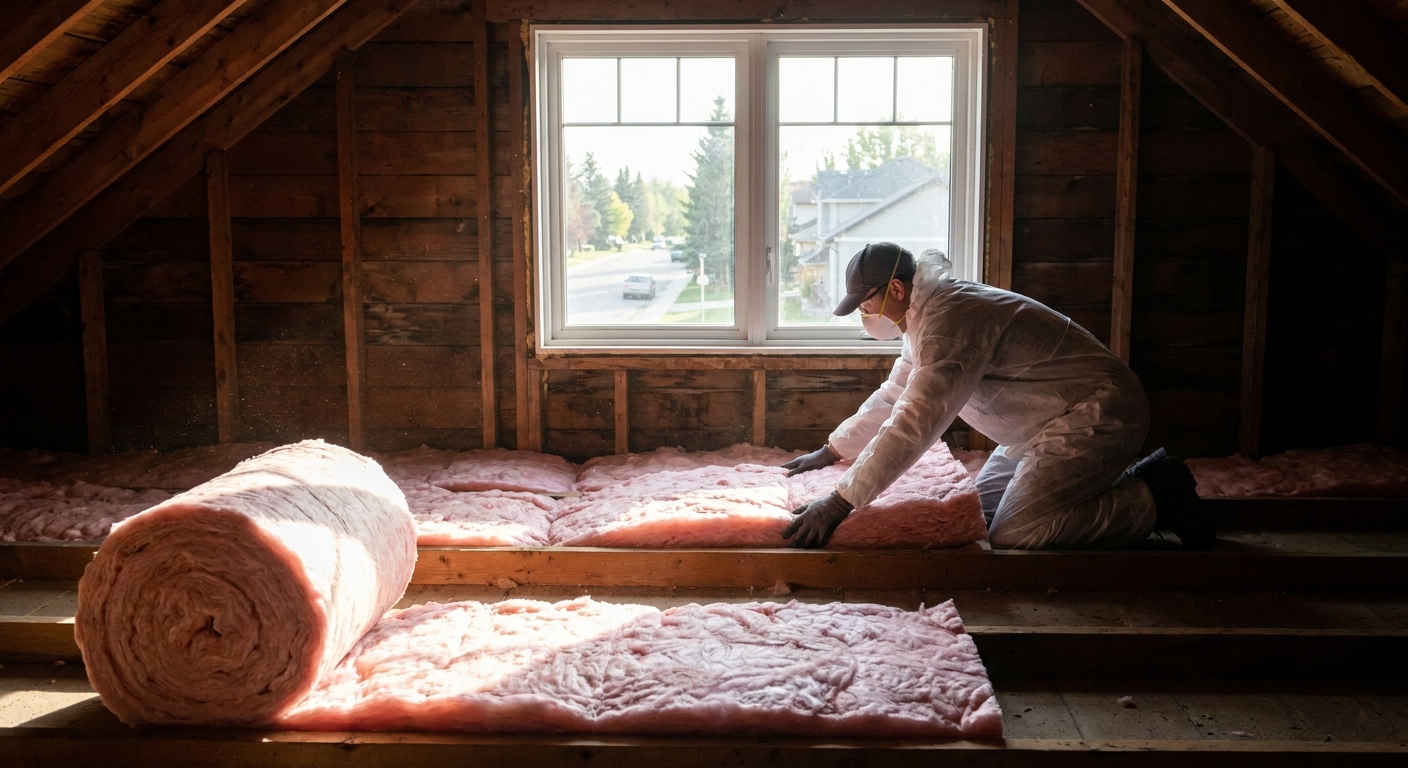
High River homeowners deal with Chinook swings, wind-driven snow, and Alberta’s climate zone 7B winters, and attic insulation is the single biggest factor in whether your heating bill and ice dams stay under control this year.
- Attic insulation in High River should hit R-50 — spray foam and blown-in cellulose clear that bar, batts usually don’t.
- Open-cell spray foam runs about R-6.5 per inch, beating blown-in fiberglass on ice damming. Buy for older attics.
- Blown-in cellulose top-ups suit attics already near R-20. Consider this before a full tear-out and re-insulation job.
- Seal attic bypasses — hatches, pot lights, plumbing stacks — before adding insulation, or heat keeps escaping regardless of R-value.
Why This Matters
A lot of High River attics were insulated to a code that no longer applies. Homes built before the early 2000s commonly sit at R-20 or lower, which was fine decades ago and isn’t fine now. Alberta’s building code guidance for climate zone 7B calls for R-50 in the attic, and the gap between R-20 and R-50 is where your heating dollars go every winter.
Cost is the real question homeowners ask first, and the numbers for spray foam vary by attic size and target R-value — the detailed spray foam insulation cost in Calgary breakdown covers the same pricing structure used across Aztec Spray Systems’ Calgary, Okotoks, High River, and Lethbridge service area. Chinooks make the stakes higher here than in a steady-cold climate: a 20°C swing in a few hours stresses an under-insulated attic more than three straight weeks at -30°C, because the freeze-thaw cycle at the eave line repeats over and over.
Who This Guide Is For
This is for High River homeowners with an attic built or last insulated before roughly 2005, anyone seeing ice dams or icicles along the eaves each winter, and buyers doing a pre-listing energy upgrade before selling. If your attic hatch is cold to the touch or your upstairs bedrooms run 3-4 degrees colder than the main floor, you’re the buyer profile this page is written for.
What to Look for in Attic Insulation for High River Homes
R-value rated for Alberta’s climate, not a national average
Generic online guides quote R-38 or R-40 because that’s a warmer-zone number. High River sits in climate zone 7B, where R-50 is the target. Anything an installer quotes below that isn’t sized for your winters.
Air sealing before the insulation goes in
Pot lights, plumbing stacks, and the attic hatch are the biggest heat leaks in most homes, and no amount of R-value fixes a bypass that’s still open. A contractor who skips this step and goes straight to blowing in insulation is treating the symptom, not the leak.
Ice dam and moisture performance
High River’s Chinook cycles mean roof snow melts and refreezes repeatedly through a single winter. Spray foam’s closed-cell structure blocks air movement into the attic space, which is what actually stops ice damming — loose-fill products slow heat transfer but don’t stop air leakage the same way.
Material cost per R-value, not sticker price alone
A cheaper quote with a lower R-value target isn’t actually cheaper once you count the extra heating bills for the next 15 winters. Compare quotes on R-value achieved, not just the invoice total.
Licensed and insured installation
Attic work involves ladders, exposed insulation dust, and sometimes knob-and-tube wiring in older High River homes. A licensed and insured contractor protects you if something goes wrong during the job — an uninsured crew doesn’t.
Coverage across your actual attic, not just the easy sections
Eave sections and low-slope corners get skipped by installers rushing a job, and those are exactly the spots where ice dams start. Ask for a coverage diagram, not just a square-footage number.
Get an attic insulation quote
Licensed and insured service across Calgary, Okotoks, High River, and Lethbridge.
Top Picks: Attic Insulation Options for High River
Open-cell spray foam — the ice-dam fix. Runs about R-6.5 per inch and forms a continuous air barrier, which is the piece that actually stops the freeze-thaw cycle at your eaves. Aztec Spray Systems installs this for full attic re-insulation jobs across High River and the surrounding region in 2026. Verdict: Buy for homes with existing ice dam history or an attic still sitting at R-20 or below.
Blown-in cellulose — the budget top-up. Runs roughly R-3.7 per inch and works well when the attic is already close to target and just needs another 6-8 inches to hit R-50. It’s the cheaper path per R-value point but doesn’t solve air leakage on its own. Verdict: Consider if your attic tested near R-30-R-35 already.
Closed-cell foam at the hatch and rim joist — the small-job fix. A handful of square feet of closed-cell foam around the attic hatch and top plates closes the leaks that cause most of the cold-spot complaints in older High River homes. Verdict: Buy as a standalone fix if a full re-insulation isn’t in this year’s budget.
Fiberglass batts — the tempting shortcut. Batts look like a DIY-friendly option at the hardware store, but they compress under wind-driven snow load and leave gaps at every joist that a blower doesn’t. In a windy prairie town like High River, gaps mean convective heat loss even at a nominal R-38 rating. Verdict: Skip for attic work; batts belong in wall cavities, not open attic floors.
Blown-in fiberglass — the wildcard. Slightly better moisture resistance than cellulose and comparable R-value per inch, but settling over time can drop performance by a noticeable margin after 10-15 years if not topped up. Verdict: Consider as a second choice behind cellulose.
What to Avoid
- Insulation without air sealing first. Adding R-value on top of open bypasses is money spent on a problem that’s still there.
- Any installer who won’t confirm licensing and insurance in writing. Attic and roof-adjacent work carries real liability; get it documented before the crew shows up.
- Batt-only attic jobs sold as a full re-insulation. They’re a partial fix marketed as a complete one, and High River’s wind exposure makes the gaps worse than in a calmer climate.
Verdict Comparison
| Method | R-value per inch | Best for | Verdict |
|---|---|---|---|
| Open-cell spray foam | ~R-6.5 | Ice dam history, attics at R-20 or below | Buy |
| Blown-in cellulose | ~R-3.7 | Top-ups on attics near R-30+ | Consider |
| Closed-cell foam (hatch/rim joist) | ~R-6-7 | Spot-fixing leaks on a tight budget | Buy |
| Blown-in fiberglass | ~R-3.7 | Moisture-sensitive attics | Consider |
| Fiberglass batts (attic floor) | ~R-3.2 | Wall cavities, not open attics | Skip |
FAQ
What R-value do I need for attic insulation in High River, Alberta?
High River sits in Alberta’s climate zone 7B, where R-50 is the recommended attic target for 2026 builds and upgrades. Homes insulated before roughly 2005 often sit at R-20 or lower and benefit the most from a top-up.
Is spray foam or blown-in insulation better for High River attics?
Spray foam wins on ice dam prevention because its closed-cell structure blocks air movement, not just heat transfer. Blown-in cellulose costs less per R-value point but doesn’t stop air leakage the same way.
How much does attic insulation cost in High River in 2026?
Pricing depends on attic size, existing R-value, and target R-value, and follows the same cost structure detailed for Calgary-area jobs. Get a site-specific quote since square footage and access difficulty both move the number.
How do I know if my attic needs more insulation?
Ice buildup at the eaves, cold upstairs rooms, and visible frost on the underside of the roof deck are the clearest signs. A quick attic inspection measuring existing insulation depth against the R-50 target confirms it.
Does spray foam insulation stop ice dams in Alberta winters?
Open-cell spray foam stops most ice damming because it seals air leaks that let warm interior air reach the roof deck and melt snow unevenly. Loose-fill insulation alone doesn’t address that air movement.
Can I install attic insulation myself in Alberta?
Blown-in cellulose top-ups are DIY-feasible with a rented blower, but spray foam requires licensed equipment and training. Attics with knob-and-tube wiring or existing ice dam damage should go to a licensed contractor regardless of insulation type.
How long does spray foam attic insulation take to install?
A standard residential attic in the High River area typically takes one day for a licensed crew, depending on square footage and access. Air sealing at bypasses adds a small amount of time but prevents callbacks later.
One Last Thing
Most High River homeowners assume ice dams mean their insulation failed. Usually it’s the opposite: the insulation is fine, but a Chinook swing of 20°C or more in a single afternoon melts roof snow that refreezes overnight at the eave line, and an unsealed bypass is what let the warm air up there in the first place. Fix the air seal in 2026 before you spend more on R-value you already have.