Your basement walls are working against you — and most Calgary homeowners don’t realize it until they see the heating bill. An uninsulated or poorly insulated basement can account for 20 to 30 percent of a home’s total heat loss, and in Calgary’s Climate Zone 7A, where temperatures routinely hit -30°C, that translates directly into dollars leaving your house every month. The right insulation material matters as much as the R-value: concrete foundation walls are cold, slightly damp, and full of microscopic voids, and most traditional insulation products are poorly suited to that environment. Spray foam is the exception.
Quick Answer
Calgary basement walls in Climate Zone 7A require at least R-19.6 effective insulation under Alberta Building Code. Closed-cell spray foam delivers approximately R-6 per inch, so a 3.5-inch application meets code, seals air and vapour, bonds directly to concrete, and helps block radon — making it the most complete single-step basement wall insulation solution for Calgary homes.
Why Do Calgary Basement Walls Lose So Much Heat — and Why Does Standard Insulation Fail?
Concrete is a surprisingly poor insulator. At approximately R-0.08 per inch, a standard 8-inch poured concrete foundation wall provides just R-0.64 of thermal resistance — essentially nothing against a Calgary January. The soil on the exterior side offers some buffering below the frost line (roughly 1.2 to 1.5 metres in Calgary), where ground temperatures hover around 4 to 6°C year-round. But the top 1 to 1.5 metres of the wall — the exposed above-grade section and the area just below grade — faces the full swing of Calgary’s outdoor temperatures, including those -30°C cold snaps and the dramatic Chinook swings that can move temperatures by 20°C in hours.
Traditional fiberglass batt insulation installed between studs framed away from the concrete wall has a structural problem: it can’t seal air gaps, it allows moisture to migrate freely, and it provides no adhesion to the concrete surface. The air gap between the concrete and the back of the batts becomes a zone where cold air circulates, condensation forms on the concrete, and mould begins to grow — usually invisibly, behind the drywall, until the damage is already done. Many Calgary homeowners who insulated their basements 15 to 20 years ago with fibreglass are now tearing it all out and replacing it with spray foam after discovering exactly this problem.
The rim joist area — where the floor joists rest on top of the foundation wall — is especially vulnerable. This area is notoriously difficult to insulate with batts, and it is perforated by joists every 16 inches. Cold air infiltrates here and makes the floor above the basement perpetually cold. Spray foam seals this area completely, which is why it is often the highest-impact single upgrade a Calgary homeowner can make. Our detailed guide on rim joist and crawlspace spray foam insulation covers that specific application.
What R-Value Does Your Calgary Basement Wall Need Under Alberta Building Code?
Alberta Building Code Section 9.36, which mirrors the National Building Code of Canada, specifies minimum effective R-values for basement walls in Climate Zone 7A. The minimum is RSI 3.46 — approximately R-19.6 effective — for homes without a heat recovery ventilator (HRV). Homes equipped with an HRV may qualify for the slightly lower RSI 2.98 (R-16.9) requirement. These are effective R-values measured across the full assembly, accounting for thermal bridging through framing — not just the nominal rating of the insulation material itself. This distinction matters: fibreglass batts installed between studs lose 15 to 25 percent of their nominal R-value to thermal bridging through the wood.
Closed-cell spray foam applied directly to the concrete wall (no framing required) delivers approximately R-6 per inch with minimal thermal bridging. A 3.5-inch application achieves approximately R-21 — above the code minimum without an HRV. Alternatively, 2 inches of closed-cell spray foam (R-12) applied to the concrete, combined with a 2-by-4 stud wall filled with R-14 mineral wool batts, can deliver a full R-26 effective assembly with excellent moisture control. The spray foam acts as the air and vapour control layer; the stud wall adds cost-effective R-value. Your spray foam contractor should walk you through both options based on your available wall depth and budget.
For reference, Natural Resources Canada’s “Keeping the Heat In” guide is the authoritative homeowner reference for basement insulation in Canada’s cold climates. It recommends pre-insulation moisture checks, confirms the rim joist as a priority area, and outlines the performance expectations for different insulation approaches in Zone 7 climates.
How Does Spray Foam Insulation Actually Work on Concrete Basement Walls?
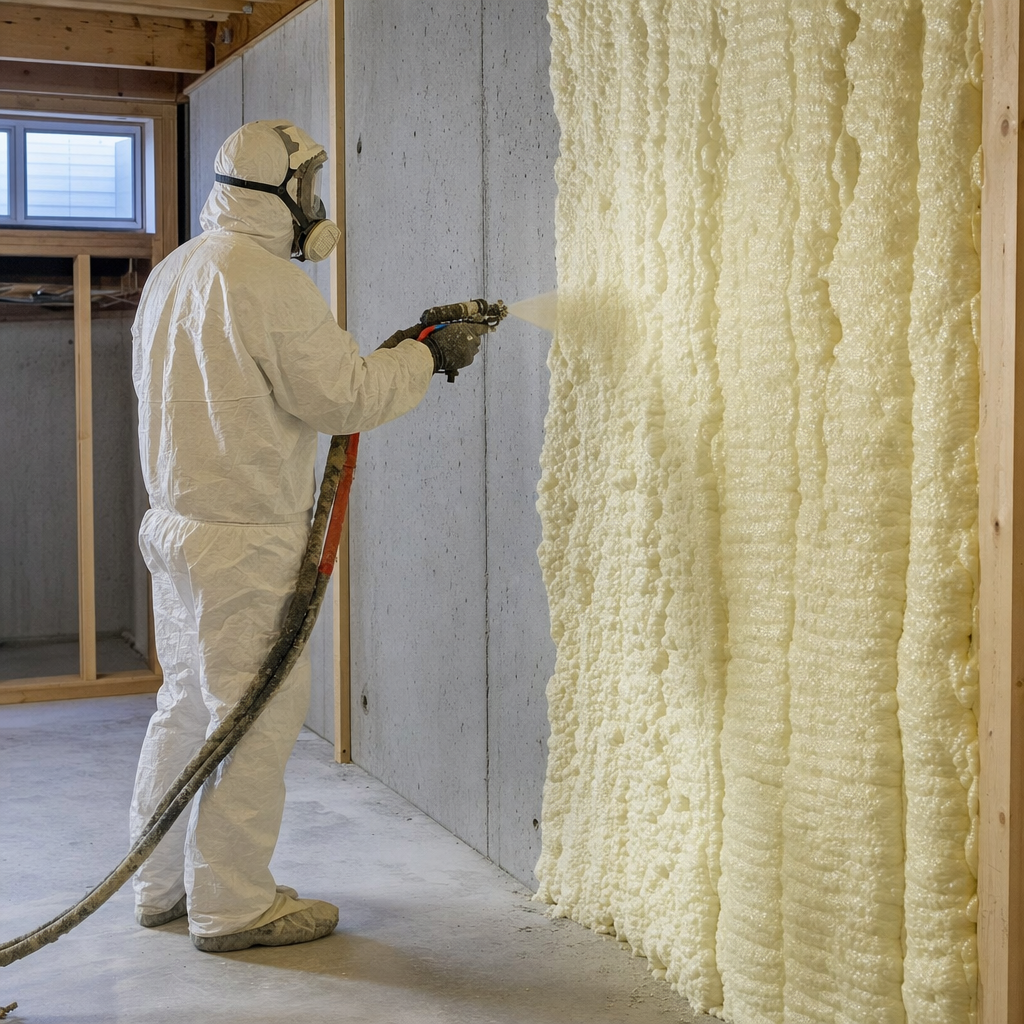
Professional spray foam application to basement walls is a two-component process. Component A (isocyanate) and Component B (polyol resin and blowing agent) are held in separate heated tanks on the installer’s truck and mixed at the spray gun tip at the wall surface. The two components react instantly, expanding to roughly 30 to 40 times their liquid volume within seconds and adhering permanently to the concrete surface. The foam’s cellular structure closes off as it cures, creating the dense, rigid, moisture-resistant closed-cell product.
Unlike batts or rigid board, spray foam fills every void, crack, and irregularity in the concrete surface — including the porous surface of older block foundations that are notoriously difficult to seal. There is no air gap between the foam and the concrete, which eliminates the condensation zone that destroys batt insulation. The foam bonds directly to the substrate and does not require adhesive or mechanical fasteners, and it will not sag, shift, or compress over time the way fibreglass does. Once applied, it can be left exposed (in an unfinished utility space) or covered with drywall if the basement is being finished.
The process is completed in a single visit for most basement applications. Installers typically wear full PPE (respirators, protective suits) during application, and the home should be vacated for 24 hours while the foam cures. After that 24-hour window, the foam is inert and safe. See our article on spray foam safety and off-gassing for the full Health Canada guidance on occupancy timelines.
Is Spray Foam Better Than Fiberglass Batts for Calgary Basement Walls?
For most Calgary basement wall applications, yes — by a significant margin. The comparison is not just about R-value; it is about the total performance of the assembly. Fibreglass batts require a framed stud wall, which adds cost and reduces floor space. Batts do not air-seal, so you still need to detail an air barrier across every penetration and junction — a step that is difficult to do properly and often skipped. Batts allow moisture to migrate through them and condense on the cold concrete, creating ideal conditions for mould.
Closed-cell spray foam eliminates all three of those problems in a single product. It requires no framing (though framing can still be added over it for finishing), it is the air barrier, and it prevents moisture migration to the concrete surface. The cost per square foot is higher than batts, but when you factor in the framing, vapour barrier, and air sealing labour that batts require — and the absence of mould remediation costs down the road — closed-cell spray foam often delivers better long-term value.
| Factor | Closed-Cell Spray Foam | Fiberglass Batts + Framing |
|---|---|---|
| R-Value at 3.5″ | ~R-21 (no thermal bridging) | ~R-13 to R-15 effective (bridging losses) |
| Air Sealing | Complete | None — separate step required |
| Vapour Control | Yes (at 2″+ thickness) | No — separate poly required |
| Moisture Risk | Very low | High (condensation behind batts) |
| Framing Required? | No | Yes (loses 3.5-5.5″ of floor space) |
| Radon Resistance | Significant (35× better than poly) | None |
What About Radon, Moisture, and Concrete Foundations — Should I Be Worried?
Radon is a legitimate concern for Calgary homeowners. Alberta has one of the highest average indoor radon concentrations in Canada, driven by uranium-rich soils in the region. Radon is a naturally occurring radioactive gas that enters homes through cracks, gaps, and porous concrete in the foundation — and it is the leading cause of lung cancer among non-smokers in Canada according to Health Canada. Closed-cell spray foam performs approximately 35 times better than a standard 6-mil polyethylene sheet as a radon gas barrier at just 1 inch of thickness, because it expands to fill the smallest cracks and adheres directly to the concrete surface — pathways that poly sheets cannot seal.
Moisture is the other critical concern. Before any basement wall insulation is installed, Natural Resources Canada recommends taping a plastic sheet to the concrete wall for 24 to 48 hours. If condensation forms on the wall side of the plastic, you have active moisture intrusion from the exterior soil — a drainage or waterproofing problem that must be addressed before any insulation goes in. If condensation forms only on the room-side face of the plastic, the moisture is coming from interior air, which spray foam will help control. Aztec Spray Systems includes this moisture assessment as part of every pre-installation consultation, so you don’t discover a drainage problem after the foam is in place.
For homes finishing their basements, spray foam on the concrete walls before framing creates an ideal sequence: foam goes on first, dries within 24 hours, framing goes up against the foam face, and the stud bays can be left open or filled with additional insulation. This avoids the moisture trap that forms when framing is pressed directly against uninsulated concrete and then covered with drywall. Learn more about the complete approach to spray foam insulation services we offer for Calgary residential projects.
What Does Basement Wall Spray Foam Cost in Calgary, and Are There Rebates?
Closed-cell spray foam for basement walls in Calgary typically costs between $3 and $5 per board foot (a board foot = 1 square foot at 1 inch thickness), depending on the product, thickness, and total project size. A typical 1,200-square-foot Calgary basement with 8-foot walls might require 3 to 4 inches on the walls and 3 inches on the rim joists, putting the material and labour cost in the $4,500 to $9,000 range. Projects vary significantly depending on concrete condition, number of penetrations, and access. Our 2026 Calgary spray foam cost guide provides a detailed breakdown by application type.
On the rebate side: the Canada Greener Homes Grant closed to new applicants in October 2025. Its successor — the Canada Greener Homes Affordability Program — is slated to launch in 2026 with an $800 million budget targeting lower-to-median income households through a direct-install, no-upfront-cost model. Watch for eligibility announcements at Natural Resources Canada. Provincially, check our updated Alberta spray foam rebates guide for the latest available programs. Even without rebates, the payback period for basement spray foam in Calgary is typically 7 to 12 years based on reduced heating costs alone — and the mould prevention and radon reduction benefits are harder to put a number on but very real.
Frequently Asked Questions
How much spray foam do I need on Calgary basement walls to meet building code?
Alberta Building Code requires at least R-19.6 effective for basement walls in Calgary’s Climate Zone 7A (without an HRV). Closed-cell spray foam delivers approximately R-6 per inch, so you need at least 3.5 inches to meet code on its own. With an HRV installed, the requirement drops to R-16.9, achievable with 3 inches of closed-cell. Always confirm with your permit office and contractor based on your specific assembly.
Can spray foam insulation prevent mould on Calgary basement walls?
Yes — significantly. Mould on basement walls is almost always caused by condensation forming where warm indoor air meets cold concrete. Closed-cell spray foam eliminates this by keeping the concrete surface above the dew point and blocking moisture migration. It does not fix pre-existing drainage problems, however; active water intrusion must be addressed before insulating.
Does spray foam help with radon in Calgary basements?
Yes. Closed-cell spray foam adheres to concrete and fills microscopic cracks that standard poly sheets cannot seal, making it a substantially more effective radon gas barrier. However, spray foam alone is not a substitute for proper radon mitigation if your home tests above Health Canada’s action level of 200 Bq/m³. A sub-slab depressurization system is the definitive radon fix; spray foam is a complementary measure that reduces radon entry.
How long does spray foam take to cure in a Calgary basement, and can I stay home?
Spray foam reaches its full structural cure within 24 hours of application. During installation and for the first 24 hours after, occupants should vacate the home — proper ventilation is required while the foam cures and residual odours dissipate. After 24 hours, the cured foam is inert and safe. Most Calgary basement projects are completed in one day, so homeowners are typically back in their homes the following morning.
Is spray foam or rigid foam board better for Calgary basement walls?
Both closed-cell spray foam and rigid extruded polystyrene (XPS) board are effective at blocking moisture and providing vapour control. Spray foam wins on air sealing — it fills every crack and void in the concrete surface without taping or caulking. Rigid board is less expensive per R-value but requires careful joint taping and is harder to install around irregular surfaces, pipes, and penetrations. For most Calgary basements, spray foam delivers a more reliable long-term result, particularly in older homes with rough or irregular concrete walls.
How Aztec Spray Systems Helps Calgary Homeowners Insulate Their Basements
A properly insulated basement is one of the highest-return energy upgrades a Calgary home can receive — and getting the details right (moisture assessment, correct thickness, air sealing at the rim joist) makes the difference between an upgrade that lasts 40 years and one that causes problems in five. Aztec Spray Systems brings professional closed-cell and open-cell spray foam application to residential basements, crawlspaces, and rim joist areas across Calgary, Airdrie, Cochrane, Okotoks, and surrounding communities.
Every project starts with a site assessment to check for moisture intrusion, measure your existing wall depth and configuration, and confirm the right product and thickness for your Alberta Building Code requirements. We provide full documentation for permit applications and inspections. Whether you are finishing your basement for the first time, replacing failed fibreglass insulation, or sealing a crawlspace under an older Calgary home, our team will specify and install the solution that performs correctly for our climate — the first time.
Request a free, no-obligation quote today, or call us at (403) 830-7669. We also handle commercial spray foam insulation for Calgary warehouses, agricultural buildings, and industrial facilities — ask us about any project type.