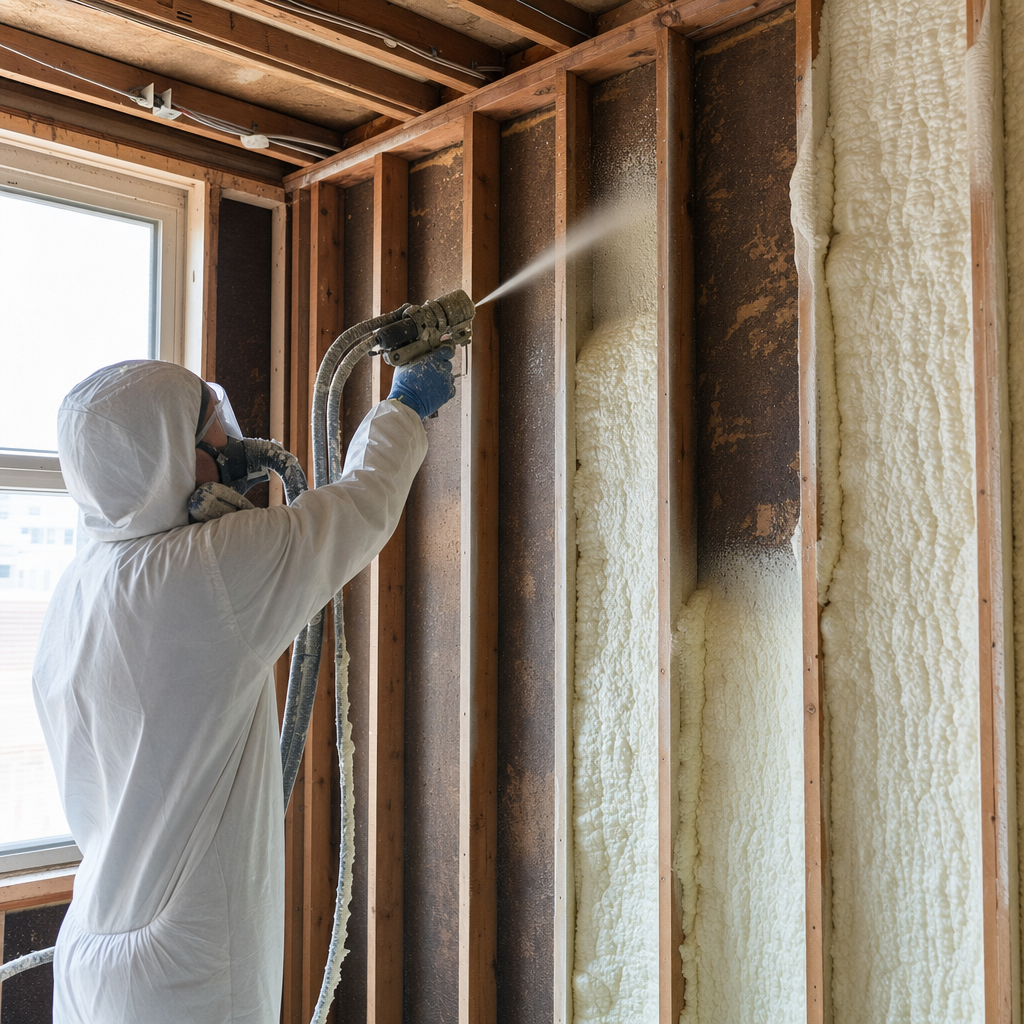
Calgary is full of homes built between the 1950s and 1980s — original bungalows in Banff Trail, split-levels in Glendale, two-storey foursquares in Inglewood. These houses were built when R-8 in the walls was considered adequate, when polyethylene vapour barriers weren’t yet code, and when knob-and-tube wiring was still being installed in new construction. If you own one of these homes, you’ve likely felt the drafts, watched your energy bills climb through a -30°C cold snap, and wondered whether spray foam could finally solve the problem. The answer is yes — spray foam works exceptionally well in older Calgary homes. But there are critical steps that must happen before the first drum of chemical is mixed on your property.
Quick Answer
Yes, you can spray foam an older Calgary home — but it requires a pre-installation inspection for knob-and-tube wiring, asbestos-containing materials, and existing moisture damage before any foam is applied. Closed-cell spray foam at R-6 per inch is the right product for Calgary’s Zone 7A climate, and unvented hot-roof attic assemblies specifically require a City of Calgary building permit.
What Makes Older Calgary Homes Different to Insulate?
Homes built before 1980 present a specific set of challenges that simply don’t exist in newer construction. The wall cavities in most 1950s–1970s Calgary builds use 2×4 framing (89 mm), limiting the usable depth to about 3.5 inches. At R-6 per inch with closed-cell foam, that gives a maximum of about R-21 in the wall cavity alone — which falls just below the current National Building Code – Alberta Edition minimum of R-22 (RSI 3.08) for Zone 7A walls. Older attics typically contain only 75–100 mm of original blown cellulose or fibreglass batt, delivering R-12 to R-16 — far below today’s code target of R-60 (RSI 10.43), as confirmed by the City of Calgary’s climate-ready insulation guidance.
Beyond framing dimensions, older homes typically lack a continuous air barrier. The original exterior sheathing was often let-in diagonal boards, tongue-and-groove planks, or early fibreboard — none of which stop air movement the way modern OSB or plywood sheathing does. The result is that the “effective” R-value of an older wall is substantially lower than the nominal value of whatever insulation is stuffed into the cavity, because cold air short-circuits through gaps in the sheathing, around electrical boxes, and through the band joist. Spray foam addresses this directly: because it expands to fill every crevice and adheres to the framing, it eliminates the air movement that defeats conventional batt insulation in older assemblies.
Is Spray Foam Safe in a Home Built Before 1980?
This is the question that matters most, and it has a careful answer. Spray foam itself is safe once fully cured — see our dedicated article on spray foam safety and off-gassing for Calgary homeowners for the full detail on what happens during and after installation. The safety questions in older homes are about what you may encounter before the foam goes in, not about the foam product itself.
Knob-and-Tube Wiring: The Critical Safety Issue
Knob-and-tube (K&T) wiring was standard in Canadian homes built through the 1940s and was still being installed in some homes into the 1960s. It runs as individual wires strung between ceramic knobs and through ceramic tubes in the framing, without any sheathing connecting the hot and neutral conductors. The wire relies on free-air cooling to dissipate heat — and if insulation surrounds it, that cooling is eliminated, creating a serious fire hazard.
Natural Resources Canada’s Keeping the Heat In guide states explicitly: “Never allow insulation materials to come into contact with … old knob and tube wiring because these can pose a fire hazard.” This applies to all insulation types — spray foam, blown cellulose, fibreglass batt. Before a spray foam contractor can legally or safely work in an attic or wall cavity of a pre-1960s Calgary home, a licensed electrician must confirm that any K&T wiring in the affected area has been replaced or safely disconnected. Many older Calgary homes have had the visible K&T replaced but still have hidden runs in the attic framing — these must be traced and confirmed clear before insulation work begins. If you’re unsure, a licensed electrician or home inspector can check during a pre-renovation assessment.
Asbestos and Original Insulation Materials
Homes built through the mid-1970s may contain asbestos in pipe insulation, ceiling tiles, floor tiles, or in blown insulation in the attic. Vermiculite insulation — a grey, pebble-like material sometimes found in older Calgary attics — is particularly concerning because much of the vermiculite sold in Canada before 1990 came from a mine in Libby, Montana that was contaminated with asbestos-bearing tremolite fibres. Natural Resources Canada notes that products containing asbestos cannot be sold as consumer products in Canada (prohibited since 2018) and that any suspected asbestos-containing materials require testing and professional handling before being disturbed.
If your home was built before 1980 and you have not had an asbestos inspection, arrange one before any insulation work begins. A certified asbestos inspector can take samples of any suspected materials and send them for laboratory analysis. If asbestos-containing materials are present and in good, undisturbed condition, a qualified abatement contractor must assess whether they can be left in place and encapsulated, or whether full remediation is required. Spray foam applied over intact, non-friable asbestos in certain crawlspace situations can sometimes encapsulate it safely — but this determination must be made by a professional, not by assumption. Do not disturb suspected asbestos on your own.
Does Spray Foam in an Older Calgary Home Require a Permit?
This depends on exactly what you are insulating. According to the City of Calgary’s building permit guidelines for energy code improvements under Section 9.36 of the National Building Code – Alberta Edition:
- Interior wall cavities and basement rim joists: No permit required for spray foam insulation.
- Attic floor top-ups (foam between floor joists with attic ventilation maintained): Generally no permit required.
- Hot-roof or unvented attic assembly (foam applied directly to the underside of roof sheathing, eliminating ventilation): A building permit IS required.
- Exterior insulation added to the outside of existing sheathing: Permit required, as this changes the building envelope profile.
The permit requirement for hot-roof assemblies exists because eliminating attic ventilation fundamentally changes the moisture dynamics of the entire roof structure — done incorrectly, it can cause roof sheathing rot within a few years. The building inspector’s review during the permit process also surfaces the electrical and asbestos issues discussed above, which is a feature, not a bureaucratic inconvenience. A permit creates a paper trail that protects you legally and matters when you sell your home and the buyer’s inspector asks whether work was done to code.
A reputable spray foam contractor will handle the permit application on your behalf as part of the project. If a contractor proposes a hot-roof assembly and doesn’t mention a permit, ask specifically — it should be automatic. You can also find answers to common process questions on our spray foam FAQ page.
How Much Insulation Does an Older Calgary Home Actually Need?
The answer starts with what current code requires, then works backward from what you currently have. Under the National Building Code – Alberta Edition, Section 9.36, Calgary homes in Climate Zone 7A need minimum insulation values of R-22 (RSI 3.08) in above-grade walls, R-60 (RSI 10.43) in attic/ceiling assemblies, and approximately R-17 in basement walls — values confirmed by the City of Calgary’s own climate-ready measures documentation.
A typical pre-1980 Calgary home has R-11 in the walls (3.5-inch 2×4 cavity with fibreglass batt) and R-20 to R-30 in the attic, if the insulation hasn’t compressed or settled. Getting that wall from R-11 to R-22 without gutting the exterior or interior finishes is where spray foam’s high R-per-inch density becomes essential. Two approaches work for exterior walls in an older home: injecting foam into the cavity through small drilled holes in the exterior cladding (a minimally invasive technique), or applying closed-cell foam directly to the exterior sheathing during a re-cladding project before new cladding and a continuous exterior insulation layer go on. For the attic, adding blown cellulose or fiberglass on top of the existing insulation is often the most cost-effective path to R-60 — but if there are air sealing deficiencies at the attic floor (around pot lights, plumbing penetrations, or the top plates), a targeted spray foam air seal pass before topping up with blown insulation is the professional approach recommended by NRCan’s Keeping the Heat In guide.
Closing the Gap With Closed-Cell Spray Foam
For the rim joist and band joist — almost always the single biggest thermal weak point in an older Calgary home — two inches of closed-cell spray foam delivers approximately R-12, an air seal, and a vapour retarder in one step, with no drywall disturbed and no polyethylene barrier required. This is typically the highest-return spray foam application in an older home: minimal disruption, significant comfort improvement, and immediate results. Homeowners commonly report that persistent cold drafts near the floor disappear entirely after rim joist treatment. Learn more about this application in our guide to crawlspace and rim joist insulation in Calgary.
For walls with accessible cavities during a renovation, four inches of closed-cell foam against the exterior sheathing before closing with drywall brings the wall assembly to approximately R-24, meeting code and performing well into Calgary’s Zone 7A winters. Combined with the air sealing properties of the foam, the real-world performance improvement exceeds what the R-value numbers alone suggest — because it eliminates the infiltration that was defeating the older batt insulation from the start. See our residential spray foam insulation page for a full overview of the applications we handle.
What Does the Retrofit Process Look Like in Practice?
A professional spray foam retrofit of an older Calgary home typically follows a clear sequence. First, a site assessment to identify the scope of work, confirm there are no K&T or asbestos concerns in the target areas, and identify any existing moisture damage — staining, mould, rot, or water intrusion — that must be addressed before foam goes in. NRCan’s Keeping the Heat In is explicit: “Address any moisture or structural problems before insulating.” Applying spray foam over wet, mouldy framing or rotted sheathing traps the problem inside a sealed assembly where it continues to deteriorate invisibly.
Second, the crew preps the work area — masking off surfaces, protecting contents, and ensuring ventilation. Third, the closed-cell foam is applied in controlled passes, typically 25–50 mm lifts, to manage the exothermic heat generated during curing. Fourth, after full cure (typically 24 hours), a thermal barrier — usually 12.7 mm (½-inch) drywall — is installed over any foam exposed in a living space, per the National Building Code’s fire protection requirements. The whole process for a crawlspace or rim joist is usually a single day; attic or full-wall work on a larger older home may take two to three days.
Older Calgary homes that qualify often benefit significantly from energy efficiency incentive programs. The Alberta homeowners’ guide to spray foam rebates explains what a registered EnerGuide energy advisor assessment involves and how to access federal Canada Greener Homes funding — older homes tend to show the largest EnerGuide rating improvements after a spray foam retrofit, which unlocks the highest available rebate tiers. For full details on how all our services work together, visit our services overview page.
Frequently Asked Questions
Can you spray foam over existing insulation in an older Calgary home?
In most cases, no — existing insulation must be removed first so the spray foam can adhere directly to the framing and sheathing, create a continuous seal, and allow proper inspection for moisture damage. In attics where only targeted air sealing at penetrations is needed (rather than a full foam application), foam can be applied to specific gaps while blown insulation remains, but a complete spray foam retrofit requires a clean substrate.
Does spray foam require a building permit in Calgary for older homes?
For most applications — rim joists, wall cavities, attic floor air sealing — no permit is required. However, an unvented “hot-roof” assembly where spray foam is applied directly to the underside of the roof sheathing requires a City of Calgary building permit regardless of the home’s age. A reputable contractor will identify upfront whether your project requires one and handle the application.
Is spray foam safe if my older Calgary home has knob-and-tube wiring?
Not without electrical remediation first. Natural Resources Canada states that insulation of any type must never contact knob-and-tube wiring due to fire risk — the wiring relies on air cooling that insulation eliminates. Any K&T wiring in attic spaces or wall cavities to be insulated must be replaced or disconnected by a licensed electrician before spray foam work begins.
How much does it cost to spray foam an older Calgary home?
Costs vary significantly by scope. Rim joist treatment for a typical older Calgary bungalow (roughly 60–80 linear feet) typically runs $800–$1,500. Full wall cavity treatment ranges from $3,000–$8,000+ depending on area, access method, and cavity depth. Our detailed 2026 Calgary spray foam cost guide has current per-square-foot pricing by application type.
Will spray foam improvements on my older Calgary home qualify for rebates?
Potentially yes — older Calgary homes often show the largest EnerGuide rating improvements after a spray foam retrofit, qualifying for higher Canada Greener Homes rebate tiers. A registered EnerGuide energy advisor must complete both a pre- and post-renovation assessment to access federal funding. Many older homes jump two or three EnerGuide label bands after a combined air-sealing and insulation upgrade.
How Aztec Spray Systems Helps
Aztec Spray Systems has worked across many of Calgary’s established neighbourhoods — from mature inner-city communities to the older suburbs in the northwest and southeast. We understand the specific challenges that pre-1980 construction presents: tight 2×4 cavities, original diagonal sheathing, exposed brick chimneys with required clearances, and wiring that may have been modified multiple times over the decades. Our site assessment process is designed to identify these issues before the first drum of chemical is mixed, not partway through the job.
We offer free no-obligation quotes on residential and commercial spray foam projects throughout Calgary and the surrounding area. Whether your priority is the rim joist that has been letting cold air into your main floor for decades, a full wall retrofit during a kitchen renovation, or a new hot-roof attic assembly with the proper City of Calgary permit in hand, we scope the work clearly and explain exactly what is involved — no surprises. Call (403) 830-7669 or reach us through our contact page to schedule your free assessment today.