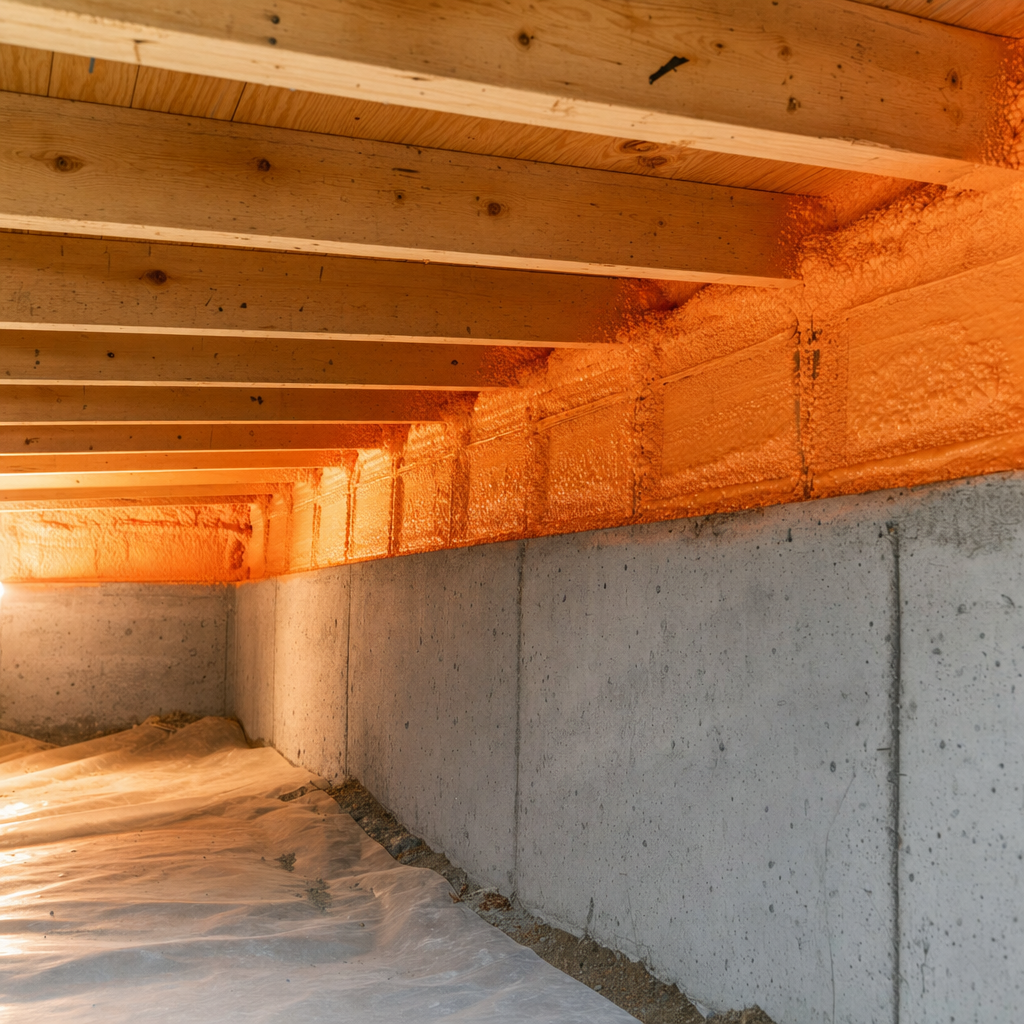
If your main-floor hardwood feels like a skating rink every January, the problem probably isn’t your furnace — it’s what’s happening two feet below your feet. In thousands of Calgary bungalows and older two-storeys, the crawlspace and the rim joist (the band of wood framing that caps your foundation) are the single leakiest, coldest part of the entire building envelope. When a -30°C cold snap settles over the city, outdoor air pours through these areas, chills your floor assembly from below, and forces your furnace to run almost continuously just to hold 21°C. The fix isn’t more heat. It’s stopping the cold at its source — and closed-cell spray foam is the one material purpose-built for exactly this job.
Why Crawlspaces and Rim Joists Leak So Much Heat in Calgary
Natural Resources Canada’s Keeping the Heat In guide puts a number on it: below-grade spaces can account for roughly 25 percent of a home’s total heat loss. The guide specifically calls out “a lot of air leakage… at the top of the foundation wall (sill area and rim joist)” — precisely the zone most Calgary homes leave bare wood or stuff with a sagging fiberglass batt.
The physics are simple. Your rim joist sits at the junction of three materials — concrete foundation, wood sill plate, and floor framing — and every junction is a seam that leaks air. In winter, warm air rising through your house (the stack effect) creates negative pressure at the lowest level, actively sucking -30°C outdoor air in through every gap around the sill plate, wiring penetrations, and dryer or plumbing pass-throughs. Calgary sits in Climate Zone 7A with about 5,000 heating degree days, so that pressure differential works against your house for six-plus months a year.
Crawlspaces compound the problem. A typical 2–4 foot crawlspace under a Calgary bungalow is surrounded by cold concrete on the sides and cold ground below, often with old vents that were never plugged for winter. The floor above it is your living room floor. If the crawlspace walls are uninsulated, your floor is effectively resting on an outdoor deck.
Why Fiberglass Batts Fail Here — and Spray Foam Doesn’t
Plenty of Calgary homes have fiberglass batts shoved into the rim joist cavities. It rarely works, and it can actively cause damage. Fiberglass slows heat conduction but does nothing to stop airflow — cold air simply moves through and around it. Worse, when warm indoor air sneaks behind the batt and touches the frigid wood of the rim joist, the moisture in that air condenses on the cold surface. Season after season, that condensation feeds mould and can eventually rot the rim joist itself — the structural band your entire floor system bears on. Building scientists consider this the predictable failure mode of fibrous insulation at rim joists in cold climates.
Closed-cell spray foam solves both problems in a single pass because it is the only common insulation that insulates and air-seals at the same time. Applied as a liquid, it expands into every gap around wiring, plumbing, and irregular framing, then cures into a rigid layer bonded directly to the wood and concrete. There is no air gap for condensation to form in, because there is no air movement at all. The numbers make the case:
| Property | Closed-Cell Spray Foam | Fiberglass Batt |
|---|---|---|
| R-value per inch | ~R-6 | ~R-3.2–R-3.8 |
| Air barrier | Yes — built in | No |
| Vapour barrier | Yes, at ~2″+ thickness | No — separate poly required |
| Moisture tolerance | Closed cells shed water | Absorbs moisture, loses R-value |
| Fits irregular cavities | Expands to fill perfectly | Gaps at every obstruction |
That vapour barrier point matters more in Alberta than almost anywhere else. The National Building Code — Alberta Edition requires a continuous vapour retarder on the warm side of insulation. With batts, that means a separate polyethylene sheet meticulously sealed around every joist bay — a fussy, failure-prone job in a cramped rim joist area. At two inches or more, closed-cell foam is the vapour barrier, the air barrier, and the insulation in one continuous layer. You can read more about how this works in practice on our spray foam insulation service page.
How Much Foam Does a Calgary Home Actually Need?
Calgary’s Zone 7A prescriptive requirements under Section 9.36 of the building code are demanding. According to NAIMA Canada’s published Zone 7A tables, foundation and crawlspace walls need roughly RSI 3.46 (about R-19.6) in homes without a heat recovery ventilator, and floors over unheated crawlspaces need approximately R-28.5. With closed-cell foam at roughly R-6 per inch, that translates to about 3 to 3.25 inches on crawlspace walls — a thickness spray foam reaches easily in one or two lifts, where batts and rigid board struggle with fastening, sealing, and moisture detailing against concrete.
For rim joists, the typical Calgary specification is 2 to 3 inches of closed-cell foam (R-12 to R-20) applied across the interior face of the rim joist, over the sill plate, and lapped slightly onto the foundation wall to seal the notorious sill-plate gap. As a reference point, the federal Canada Greener Homes program required a minimum R-20 increase at the basement header to qualify for its rim joist grant — a good proxy for what “done right” looks like. Our Alberta rebate guide for spray foam insulation covers the incentive landscape in more detail.
One important classification detail: if your crawlspace contains ductwork or is open to the basement, code treats it as a heated crawlspace, and the walls must be insulated to the same standard as your living space. Most Calgary crawlspaces fall into this category — which is exactly why insulating the walls with spray foam (rather than stuffing batts between the floor joists above) is usually the right strategy. It brings the crawlspace inside the building envelope, keeps plumbing safely above freezing during cold snaps, and turns the space from a liability into a buffer.
The Hidden Payoffs: Warm Floors, Frozen-Pipe Protection, and Fewer Ice Dams
The most immediate change homeowners notice is underfoot: floors above a foam-sealed crawlspace typically warm up several degrees because cold air is no longer washing across the underside of the subfloor. Bathrooms and kitchens at the perimeter of the house — the rooms directly above the rim joist — feel the difference most.
The second payoff is pipe protection. Every February cold snap, Calgary plumbers field calls about frozen supply lines running through crawlspaces and along rim joists. Sealing these zones with closed-cell foam keeps them within the heated envelope, dramatically cutting the risk of a burst pipe and the five-figure water damage claim that follows.
The third is less obvious: ice dams. The stack effect that pulls cold air in at your rim joist is the same engine that pushes warm, moist air up into your attic, where it heats the roof deck, melts the snow layer from below, and refreezes it into ice dams at the eaves. Air-sealing the bottom of the house weakens that engine. Pairing rim joist foam with proper attic insulation attacks the ice dam problem from both ends — less driving pressure below, less heat escaping above.
A quick self-check you can do this week: on a cold, windy day, hold an incense stick or a damp hand along the top of your basement foundation wall where the wood framing meets concrete. Moving smoke or a cold draft on your skin means outdoor air is entering — and if you feel it in one bay, it’s happening in all of them.
Why Professional Installation Matters
Two-component spray foam is not a DIY product at this scale. In Canada, professional installers certified through CUFCA (the Canadian Urethane Foam Contractors Association) apply foam that complies with the CAN/ULC-S705.2 national standard, verify substrate temperatures and mix ratios, and follow re-occupancy protocols — occupants and pets stay out during installation and for about 24 hours after, while the foam fully cures and any installation odours dissipate. Getting the chemistry, thickness, and pass sequence right is the difference between a 50-year assembly and a callback. If you have questions about safety, off-gassing, or what installation day looks like, our spray foam FAQ answers the ones we hear most from Calgary homeowners.
How Aztec Spray Systems Helps
Aztec Spray Foam Insulation Systems has insulated crawlspaces, rim joists, basements, garages, and attics across Calgary and the surrounding area — from 1950s bungalows in Killarney to acreage shops outside Okotoks — along with commercial buildings that face the same Zone 7A physics at a larger scale. We assess how your crawlspace is classified, spec the right closed-cell thickness for code and comfort, and install to CUFCA standards so the work is done once and done right.
Stop paying to heat the outdoors from the bottom of your house up. Call us at (403) 830-7669 or request your free, no-obligation quote online — we’ll take a look at your rim joists and crawlspace and tell you exactly what it would take to make your floors warm again before the next cold snap rolls in.