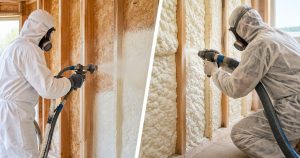
For Calgary's harsh winters, you'll want to choose closed-cell spray foam insulation with an R-value of 6.5-7 per inch to meet local building code requirements of R22 for above-ground walls. This type offers superior moisture resistance and air-sealing properties compared to open-cell alternatives, helping you achieve up to 40% reduction in heat loss through air movement. While the initial cost ranges from $1.50 to $3.00 per square foot, the long-term energy savings and increased property value make it a worthwhile investment. Professional installation guarantees peak performance and proper coverage, with several factors affecting your specific situation and potential cost savings.
Key Takeaways
- Choose closed-cell spray foam with R-value 6.5-7 per inch to meet Calgary's building code requirement of R22 for above-ground walls.
- Consider professional installation over DIY kits to ensure proper coverage and maximize energy efficiency in Calgary's harsh winters.
- Select moisture-resistant closed-cell foam rather than open-cell foam to protect against Calgary's extreme weather conditions.
- Compare long-term energy savings against initial costs, with potential savings of up to 40% on heating bills.
- Look for low-VOC formulations that maintain good indoor air quality while providing superior insulation performance.
Understanding Calgary's Climate Requirements
When selecting spray foam insulation for Calgary homes, understanding the city's unique climate requirements is vital for ideal performance and energy efficiency. Your home's thermal resistance needs are significant due to long winters and brief summers, making proper insulation selection fundamental.
Calgary's demanding climate requires insulation solutions with superior moisture resistance and high R-values. You'll want to focus on closed-cell spray foam insulation, which delivers R-values of 6.5 to 7 per inch, meeting the National Building Code's R22 requirement for above-ground walls. This option outperforms open-cell alternatives in both heating and cooling efficiency, particularly during harsh winters. By choosing the right spray foam insulation, you'll address the 40% heat loss through air movement while ensuring your home maintains maximum energy efficiency. Remember, Calgary is Beyond Foam regarding standard insulation requirements.
Types of Spray Foam Available
Calgary's demanding climate calls for specific spray foam solutions, and you'll find two main types dominating the market: open-cell and closed-cell foam insulation. While open-cell foam provides an insulation value of 3-4 per inch and works well for interior applications, closed-cell foam delivers superior thermal insulation at 6.5-7 per inch, making it ideal for Calgary's harsh winters.
Consider these key factors when choosing your spray foam:
- Application versatility: Both types can be installed in attics, walls, and crawl spaces
- Cost efficiency: Open-cell foam costs less initially, while closed-cell foam offers better long-term energy savings
- Environmental impact: Look for low-VOC formulations that maintain indoor air quality while providing effective insulation
For Calgary homes, closed-cell foam's moisture resistance and higher R-value typically make it the preferred choice for exterior walls and basements.
R-Value and Insulation Performance
Understanding R-value is essential for maximizing your home's insulation performance in Calgary's extreme climate. When selecting spray foam insulation, you'll need to take into account that closed-cell spray foam offers superior thermal resistance, with R-values of 6.5 to 7 per inch, while open-cell variants provide 3 to 4 per inch.
To meet the National Building Code requirements in Alberta, your above-ground framed walls must achieve a minimum R-value of R22. You can effectively reach this threshold by choosing closed-cell spray foam, which delivers nearly double the insulation performance of traditional fiberglass. If you're looking to customize your home's thermal resistance, think about layering different insulation types. This strategy allows you to combine the moisture resistance of closed-cell spray foam with other materials to achieve the best performance for Calgary's demanding weather conditions.
Cost and Long-Term Value
The initial investment in spray foam insulation directly reflects its superior R-value performance. You'll find costs ranging from $1.50 to $3.00 per square foot, which is higher than traditional options. However, the long-term value proposition becomes clear when you consider the energy efficiency gains and durability of this investment.
Consider these key financial benefits:
- Energy savings of up to 40% on heating and cooling costs
- Access to Alberta-specific rebates and incentives that offset initial costs
- Improved resale value due to closed-cell foam's superior R-value of 6.5-7 per inch
As a homeowner, you're investing in a solution that lasts for decades without degradation. While the upfront costs are significant, the combination of energy savings, incentives, and increased property value makes spray foam insulation a financially sound choice for Calgary homes.
Professional Installation Vs DIY
When deciding between professional installation and DIY spray foam insulation, experienced contractors offer significant advantages that directly impact your home's thermal performance. Professional installation by trained technicians guarantees proper application techniques and ideal insulating properties that DIY spray foam kits simply can't match.
| Feature | Professional | DIY |
|---|---|---|
| Application Quality | Consistent coverage | Often uneven |
| Equipment | Industrial-grade | Basic kit tools |
| Warranty | Full coverage | Limited/void |
While you might save money initially with DIY installation, you'll likely sacrifice energy efficiency and long-term performance. Professional contractors use superior equipment and materials, delivering a consistent insulating barrier that enhances your home's thermal protection. They'll complete the job efficiently, and you'll benefit from thorough warranty coverage on both materials and workmanship, safeguarding your investment.
Environmental Impact and Safety
Beyond installation considerations, environmental responsibility shapes modern insulation choices for Calgary homeowners. You'll find that environmentally friendly spray foam insulation markedly reduces your home's carbon footprint while creating a healthier living space. Low-VOC formulations improve indoor air quality, making your home safer for your family.
Key environmental and safety benefits include:
- Closed-cell foam creates an effective moisture barrier, preventing mold growth and reducing the need for chemical treatments
- High-performance insulation decreases energy consumption in heating and cooling systems by up to 50%
- Natural pest resistance eliminates the need for harmful chemical pest control methods
Your choice of spray foam directly impacts both environmental sustainability and home safety. Modern formulations offer superior protection while minimizing ecological impact through reduced emissions during manufacturing and application processes.
Local Building Code Compliance
Meeting Calgary's rigorous building code requirements stands as an important obligation when selecting spray foam insulation for your home. You'll need to guarantee your insulation meets the minimum R-value of R22 (RSI 3.08) for above-ground framed walls, as mandated by the National Building Code – Alberta Edition.
When you're seeking spray foam insulation, prioritize local building code compliance, particularly regarding fire safety standards and protective coverings. You'll want to work with professional installers who understand these requirements and can verify that materials meet performance criteria. Don't overlook the significance of thermal resistance specifications and ongoing compliance monitoring. For homeowners seeking to maintain code adherence, schedule regular inspections to verify your insulation continues to meet regulations. Keep in mind that building codes can change, so staying informed about updates through qualified professionals is vital.