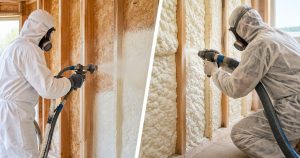
You'll find closed-cell spray foam delivers exceptional moisture control in Calgary's climate by creating an impermeable barrier with vapor transmission rates below 1.0 perms. The high-density foam achieves R-values of 6.0-7.0 per inch while preventing condensation through its airtight seal. When professionally installed, the expanding foam fills gaps and creates a continuous moisture barrier that traditional insulation can't match. Advanced moisture detection methods, including infrared thermography, verify the installation's effectiveness. Professional installation guarantees your spray foam barrier maintains peak performance throughout Calgary's challenging weather cycles. Understanding the technical specifications reveals why this solution outperforms conventional alternatives.
Key Takeaways
- Closed-cell spray foam creates an impermeable barrier with extremely low vapor transmission, preventing moisture infiltration in Calgary's climate conditions.
- The foam's expansive properties seal all gaps and crevices completely, eliminating potential pathways for moisture to enter building structures.
- Professional installation ensures continuous coverage without breaks, maintaining an uninterrupted moisture barrier throughout the entire application area.
- Spray foam's high R-value of 6.0-7.0 per inch combines superior insulation with moisture protection in a single application.
- Pre-installation moisture testing and quality control measures guarantee long-term effectiveness of the moisture barrier in Calgary buildings.
Understanding Moisture Control Fundamentals
When managing moisture control in Calgary's variable climate, understanding the fundamental principles of vapor barriers and building envelope protection becomes essential. You'll need to evaluate how moisture migration affects your structure's integrity and how installing spray foam insulation can prevent condensation issues. Closed-cell spray foam serves as an exceptional vapor barrier, offering superior moisture resistance while maintaining high R-value per inch.
Building codes mandate specific requirements for moisture control, and closed-cell spray foam exceeds these standards through its low permeability rating. You'll find this particularly significant in preventing mold growth and maintaining ideal energy efficiency. When properly installed on the warm side of walls, this foam creates an impermeable barrier that protects your building envelope while simultaneously enhancing insulation performance and reducing energy costs.
Types of Spray Foam Barriers
Spray foam barriers come in two distinct classifications: closed-cell and open-cell variants, each offering specific moisture control characteristics. You'll find closed-cell spray foam delivers superior moisture barrier protection with a permeability rating that effectively blocks vapor infiltration. Its R-value of 6.0-7.0 per inch guarantees exceptional thermal resistance and energy efficiency.
Open-cell spray foam, while providing quality insulation, won't serve as your primary moisture barrier due to its vapor-permeable nature. When selecting between types, you'll need to take into account local building codes and specific application requirements. Insulation professionals recommend closed-cell variants for basements and high-humidity areas. Proper installation remains vital – even minor gaps can compromise the barrier's effectiveness. You'll want expert application to ascertain your spray foam barrier maintains peak performance within your building envelope.
Benefits of Calgary Climate Applications
Calgary's unique climate conditions make closed-cell spray foam insulation particularly valuable as a moisture barrier solution. Using spray foam in your home provides superior protection against moisture problems while delivering exceptional thermal performance with its high R-value of 6-7 per inch. This effective solution aligns with local building code requirements and addresses Calgary's specific environmental challenges.
Key advantages of spray foam insulation in Calgary include:
- Creates an impermeable barrier that prevents mold growth by blocking water vapor transmission
- Maintains ideal indoor air quality through thorough air sealing, reducing external moisture infiltration
- Protects structural elements in basements and crawl spaces, where moisture typically accumulates
The expansive properties of spray foam guarantee complete coverage, sealing gaps that traditional insulation methods might miss, making it particularly effective for Calgary's dry yet variable climate conditions.
Professional Installation Best Practices
Three critical phases define professional spray foam installation: preparation, application, and quality control. You'll need trained installers to assess surface conditions and address moisture issues before proceeding to guarantee proper adhesion and structural integrity.
During application, specialists utilize precise equipment to create an effective air barrier and moisture barrier, applying the foam in calculated layers according to manufacturer specifications. They'll monitor expansion rates and thickness while maintaining strict safety protocols, including PPE usage and ventilation controls.
Quality control encompasses post-installation inspections to verify the foam's performance as both an air and moisture barrier. You'll want to document thickness measurements, adhesion tests, and vapor barrier compliance. Regular inspections help maintain the installation's long-term effectiveness while confirming it continues to meet local building codes and performance standards.
Moisture Testing and Quality Assurance
Before initiating spray foam application, thorough moisture testing protocols must be implemented to safeguard the installation's integrity. You'll need to verify that substrate moisture content remains below 15% to guarantee peak adhesion and performance of your superior moisture barrier. Advanced moisture detection methods, including infrared thermography, help identify hidden moisture pockets that could compromise insulation integrity.
Key quality assurance steps for effective moisture management:
- Conduct extensive pre-installation moisture testing to identify and address existing moisture issues
- Implement regular post-installation inspections using calibrated moisture detection equipment
- Document all findings to guarantee compliance with local building codes and maintain verification records
These systematic procedures guarantee your spray foam installation maintains its effectiveness as a moisture barrier while meeting regulatory requirements. Regular monitoring helps prevent future complications and extends the insulation's service life.
Long Term Performance Results
Extensive field studies demonstrate that properly installed spray foam moisture barriers deliver exceptional long-term performance metrics. You'll find that closed-cell spray foam maintains its superior insulation properties with R-values of 6.0-7.0 per inch for over two decades, substantially outperforming traditional materials. The moisture barrier's integrity remains intact throughout its 20+ year lifespan, effectively preventing air leaks and moisture infiltration.
Your investment in spray foam delivers quantifiable benefits through sustained thermal resistance and energy efficiency. Data shows that properly maintained installations continue blocking mold growth and maintaining structural integrity without degradation. Regular professional inspections verify the long-term performance of your moisture barrier, ensuring it maintains its airtight seal and superior insulation characteristics. This sustained performance translates to consistent energy savings and protected indoor air quality over the system's lifetime.
Building Code Compliance Requirements
Professional spray foam installations in Calgary must adhere to the National Building Code of Canada (NBCC) and local municipal requirements. When you're considering spray foam insulation, closed-cell spray foam requires specific attention in areas with moisture exposure, functioning as both a moisture barrier and vapor barrier.
Key compliance requirements include:
- Meeting minimum R-values of 6.0-7.0 per inch for closed-cell applications
- Installation by certified professionals who understand local building codes
- Proper material selection based on exposure conditions and performance requirements
You'll need to verify that your installation meets all building codes and local regulations. The effectiveness of spray foam as a moisture barrier depends on proper installation techniques and material selection, making professional certification crucial for compliance with both NBCC standards and Calgary's specific requirements.