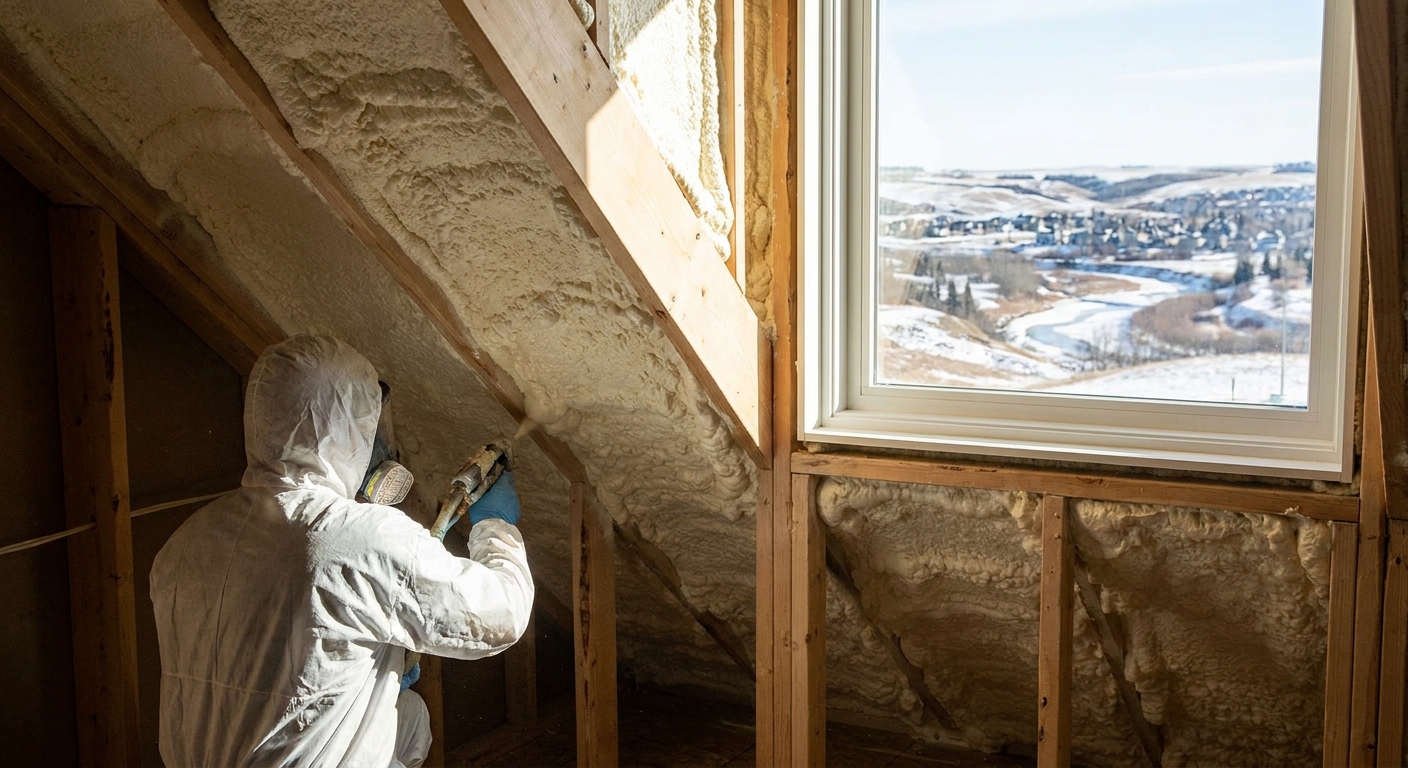
Okotoks winters push spray foam insulation from a nice-to-have into a structural decision, and picking the wrong type or the wrong installer costs you a full winter of drafts before anyone notices. This guide breaks down what actually matters for homes in Okotoks, High River, and the rest of the Foothills corridor in 2026.
- Closed-cell spray foam insulation hits R-6.5 per inch and is the safe pick for Okotoks attics and rim joists in 2026. Buy.
- Open-cell foam costs less per board foot but needs a vapor barrier detail in Alberta’s freeze-thaw climate. Consider.
- Alberta Building Code targets roughly R-40 in attics for new construction — uninsured crews routinely miss this. Skip them.
- Aztec Spray Systems installs spray foam insulation across Okotoks, Calgary, High River, and Lethbridge as a licensed, insured contractor.
Why this matters
Okotoks sits close enough to the Foothills that chinook swings hit harder than in central Calgary — a 20°C temperature jump in 48 hours is not unusual in January. That thermal cycling stresses insulation and air barriers in ways flatter, milder climates never see.
Spray foam insulation handles that stress better than batt insulation because it bonds to the framing and seals air leaks in the same step. Aztec Spray Systems works on attics, walls, and rim joists for homeowners across the region, and the choices below reflect what actually holds up through an Okotoks winter, not generic national advice.
Who this is for
This guide is for Okotoks homeowners with older bungalows or acreage properties built before 2000, new-build owners doing a retrofit on a builder-grade attic, and anyone who has noticed ice damming, cold walls near the garage, or a rim joist that’s cold to the touch in February. If your attic still has R-20 or less of loose-fill fiberglass, you’re behind current Alberta Building Code expectations and losing heat every day the furnace runs.
What to look for in spray foam insulation for Okotoks homeowners
1. R-value per inch versus code minimums
Closed-cell spray foam delivers roughly R-6 to R-7 per inch, while open-cell lands closer to R-3.5 per inch. Alberta Building Code effectively pushes attic assemblies toward the R-40 to R-60 range for new construction, so the type you pick determines how many inches you actually need to hit that target without eating into headroom.
2. Open-cell vs. closed-cell for a freeze-thaw climate
Closed-cell foam is denser and acts as its own vapor barrier, which matters in Okotoks because chinooks create repeated freeze-thaw cycles that push moisture through wall assemblies. Open-cell foam is lighter and cheaper per board foot but absorbs more moisture if the vapor barrier detail is wrong, so it needs a contractor who gets that detail right the first time.
3. Air sealing and moisture control
A spray foam job that skips proper air sealing around plumbing stacks, electrical penetrations, and the attic hatch leaves you with insulation that still lets conditioned air escape. Ask any contractor specifically how they handle these penetrations before they touch your attic — vague answers here predict a callback in year two.
4. Contractor licensing and insurance
Spray foam installation involves pressurized chemical application, and an uninsured crew that damages your roof deck or trusses leaves you with no recourse. Confirm the company is a licensed and insured contractor before signing anything, not after the trucks show up.
5. Rim joist and cold-spot coverage
Rim joists are the single most common cold spot in Okotoks homes built before 2010, because builders historically used fiberglass batts that compress and leave gaps. Closed-cell foam sprayed directly into the rim joist cavity seals that gap permanently and stops the draft that shows up right at floor level in bedrooms above a garage.
6. Local climate exposure and chinook cycling
A product that performs fine in a stable climate can underperform in Okotoks specifically because of repeated freeze-thaw stress on the building envelope. Closed-cell’s rigidity and moisture resistance make it the more forgiving choice for exterior-facing assemblies exposed to those swings.
Top picks for Okotoks homes
Closed-cell spray foam for attics — the moisture-proof pick. Delivers roughly R-6.5 per inch and doubles as an air barrier and vapor barrier in one application. For an older Okotoks bungalow with R-20 or less currently in the attic, this closes the code gap in a single visit. Buy.
Open-cell spray foam for interior stud walls — the value pick. Runs closer to R-3.7 per inch but costs less per board foot and expands to fill irregular stud cavities completely. Works well for interior partition walls where moisture exposure is minimal. Consider for interior walls only, not exterior assemblies.
Rim joist spray foam — the cold-spot fix. A targeted application in rim joist cavities, usually closed-cell given the moisture exposure at the foundation line. This is the highest return-on-comfort project in most Okotoks retrofits because it’s the spot homeowners actually feel. Buy.
Attic top-up combined with air sealing — the retrofit pick. Pairs new spray foam with sealing of existing penetrations rather than just adding depth. For a 2026 retrofit on a home built before 2005, this combination typically closes more of the code gap than foam depth alone. Buy.
Fiberglass batt-only retrofit with no air sealing — the false economy. Costs less upfront but leaves convective air loops inside the attic that spray foam eliminates. Homeowners who go this route usually redo the job within five years. Skip.
Get an Okotoks insulation quote
Licensed and insured spray foam installation across Okotoks and the Foothills.
What to avoid
- Open-cell foam in exterior rim joists. It absorbs moisture in freeze-thaw conditions that closed-cell shrugs off — fine indoors, risky at the foundation line.
- DIY foam-in-a-can kits for whole-attic coverage. They’re built for gap-filling, not R-value performance, and won’t get you near Alberta Building Code targets.
- Uninsured installers quoting well below market. A spray foam crew without insurance that damages roof sheathing leaves the homeowner covering the repair, not the contractor.
Verdict comparison table
| Option | R-value per inch | Best use | Verdict |
|---|---|---|---|
| Closed-cell attic foam | ~6.5 | Attics, exterior assemblies | Buy |
| Open-cell wall foam | ~3.7 | Interior stud walls | Consider |
| Rim joist closed-cell | ~6.5 | Rim joist cavities | Buy |
| Attic top-up + air sealing | ~6.5 (added) | Retrofits pre-2005 | Buy |
| Fiberglass batt-only | ~3.2 | Budget-only, no air sealing | Skip |
For a cost breakdown specific to the region, the Calgary spray foam cost guide covers how attic size, access, and foam type affect the final number for 2026 projects.
FAQ
What’s the best spray foam insulation for Okotoks homes?
Closed-cell spray foam is the better choice for most Okotoks homes because it delivers roughly R-6.5 per inch and resists moisture from freeze-thaw cycling. Open-cell works fine for interior walls but isn’t ideal for exterior-facing assemblies in this climate.
Is spray foam insulation better than fiberglass batts in Alberta?
Yes, for air sealing performance — spray foam bonds to framing and blocks air leaks in one step, while batts leave gaps that fiberglass alone can’t close. Alberta Building Code targets around R-40 to R-60 in attics, which is easier to hit with spray foam depth than batt-only retrofits.
How much does spray foam insulation cost in Okotoks?
Cost depends on attic size, access difficulty, and whether you choose open-cell or closed-cell foam. A detailed 2026 cost breakdown for the region is available in Aztec Spray Systems’ Calgary cost guide.
Do I need a licensed contractor for spray foam insulation?
Yes — spray foam application involves pressurized chemical spraying, and an uninsured crew leaves you with no recourse if roof sheathing or trusses get damaged. Confirm licensing and insurance before signing a contract.
How long does spray foam insulation last?
Properly installed spray foam insulation is a permanent building material that doesn’t settle or compress the way fiberglass batts do over time. It doesn’t need replacement on a schedule the way some insulation types do.
Can spray foam insulation fix cold rim joists?
Yes, this is one of the most common fixes in Okotoks homes built before 2010. Spraying closed-cell foam directly into rim joist cavities eliminates the draft that shows up at floor level in rooms above a garage or crawlspace.
Does spray foam insulation help with ice damming?
Yes, because ice damming is usually caused by heat escaping into the attic and melting snow unevenly, and spray foam’s air-sealing properties stop that heat loss at the source. Fixing air leaks matters as much as adding R-value here.
One last thing
The detail most Okotoks homeowners miss isn’t the foam type — it’s the attic hatch. An unsealed hatch can undo a significant chunk of the air-sealing benefit from a full attic job, and it’s a five-minute fix most contractors skip unless you ask directly. Bring it up before the crew starts, not after.