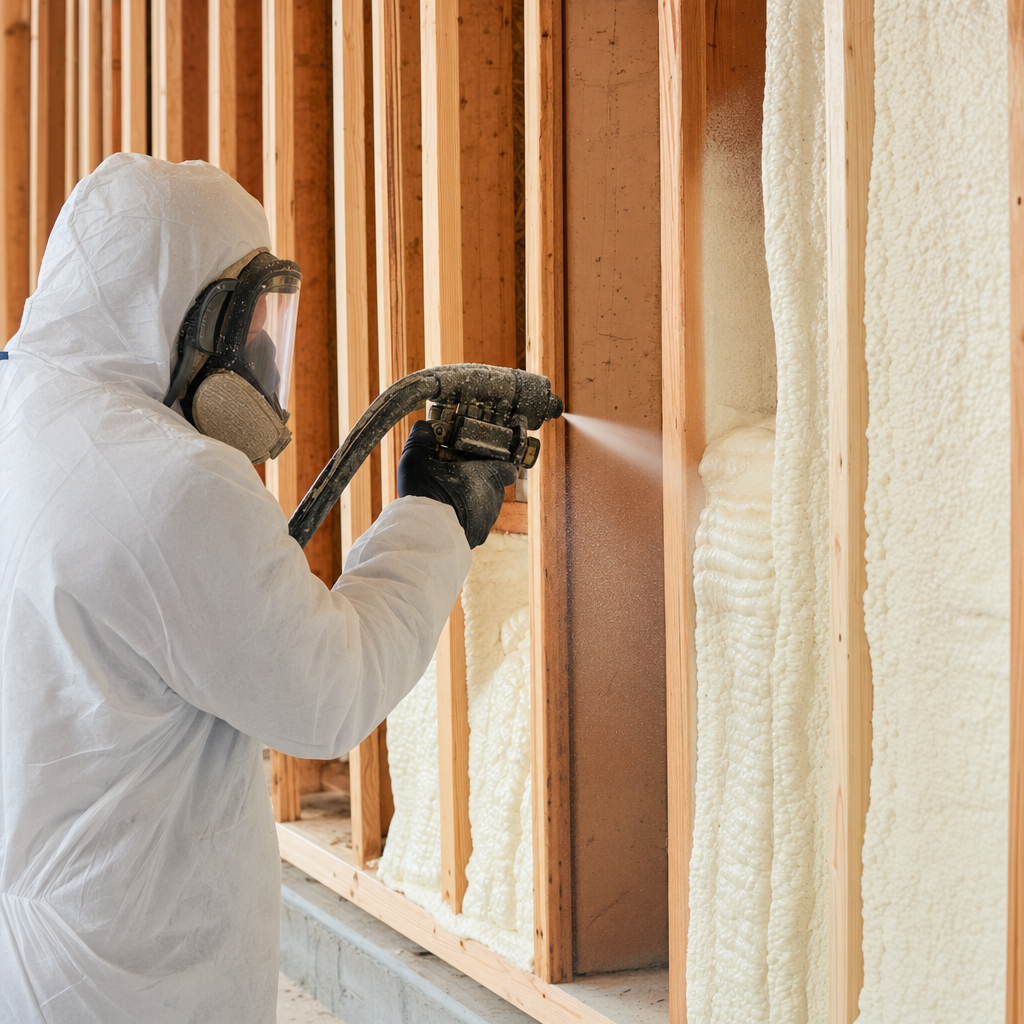
When you start researching spray foam insulation for your Calgary home, you quickly run into a choice that most guides barely explain: closed-cell or open-cell? They look similar coming out of the spray gun and both expand to fill a cavity — but under Calgary’s brutal winters, wild Chinook swings, and tight Alberta building code requirements, the two products behave very differently. Getting this decision wrong means either overspending on a feature you don’t need or ending up with moisture problems inside your walls years down the road.
Quick Answer
In Calgary’s Climate Zone 7A, closed-cell spray foam is the right choice for most applications. It delivers R-6 per inch versus R-3.6 for open-cell, acts as its own vapour barrier at just 50 mm thick, and resists moisture during the 16+ annual freeze-thaw cycles Calgary’s Chinook climate produces. Open-cell works for interior sound control but requires a separate vapour barrier per Alberta’s building code.
What Is the Difference Between Closed-Cell and Open-Cell Spray Foam?
Both products start as two liquid chemicals mixed at the spray gun — an isocyanate and a polyol resin — that expand rapidly on contact. The difference lies in what happens inside the foam as it cures. In open-cell foam, the expanding cells deliberately break open, leaving an interconnected spongy matrix. The result is a soft, flexible material roughly the density of a marshmallow (about 8 kg/m³ or 0.5 lb/ft³). In closed-cell foam, the cells are sealed shut and filled with an insulating blowing gas, creating a rigid, dense material (roughly 32 kg/m³ or 2 lb/ft³) that feels almost like hard plastic when fully cured.
That structural difference drives every downstream performance distinction — R-value, vapour permeability, structural contribution, and moisture resistance. Understanding the physics helps you have a confident conversation with your installer long before anyone starts mixing chemicals in your attic or crawlspace.
Which Type of Spray Foam Handles Calgary’s Climate Best?
Calgary sits in Climate Zone 7A under the National Building Code — Alberta Edition, which means design temperatures of -30°C and annual heating degree days in the 5,000–5,500 range. On top of that, the city is famous for Chinook winds: a western Pacific air mass rolls over the Rockies and can push temperatures up by 20–30°C within a few hours in the middle of January. Your insulation assembly must contain heat at -30°C one week, then manage a rapid moisture flux as accumulated frost melts off your roof sheathing within hours the next. According to research drawing on City of Calgary climate data, Calgary averages 16.2 freeze-thaw cycles each winter — a number projected to rise to 18.5 by 2050.
Open-cell foam has vapour permeance of roughly 10–20 perms — highly permeable. When your warm, humid interior air (30–40% relative humidity in a typical Calgary home) contacts open-cell foam on a -30°C night, water vapour migrates through the foam toward the cold exterior sheathing. During a Chinook, that condensed moisture can briefly liquefy inside the foam matrix before re-freezing. Repeated freeze-thaw-freeze cycling gradually saturates the open cells with water, degrading R-value over time. Building Science Corporation Report RR-0912, co-developed with the Canadian Urethane Foam Contractors Association (CUFCA), is explicit: in climates above 4,500 heating degree days — which Calgary meets — open-cell foam without a separate vapour barrier requires interior relative humidity to be kept below approximately 30% RH to avoid moisture risk. That is a target most Calgary households do not maintain through a -30°C cold snap when residents are humidifying their homes to stay comfortable.
Closed-cell foam’s rigid, sealed-cell structure physically resists moisture ingress. Its vapour permeance is ≤60 ng/(Pa·s·m²) at 50 mm thickness — roughly ≤1 perm — which falls below the vapour barrier threshold defined under the National Building Code. According to the National Research Council Canada’s CCMC evaluations for closed-cell products, the in-service temperature range is -60°C to +80°C — purpose-built for the full swing of Calgary’s extremes.
The R-Value Gap Matters More Than You Think
According to Natural Resources Canada’s Keeping the Heat In guide, closed-cell foam has a long-term design R-value of approximately R-5.1 to R-6 per inch (RSI 0.90–1.06 per 25.4 mm), while open-cell foam delivers about R-3.6 per inch (RSI 0.63 per 25.4 mm). That gap is enormous in a constrained cavity. A standard 2×6 wall stud bay is 140 mm (5.5 inches) deep. Fill it entirely with open-cell foam and you get approximately R-20. Fill the same cavity with closed-cell and you get approximately R-33. Calgary’s building code requires at least R-22 in above-grade walls — closed-cell achieves it comfortably; open-cell barely meets the minimum when the full cavity is used.
In an attic where depth is not constrained, open-cell’s lower cost per unit of R-value can look attractive at first glance. But even there, the vapour and moisture management requirements for Zone 7A tip the balance back toward closed-cell for most assemblies — particularly unvented or hot-roof designs where spray foam is applied directly to the underside of sheathing. In those assemblies, the foam must satisfy both the insulation and vapour barrier requirements simultaneously.
Vapour Barriers and Alberta’s Building Code
This is where the choice becomes non-negotiable for many Calgary applications. NRCan’s Keeping the Heat In guide states directly: high-density (closed-cell) spray foam “acts as a vapour barrier, so the wall does not need a polyethylene vapour barrier,” while low-density (open-cell) foam “functions as an air barrier, but not a vapour barrier — you will have to install an additional vapour barrier.” In a retrofit where walls are already finished, adding a polyethylene vapour barrier is expensive and disruptive. When you factor in that cost, the apparent price saving of open-cell foam often disappears.
| Factor | Closed-Cell | Open-Cell |
|---|---|---|
| R-value per inch | R-5.1 to R-6 | R-3.6 |
| Density | ~32 kg/m³ (2 lb/ft³) | ~8 kg/m³ (0.5 lb/ft³) |
| Acts as vapour barrier? | Yes — at 50 mm (2 in.) | No — poly sheet required |
| Moisture resistance | Excellent — rigid closed cells | Limited — absorbs water |
| Freeze-thaw durability | Superior | Vulnerable in Zone 7A |
| Adds structural rigidity? | Yes | No |
| Typical installed cost | Higher per board-foot | Lower (but add vapour barrier cost) |
| Best applications | Walls, rim joists, roof decks, crawlspaces | Interior sound control, low-moisture areas |
Does Open-Cell Spray Foam Meet Alberta’s Building Code in Zone 7A?
For most exterior envelope applications in Calgary, the short answer is no — not on its own. The National Building Code – Alberta Edition requires a vapour barrier on the warm side of the insulation in Climate Zone 7A. Open-cell foam does not satisfy this requirement independently. A certified installer must pair open-cell with a separate polyethylene vapour barrier (minimum 6-mil poly) installed on the interior warm side of the assembly — which adds labour, material cost, and complexity, particularly in a retrofit where walls are already finished.
There is one genuine exception: interior partition walls used for sound control, where the assembly is not part of the exterior thermal envelope, have no vapour barrier requirement. This is the one application where open-cell foam makes clear economic sense in a Calgary home. Open-cell is softer and more flexible, which means it absorbs sound vibration more effectively than rigid closed-cell — and its lower cost is a real advantage when filling dozens of interior stud bays for noise reduction alone. For more on how foam handles acoustics, read our post on the structural and soundproofing benefits of closed-cell spray foam in Calgary.
For all exterior walls, attics, crawlspaces, basement rim joists, and anywhere that forms part of the building envelope, a qualified spray foam contractor will recommend closed-cell for any Calgary application. This is not upselling — it is what the physics and the building code require in Zone 7A. Homeowners curious about the full range of factors affecting a closed-cell vs. open-cell decision can review our spray foam FAQ page for more guidance.
Where Does Each Type of Spray Foam Make Sense in Your Calgary Home?
Understanding the right application for each foam type helps you have a more informed conversation with your installer and ensures the correct product goes into each part of your home.
Best Applications for Closed-Cell Spray Foam
Rim joists and band joists are one of the highest-return applications for closed-cell foam in a Calgary home. These narrow framing members at the top of your foundation wall are exposed to both interior humidity and outdoor cold, making them a prime condensation point. Two inches of closed-cell foam applied directly to the rim joist eliminates the air gap, adds approximately R-12, and acts as its own vapour retarder — three problems solved in one step. Learn more in our guide to crawlspace and rim joist spray foam insulation in Calgary.
Attic roof decks and hot-roof assemblies are another ideal closed-cell application. When spray foam is applied to the underside of the roof sheathing instead of the attic floor, it creates a “hot attic” — the attic space becomes part of the conditioned envelope. This eliminates ice dams at the eaves and brings any ductwork or mechanical equipment in the attic inside the thermal boundary. Closed-cell is required for this assembly in Calgary because it must satisfy the air barrier and vapour barrier requirements simultaneously in one product layer.
Exterior walls during a gut renovation are a prime candidate, particularly for older Calgary homes where wall cavities are being opened up. Three to four inches of closed-cell foam against the exterior sheathing — before additional batt insulation fills the remaining cavity — creates a continuous air and vapour control layer with no thermal bridging through the framing. Our residential spray foam insulation team can assess exactly what your wall assembly requires.
Where Open-Cell Can Make Sense
Interior sound control between rooms, basement suites, or home office spaces is the standout application for open-cell foam in a Calgary home. Open-cell foam fills stud bays completely, sealing all penetrations for wires and pipes, and its soft texture absorbs mid-frequency sound vibration better than rigid closed-cell. Because there is no vapour drive through an interior partition, no vapour barrier is needed, and the lower cost of open-cell makes it genuinely attractive for this purpose.
Some contractors use open-cell in conditioned basement walls where relative humidity is tightly controlled and a separate vapour barrier is part of the assembly design. If your basement is mechanically dehumidified and maintained below 30% RH year-round, the moisture risk can be managed — but this is a specialized application requiring careful assessment. Most Calgary homeowners are better served by closed-cell in all basement and crawlspace envelope applications.
Frequently Asked Questions
Is closed-cell spray foam worth the extra cost in Calgary?
Yes — for exterior envelope applications, closed-cell spray foam is worth the premium in Calgary. Its higher R-value per inch (R-6 vs R-3.6), built-in vapour barrier function, and superior freeze-thaw resistance make it the technically correct product for Zone 7A. Open-cell requires a separate poly vapour barrier, which often erases the apparent cost saving when installation labour is factored in.
Does open-cell spray foam meet Alberta’s building code for exterior walls in Calgary?
No, not independently. Open-cell foam does not satisfy Alberta’s vapour barrier requirement for exterior wall assemblies in Climate Zone 7A. A separate 6-mil polyethylene vapour barrier must be installed on the warm interior side. Closed-cell foam at 50 mm (2 inches) or more eliminates this requirement entirely.
How many inches of closed-cell spray foam do I need to meet Calgary’s R-22 wall code minimum?
To reach R-22 with closed-cell foam alone at R-6/inch, you need approximately 3.7 inches (94 mm). In a standard 2×6 wall cavity, this is achievable. Most contractors target a combined assembly — closed-cell against the sheathing plus batt infill — to optimize cost while meeting code and vapour control requirements across the full wall depth.
Can open-cell spray foam handle Calgary’s Chinook freeze-thaw cycles?
Not well in exterior assemblies. Open-cell foam absorbs moisture and can trap water during Calgary’s 16+ annual freeze-thaw cycles. Moisture buildup gradually degrades R-value and can lead to mould or sheathing rot over time. Closed-cell’s rigid sealed-cell structure prevents moisture ingress and performs reliably through repeated Chinook swings.
Which type of spray foam is better for soundproofing a basement suite in Calgary?
For interior sound control between suites or rooms, open-cell foam is preferred — its soft, flexible matrix absorbs sound vibration more effectively. However, any exterior walls or the rim joist of the suite should still use closed-cell foam to satisfy the vapour barrier code requirements that apply to the building envelope.
How Aztec Spray Systems Helps
At Aztec Spray Systems, we have insulated hundreds of Calgary homes — from 1960s bungalows in Ranchlands to new builds in Mahogany — and we know that the right foam type depends on exactly what you’re insulating and where. Our certified installers will assess your specific assembly, confirm which product meets Alberta’s building code for your application, and provide a free no-obligation quote with a clear breakdown of the work involved.
We handle both residential spray foam insulation and commercial spray foam projects throughout Calgary and the surrounding area. Whether you need closed-cell foam for a full exterior wall retrofit, an unvented attic assembly, crawlspace encapsulation, or a combination approach, we size the job correctly the first time. Call us at (403) 830-7669 or visit our contact page to schedule your free quote. You can also review our full range of services on the services page to see everything we offer across the Calgary area.