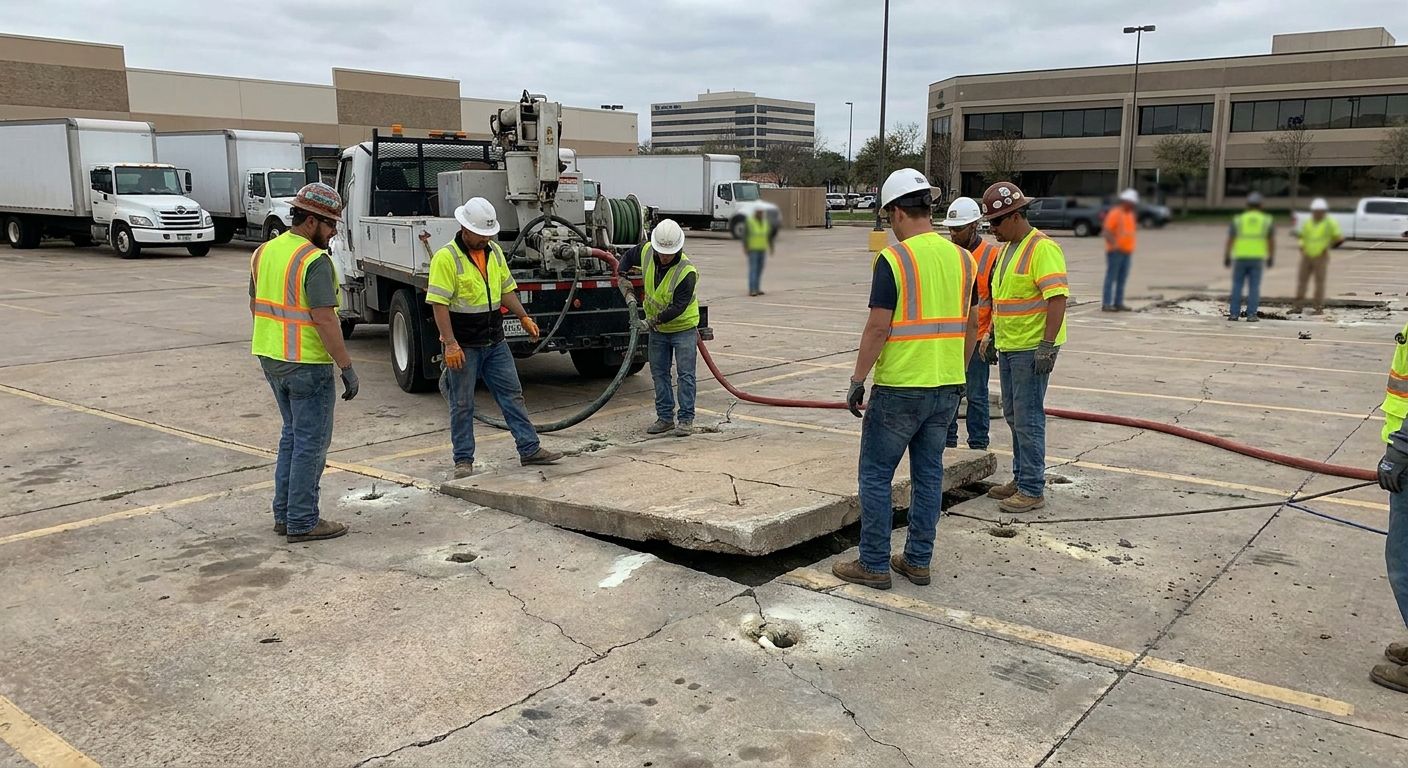
Commercial parking lots in Calgary, Okotoks, High River, and Lethbridge settle every freeze-thaw season, and concrete lifting fixes a sunken slab without tearing up pavement or closing a lot for weeks. This guide covers what a property manager needs to check before hiring a crew for concrete lifting on a commercial parking lot in 2026.
- Polyurethane foam lifting reopens a commercial parking lot to traffic in about 1 hour, the standard 2026 approach for concrete lifting commercial parking lot jobs.
- Mudjacking costs less per square foot but needs 24-48 hours to cure, closing stalls for a weekend.
- Full slab replacement only makes sense when cracking exceeds structural limits, not for simple settlement.
- Alberta’s freeze-thaw cycle reopens untreated drainage problems within one season, so fix the water source, not just the slab.
- Aztec Spray Systems handles concrete lifting alongside commercial insulation work across Calgary, Okotoks, High River, and Lethbridge.
Why this matters
A sunken slab in a parking lot is a liability problem before it's a cosmetic one. A half-inch drop at a curb or drive aisle is enough to trip a tenant, and a two-inch dip at a loading dock apron can crack a truck's air suspension line on the way through.
Replacing a full section of commercial-grade concrete runs $8 to $15 per square foot in 2026 pricing and closes stalls for one to three weeks. Concrete lifting solves the same settlement problem for a fraction of the downtime, which is why most commercial properties in Alberta lift first and only replace when the slab itself has failed.
Who this is for
This guide is built for facility managers, property management companies, and retail plaza owners in Calgary, Okotoks, High River, and Lethbridge who are staring at a settled slab, a tripping hazard near a storefront entrance, or a loading dock apron that's pulling away from the building. If your lot serves delivery trucks, tenants, or public parking and a section has dropped more than half an inch, Aztec Spray Systems' concrete lifting service is built for exactly this scenario, not a residential driveway patch.
Municipal lots, condo parkades, and industrial yards with heavy axle loads fall into this category too. The criteria below change once you're dealing with delivery truck traffic instead of a homeowner's sedan.
What to look for in concrete lifting for a commercial parking lot
Load rating for delivery and fire access
A residential polyurethane mix rated for a car isn't automatically rated for a loaded box truck or a fire apparatus. Ask the contractor for the compressive strength of the lifting foam and confirm it matches the traffic class of the lane you're repairing, not just the average of the lot.
Soil and void investigation before injection
Settlement almost always means there's a void or eroded soil under the slab, usually from a broken drain tile, a leaking storm line, or poor compaction at original construction. A contractor who lifts without checking for the void source is treating the symptom, and the slab drops again within a season.
Reopen time and lost stall-hours
Every closed stall or lane is lost revenue or a customer complaint. Polyurethane foam lifting typically reaches enough strength for vehicle traffic within about 1 hour, while cement-based mudjacking needs 24 to 48 hours before it can carry a loaded vehicle.
Material shrinkage over Alberta winters
Some lifting materials shrink over repeated freeze-thaw cycles, which is common through Calgary and Lethbridge winters. Closed-cell polyurethane resists water absorption better than cement slurry, which matters when a lot sees dozens of freeze-thaw swings between November and March.
Insurance, WCB coverage, and warranty terms
A commercial job means commercial liability exposure. Confirm the contractor carries general liability insurance sized for commercial work, current WCB coverage for the crew, and a written warranty on the lift itself, not just a verbal assurance.
Weather window for scheduling
Polyurethane injection can be done in cold weather because the reaction is exothermic, but cement mudjacking slurry struggles to cure properly below freezing. If the job needs to happen in a Calgary or High River winter, ask directly which method the crew is actually planning to use.
Top picks for commercial parking lot concrete lifting
Polyurethane foam lifting — the fast reopen. Cures to walk-on strength in minutes and vehicle-ready in about 1 hour, with a material cost typically running $3 to $8 per square foot in 2026. It's the right call for retail lots, delivery aprons, and any lane that can't sit closed over a weekend. Verdict: Buy.
Traditional mudjacking — the budget legacy option. Cement slurry costs less per square foot but needs 24 to 48 hours before it can take a loaded vehicle, and it's heavier, which can accelerate settlement in already-soft soil. It still works for low-traffic overflow lots where downtime isn't a concern. Verdict: Consider.
Spot patch and monitor — the wait-and-see. For settlement under 1 inch in a low-traffic corner, a same-day patch and a monitoring schedule can be enough to avoid a bigger job. This only holds if the drop stays under an inch and isn't near a drive lane or dock. Verdict: Consider.
Full slab replacement — the last resort. Once cracking runs through the full depth of the slab or rebar is exposed, lifting can't fix a structural failure. Replacement costs $8 to $15 per square foot and closes the area for one to three weeks. Verdict: Skip unless the slab is structurally compromised.
Hybrid lift plus drainage correction — the root-cause fix. When settlement keeps coming back in the same spot, the real problem is usually a broken drain or eroded soil feeding water under the slab. Pairing the lift with a drainage fix stops the repeat call next spring. Verdict: Buy when settlement is recurring.
Property managers already working through a capital plan that includes a commercial spray foam insulation for warehouses project know deferred maintenance compounds fast, and a sinking parking lot is no different from a warehouse envelope problem left unaddressed.
Get a concrete lifting quote
Serving commercial properties across Calgary, Okotoks, High River, and Lethbridge.
What to avoid
- DIY caulk and self-leveling patch kits. These hardware-store products fill surface cracks but do nothing for the void underneath, so the same dip reappears within one thaw cycle.
- Mudjacking a loading dock apron without engineering sign-off. Cement slurry is heavier than polyurethane and can add load stress exactly where a truck's rear axle sits, which is the wrong place to guess.
- Lifting the slab without fixing the water source. If a broken drain tile or grading issue caused the settlement, lifting alone buys one season before the same spot drops again.
Verdict comparison
| Method | Reopen time | Typical cost range | Best for | Verdict |
|---|---|---|---|---|
| Polyurethane foam lifting | ~1 hour | $3-$8/sq ft | Settled slabs under 3 inches | Buy |
| Mudjacking | 24-48 hours | $2-$5/sq ft | Low-traffic, budget-driven jobs | Consider |
| Spot patch and monitor | Same day | $500-$1,500/spot | Settlement under 1 inch | Consider |
| Full slab replacement | 1-3 weeks | $8-$15/sq ft | Structurally cracked slabs | Skip |
| Hybrid lift + drainage fix | 1-2 days | $4-$10/sq ft | Recurring settlement | Buy |
FAQ
What is concrete lifting for a commercial parking lot?
Concrete lifting raises a sunken slab back to level by injecting polyurethane foam or cement slurry beneath it, filling the void causing the settlement. It avoids tearing out and repouring the slab, which is the main draw for commercial properties that can’t afford a multi-week closure.
How much does concrete lifting cost for a commercial parking lot in 2026?
Polyurethane foam lifting typically runs $3 to $8 per square foot in 2026, while mudjacking runs $2 to $5 per square foot. Full replacement, by comparison, runs $8 to $15 per square foot when the slab is too damaged to lift.
Is polyurethane foam lifting better than mudjacking for parking lots?
Polyurethane is generally the better fit for active commercial lots because it’s ready for vehicle traffic in about 1 hour versus 24 to 48 hours for mudjacking. Mudjacking still has a place on low-traffic overflow areas where a longer closure isn’t a problem.
How long does a lifted parking lot slab last before it settles again?
A properly lifted slab with the underlying void or drainage issue addressed can hold for years without recurrence. If the water source causing the original settlement isn’t fixed, the same spot can drop again within a single freeze-thaw season.
Can concrete lifting fix a loading dock apron?
Yes, as long as the settlement hasn’t cracked through the full depth of the slab or exposed rebar. Loading dock aprons carry heavier axle loads than a standard stall, so confirm the contractor is using a load rating suited to truck traffic, not passenger vehicles.
Does concrete lifting work in cold Alberta winters?
Polyurethane injection can be done in cold weather because the chemical reaction generates its own heat, making it workable through Calgary and Lethbridge winters. Cement-based mudjacking struggles to cure properly below freezing, which limits it to warmer scheduling windows.
How do I know if my parking lot needs lifting or full replacement?
If the slab has settled but the concrete itself is intact without through-cracks or exposed rebar, lifting is almost always the cheaper and faster fix. Full replacement only becomes necessary once the structural integrity of the slab itself has failed.
Is concrete lifting covered by commercial property insurance?
Coverage depends on the policy and the cause of settlement, so check directly with the property’s insurer before assuming coverage. A written scope and invoice from a licensed and insured contractor makes any claim easier to document.
One last thing
Chinook winds push Calgary and Lethbridge through dozens of freeze-thaw cycles in a single winter, far more than most regions in Canada see in a season, and every cycle works water deeper into an existing void under a slab. That's the real reason a small dip in October turns into a 2-inch trip hazard by March if it sits unaddressed through one winter.